MDx CRO at MPP 2025: Aligning Companion Diagnostics and Drug Development under IVDR

Precision medicine needs alignment, not lighter rules

Europe’s precision medicine ecosystem advances when diagnostics and medicines move in lockstep. The real bottleneck is not regulation itself; it is the structural divergence between the Clinical Trials Regulation and the IVDR. In our work across oncology and rare disease programmes, we repeatedly see how separate clocks, committees, documentation and reporting streams create avoidable friction. Our message at MPP 2025 was simple: bring both tracks together from the start and design one plan that satisfies clinical utility and regulatory rigor at the same time.

CDx and drug trials: bridging IVDR and CTR

When a biomarker guides enrolment or treatment and the assay is not CE-marked for that purpose, Article 58 triggers a performance study alongside the medicinal trial. That study’s endpoints, analytical validation and risk–benefit narrative must be coherent with the drug protocol, because outcomes like PFS, OS and ORR depend on the test defining the right population. Misalignment costs time; EFPIA’s 2023 evidence shows many sponsors facing six to twelve-month delays linked to IVDR requirements, which ultimately pushes patient access further out.

What MDx CRO presented at MPP 2025

At the Medtech & Pharma Platform Annual Conference on 16 September 2025 at the Novartis Campus in Basel, Carlos Galamba, CEO at MDx CRO, joined the session “IVDs, CDx & Personalized Medicine: Moving from Compliance to Innovation,” chaired by Fatima Bennai-Sanfourche of Bayer and Andreas Emmendoerffer of Roche. The panel brought together Antonella Baron from the European Medicines Agency, Heike Möhlig-Zuttermeister of TÜV SÜD, and patient advocate David Haerry of Positive Council Switzerland, alongside MDx.

Evidence on delays and the impact on patients

The data are unambiguous: EFPIA’s survey indicates 43 percent of companies estimated six to twelve-month delays due to IVDR, with downstream consequences for trial starts and patient inclusion across major disease areas. Every month lost to mis-sequenced processes or unclear governance is a month patients wait for targeted therapies.

Signals from regulators, notified bodies, and patient advocates

The discussion reflected a clear appetite for convergence. EMA perspectives on embedding companion diagnostics under IVDR, TÜV SÜD’s insights on conformity assessment for CDx, and the patient community’s call for earlier access all point in the same direction: coordinated planning and earlier dialogue across agencies, notified bodies and sponsors.

Key insights from the MPP panel and fellow presenters

Compliance versus innovation is the wrong debate. The practical path forward is compliance and innovation together: a single evidence plan, shared endpoints, and a unified risk–benefit narrative that treats the diagnostic and the drug as interdependent elements of one therapy journey. That is how companion diagnostics under IVDR accelerate, rather than delay, precision medicine.

How MDx CRO accelerates CDx from design to approval

MDx builds one cross-functional plan from day one, aligning clinical and device protocols, mapping Article 58 triggers, and sequencing submissions so site start-up and “first sample tested” are not held back by documentation gaps. Our teams scrutinise analytical validation, prepare CPSPs and Annex XIV packages aligned to ISO 20916, and train investigators on device-specific safety reporting and sample flows across multilingual EU sites. This integrated approach has delivered a consistent approval track record for CDx submissions.

Operational playbook for combined studies in Europe

Effective combined studies require clear governance between drug and device sponsors, modular and wave submissions across Member States, separate informed consents for the CDx component where appropriate, and proactive scientific advice with EMA or NCAs for borderline cases. With local regulatory intelligence and language capability across Europe, we coordinate roles and documentation so CTR and IVDR remain synchronised throughout the study lifecycle.

Acknowledgment to MPP and our co-presenters

Our thanks to the Medtech & Pharma Platform Association for convening this timely discussion and to the session chairs and speakers who brought regulatory, conformity assessment and patient perspectives to the same table: Fatima Bennai-Sanfourche, Andreas Emmendoerffer, Antonella Baron, Heike Möhlig-Zuttermeister and David Haerry.

Partner with MDx CRO to make CDx work under IVDR

If your programme depends on biomarker-driven enrolment or treatment decisions, partner with a team that speaks CTR and IVDR fluently. MDx CRO compresses timelines, de-risks submissions and delivers companion diagnostics that make precision medicine real for the patients who need it most


Industry Insights & Regulatory Updates

MDx CRO at ESMO 2025 (Berlin): Advancing IVDR Transitions & Combined Clinical Trials

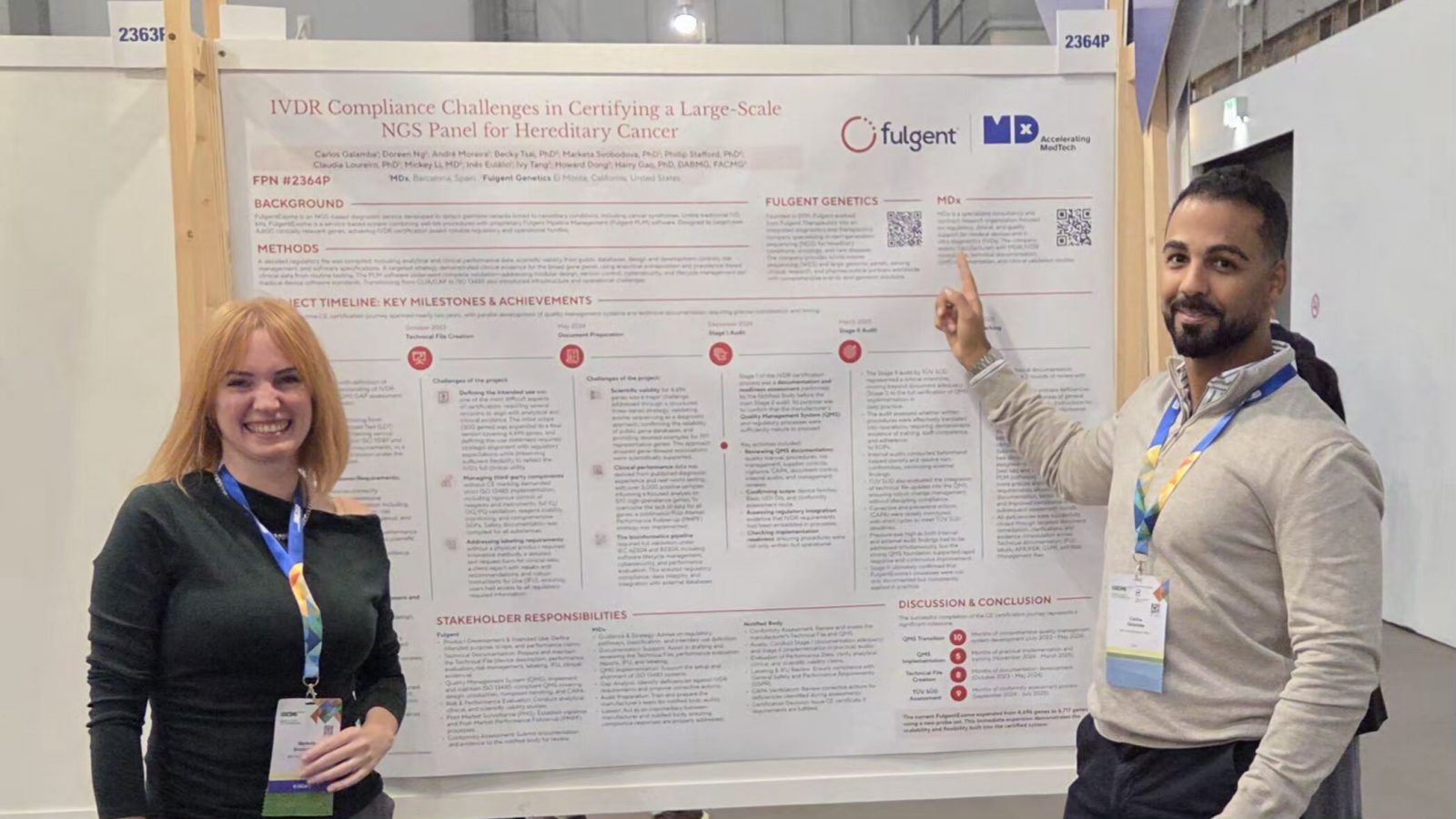
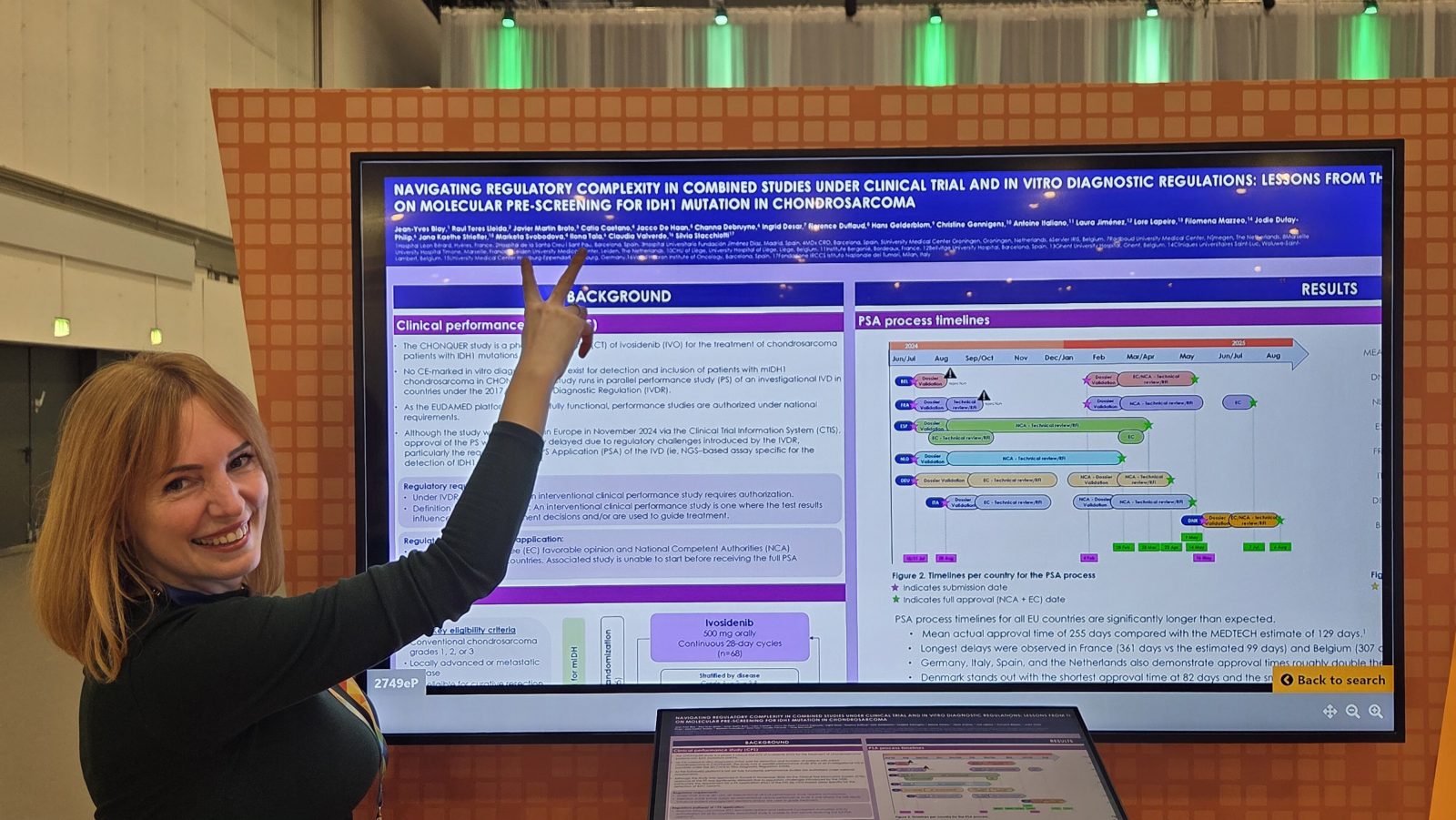
MDx CRO presented new evidence and hands‑on learnings at ESMO 2025 that reinforce our position as the partner of choice for IVDR transitions and combined clinical trials involving investigational IVDs. We were first author on a poster with Fulgent Genetics and contributors to a Servier poster—both centered on the operational and regulatory realities of bringing high‑impact oncology diagnostics into clinical practice under the EU IVDR.

Highlights from our ESMO 2025 posters

Title: IVDR Compliance Challenges in Certifying a Large‑Scale NGS Panel for Hereditary Cancer

What it covers:

  • Practical blueprint for transitioning a comprehensive, service‑based NGS hereditary cancer panel under IVDR.
  • Defining intended use and scientific validity across a large gene set; end‑to‑end technical documentation; bioinformatics validation aligned to IEC 62304/82304; and notified‑body engagement strategy.
  • Lessons on right‑sizing verification/validation and building a living evidence package to support CE‑marking.

Why it matters: Sponsors and lab developers gain an actionable path for moving complex NGS services to IVDR compliance—without slowing clinical programs.

Title: Navigating Regulatory Complexity in Combined Studies under CTR and IVDR (CHONQUER)

What it covers:

  • How combined trials (drug + investigational IVD) trigger dual oversight under CTR and IVDR and the knock‑on effects for timelines, submissions, and site activation across EU member states.
  • Operational patterns that accelerate approvals: early CPS planning, consolidated documentation, and aligned ethics/competent authority strategies.

Why it matters: Oncology sponsors can de‑risk global programs by anticipating IVDR‑specific requirements—and partnering with an IVD CRO that has worked both sides of the fence.

Key takeaways for sponsors

  • IVDR transitions—end to end. MDx CRO supports dossier strategy, clinical performance studies (ISO 20916), scientific validity, and notified‑body engagement for CE‑marking.
  • Combined trials, simplified. We design and run CPS and combined CTR + IVDR studies, harmonizing submissions across multi‑country portfolios.
  • Oncology‑ready operations. Deep experience with molecular prescreening, NGS workflows, and drug–device coordination for precision oncology.

Need a quick debrief? Contact our IVD CRO team for a walkthrough of how these findings translate to your IVDR transition or combined study plan.

FAQs

What does MDx CRO do for IVDR transitions?

We provide end‑to‑end support—from intended‑use definition and scientific validity to clinical performance studies, technical documentation, and notified‑body engagement.

How does MDx CRO support combined CTR + IVDR studies?

We plan and execute CPS and combined trials, consolidating submissions and aligning ethics/competent authority requirements to reduce delays.

Can MDx CRO help with NGS panel validation under IVDR?

Yes. We design right‑sized verification/validation programs and bioinformatics validation aligned with IEC 62304/82304.

Where can I get the ESMO 2025 posters?

Both PDFs are available at the ESMO platform; contact us for a guided readout.

Industry Insights & Regulatory Updates

TGA guidance (Oct 2025): IVD Companion Diagnostics (CDx) Requirements in Australia

What’s new

TGA IVD companion diagnostics requirements are now clearly explained in the Therapeutic Goods Administration’s guidance on IVD companion diagnostics (CDx) in Australia (updated 16 October 2025). Their revised companion diagnostics framework, adds process diagrams, a companion testing plan concept for medicine/biological sponsors, clearer clinical performance expectations, and case studies showing how the pathway works in practice.

This blog post summarises the definition of a CDx, Class 3 IVD classification, ARTG inclusion, companion testing plans, and the TGA CDx List.

What is a CDx under Australian law?

A companion diagnostic is an IVD (commercial or in‑house) that provides information essential for the safe and effective use of a corresponding medicine or biological—for patient selection, risk of serious adverse reactions, or treatment monitoring. To qualify, the test must be referenced in the Product Information (PI) for the medicine or in the Instructions for Use (IFU) of the biological. Tests used only for cell/tissue compatibility are excluded from the CDx definition.

This definition underpins the TGA IVD companion diagnostics requirements for medicines and biologicals that rely on patient selection testing.

Note: The term “a particular medicine or biological” can also cover a class of products with a similar mechanism of action, not only a single named product.

When does an indication require CDx testing?

An indication requires CDx testing when both:

  1. the medicine’s PI (or biological IFU) states that CDx testing is essential, and
  2. the CDx claims it is intended for that testing to enable use of the medicine/biological.
    This may apply to some (not all) indications of a medicine.

To aid transparency, the TGA recommends a PI “flag phrase” indicating that testing is essential and that clinical practice testing should be adequately comparable to the pivotal trial testing; the TGA also publishes a CDx List of approved tests.

How the TGA applies CDx requirements: Class 3 IVDs and ARTG inclusion

  • Classification: Under TGA IVD companion diagnostics requirements, all CDx—commercial and in-house—are Class 3 IVDs (including in‑house CDx).
  • Separate ARTG entries: Each CDx requires its own ARTG inclusion with a Unique Product Identifier (UPI) defined by the manufacturer.
  • Application audit: CDx applications are subject to a mandatory application audit unless supported by specified comparable overseas regulator documentation (e.g., EU IVDR, FDA PMA, PMDA, HSA, Health Canada).
  • Concurrent submissions: While encouraged, concurrent medicine/CDx submissions are not mandatory; however, a CDx application should only be submitted if the corresponding indication is approved or under concurrent review.

From companion testing plans to ARTG submissions, MDx CRO streamlines the end-to-end CDx pathway in Australia, aligning clinical, regulatory, and quality workstreams to the TGA’s expectations.

The companion testing plan (for medicine/biological sponsors)

Every new indication that requires CDx testing must include a companion testing plan (dated and version‑controlled) describing how Australian patients will access at least one adequate test. This is central to meeting TGA IVD companion diagnostics requirements. Four options are available:

  1. Option 1: A commercial CDx ARTG application is planned/underway (provide device submission details and sponsor contact).
  2. Option 2: An in‑house IVD CDx will be accredited under the National Pathology Accreditation Scheme (provide lab details, accreditation timeline, and quality/access reassurances).
  3. Option 3: Standard Australian testing is expected to deliver comparable clinical outcomes to the pivotal trials (provide detailed justification).
  4. Option 4: None of the above—TGA reviews full device data within the medicine dossier (appropriate when no onshore testing is expected).

If Option 4 is used, TGA may add a condition of registration requiring the sponsor to maintain and update the plan (e.g., in case of supply interruption, regulatory action, or material changes to test methodology). Approval of an indication can proceed even when no ARTG‑listed or accredited CDx is available, provided an adequate plan exists; however, a commercial CDx must be in the ARTG (or an in‑house CDx accredited) before supply in Australia.

Clinical trial assay evaluation & comparability

When an indication requires CDx testing, TGA evaluates the clinical trial assay used in the pivotal studies—reviewing scientific validity, analytical performance, clinical performance, and clinical utility. Subsequent CDx must show clinical comparability to the trial assay, typically via concordance and/or bridging studies (or other appropriate evidence) aligned to the trial assay’s core characteristics.

Responsibilities at a glance

Medicine/Biological sponsors must:

  • Use the TGA CDx identification guide to determine if CDx testing is essential.
  • Consider consequences of false positives/negatives, test failures or no result.
  • Include: (a) evidence to support evaluation of the clinical trial assay, and (b) a companion testing plan nominating at least one adequate test.
  • Note: The framework does not require a one‑to‑one link between an indication and a single proprietary CDx; it focuses on the core characteristics of testing.

Device sponsors must:

  • Submit an IVD medical device application for ARTG inclusion of the CDx (indicating the application is for a CDx and providing the UPI).
  • Demonstrate comparability to pivotal trial testing and meet Essential Principles; applications may undergo audit as above.
  • Ensure the corresponding indication is approved or under concurrent review.

In-house IVD CDx, NATA accreditation and NPAAC obligations

Pathology laboratories may develop/modify in‑house tests for use as CDx. Class 1–3 in‑house IVDs are not included in the ARTG, but require NATA accreditation, identification of CDx in the TGA notification test list, and compliance with the NPAAC standard. Under a NATA–TGA MoU, NATA can request TGA technical assistance during evaluation of in‑house CDx performance; TGA is not otherwise involved in the accreditation decision.

TGA CDx List

The TGA publishes a CDx List showing approved commercial CDx linked to corresponding indications (with in‑house CDx to be added). The list is informational (not a regulatory instrument) and may lag recent approvals by up to one month.

Transitional arrangements and change control

  • Transition: CDx previously included in the ARTG as Class 2 or 3 before 1 Feb 2020 (and certain in‑house IVDs) may continue supply until 31 Dec 2028; a new compliant application is required to continue supply thereafter.
  • Changes: Sponsors manage post‑market device changes via the TGA Device Change Request process.

Key takeaways (quick reference)

  • All CDx are Class 3 IVDs and require separate ARTG inclusion (commercial) or NATA accreditation (in‑house).
  • Every relevant medicine/biological indication must include a companion testing plan (Options 1–4).
  • TGA assesses the clinical trial assay and expects comparability evidence for subsequent CDx.
  • Approval can proceed without on‑shore CDx if a robust plan exists, but supply requires ARTG inclusion or in‑house accreditation.

FAQs

Are all CDx Class 3 IVDs in Australia?

Yes. The regulations specify all CDx (commercial and in‑house) are Class 3 IVDs.

Can an indication be approved if no Australian CDx is available yet?

Yes—if a suitable companion testing plan is in place; however, a commercial CDx must be in the ARTG (or an in‑house CDx accredited) before legal supply.

What goes into a companion testing plan?

Identify at least one adequate test and choose Option 1–4 with supporting details (e.g., ARTG application in progress, in‑house accreditation, justification that standard testing is adequate, or full device data reviewed within the medicine dossier).

Will the PI show that CDx testing is essential?

The TGA recommends a PI “flag phrase” indicating testing is essential and should be comparable to trial testing; approved tests appear on the TGA CDx List.

Written by:
Carlos Galamba

Carlos Galamba

CEO

Senior regulatory leader and advisor to top 10 global precision medicine companies with deep experience in high-risk IVDs including companion diagnostics.
Industry Insights & Regulatory Updates

Companion Diagnostic Clinical Trial Case Study

Regulatory Turnaround for a Phase 3 Global CDx Clinical Trial (Annex XIV)

A global biopharma company faced a critical delay in a phase 3 clinical trial in oncology. The study required an NGS-based companion diagnostic (CDx) assay to detect a specific mutation and pre-screen patients for eligibility. Several EU authorities initially rejected or stalled the Clinical Performance Study (CPS/PSA) due to assay validation concerns and fragmented IVDR processes. MDx CRO mobilized a specialized cross-functional team, redesigned the documentation package, and re-submitted in six EU countries within three months, clearing all RFIs and enabling on-time trial initiation. This case study has been accepted for presentation at ESMO 2025 in Berlin.

The Challenge

  • Early rejection and major RFIs: EU bodies questioned assay validation and risk management, threatening the trial start.
  • Dual-regulation complexity: The trial combined CT and IVDR CPS submissions with different national portals, templates, and timelines.
  • Harmonization gaps: With EUDAMED not fully operational, CPS authorizations varied widely by Member State, creating long and unpredictable timelines.

What was at stake: lost recruitment windows, protocol amendments, cost escalation, and missed milestones tied to major scientific congresses.

MDx CRO Approach

1) Rapid diagnostic and plan

  • Completed a 48-hour gap analysis across the submission: CDx protocol, analytical performance package, CER/PER linkages, IFU, training, and risk files.
  • Mapped country-specific expectations (EC vs NCA) to pre-empt common RFIs: informed consent, site/PI suitability, device training, and performance datasets.

2) Targeted re-engineering

  • Revised the clinical performance study protocol (CPSP) for the CDx assay to clarify endpoints, eligibility flows, and pre-screening logistics.
  • Overhauled analytical performance evidence (accuracy, precision, LoD, reproducibility) and tightened traceability to risk controls.
  • Redeveloped risk management documentation to align hazards, mitigations, and verification with Annex I GSPRs.
  • Strengthened usability & training to address EC concerns on user competence and patient protection.

3) Country-by-country execution

  • Sequenced six EU CPS submissions to match national review modalities (combined, parallel, or sequential EC/NCA), reducing idle time between waves.
  • Built a rapid RFI response playbook so sponsors and sites could respond in days, not weeks.

Results & Impact

  • All RFIs resolved: Delivered clear, evidence-backed answers across EC and NCA questions, including consent, site suitability, training, and performance data.
  • Approvals secured quickly: The re-submission strategy compressed timelines and returned the program to the original start path despite EU-wide CPS delays.
  • Trial initiation preserved: Sites opened on schedule, enabling screening with the NGS CDx pre-screen.
  • Scientific visibility: Study learnings and regulatory insights are accepted for presentation at ESMO 2025, showcasing efficient navigation of combined CT/IVDR frameworks.

Why It Matters

The IVDR raised the bar for pre-market CDx and investigational IVDs used in drug trials. Sponsors now need diagnostic-grade evidence, strong risk-benefit narratives, and country-aware submission execution. MDx CRO bridges those gaps with integrated clinical, regulatory, and diagnostics expertise so drug–diagnostic programs stay on track.

What We Delivered

  • Regulatory rescue for a phase 3 global CDx trial in oncology (Annex XIV).
  • Six-country CPS re-submission under IVDR with country-specific strategies.
  • Protocol refinement for CDx use, analytical performance reinforcement, and risk-file re-mapping to GSPRs.
  • RFI playbook & rapid responses covering EC and NCA priorities (consent, training, site suitability; analytical/clinical evidence, CPS plan).
  • On-time site activation and screening with an NGS CDx assay.

Client Outcome

“MDx CRO restored regulatory confidence and protected our timelines. Their team aligned clinical, diagnostic, and regulatory workstreams and cleared every RFI with precision.”

Ready to Accelerate Your CDx Trial?

Running an EU drug–diagnostic study under IVDR? We can accelerate CPS authorizations, clear RFIs fast, and keep your trial on schedule.

Industry Insights & Regulatory Updates

MDx to Present ESMO 2025 Poster on IVDR CE Marking for Large Germline NGS Panels

Announcement

MDx will present a peer-reviewed poster at the ESMO Congress 2025 in Berlin detailing how our team helped secure IVDR CE marking for a large, service-based germline NGS solution that integrates wet-lab workflows with a validated bioinformatics pipeline. The poster distills a practical, audit-proven pathway that labs and IVD developers can apply when scaling evidence, validating software, and navigating notified-body reviews for complex NGS offerings.

What the poster covers

  • Regulatory strategy and intended use: How to right-size scope for very large panels while planning for future expansion.
  • Technical documentation: Building Annex II/III files that stand up to Stage I/II audits, including labeling/IFU for service-based models.
  • Software validation: Applying IEC 62304/82304 rigor to a bioinformatics pipeline (architecture, V&V, cybersecurity, change control).
  • Evidence at scale: A tiered approach to scientific validity and clinical performance, plus a pragmatic PMPF plan to mature low-prevalence evidence.
  • Operationalization: Supplier controls, change management, and QMS integration to sustain post-market scalability.
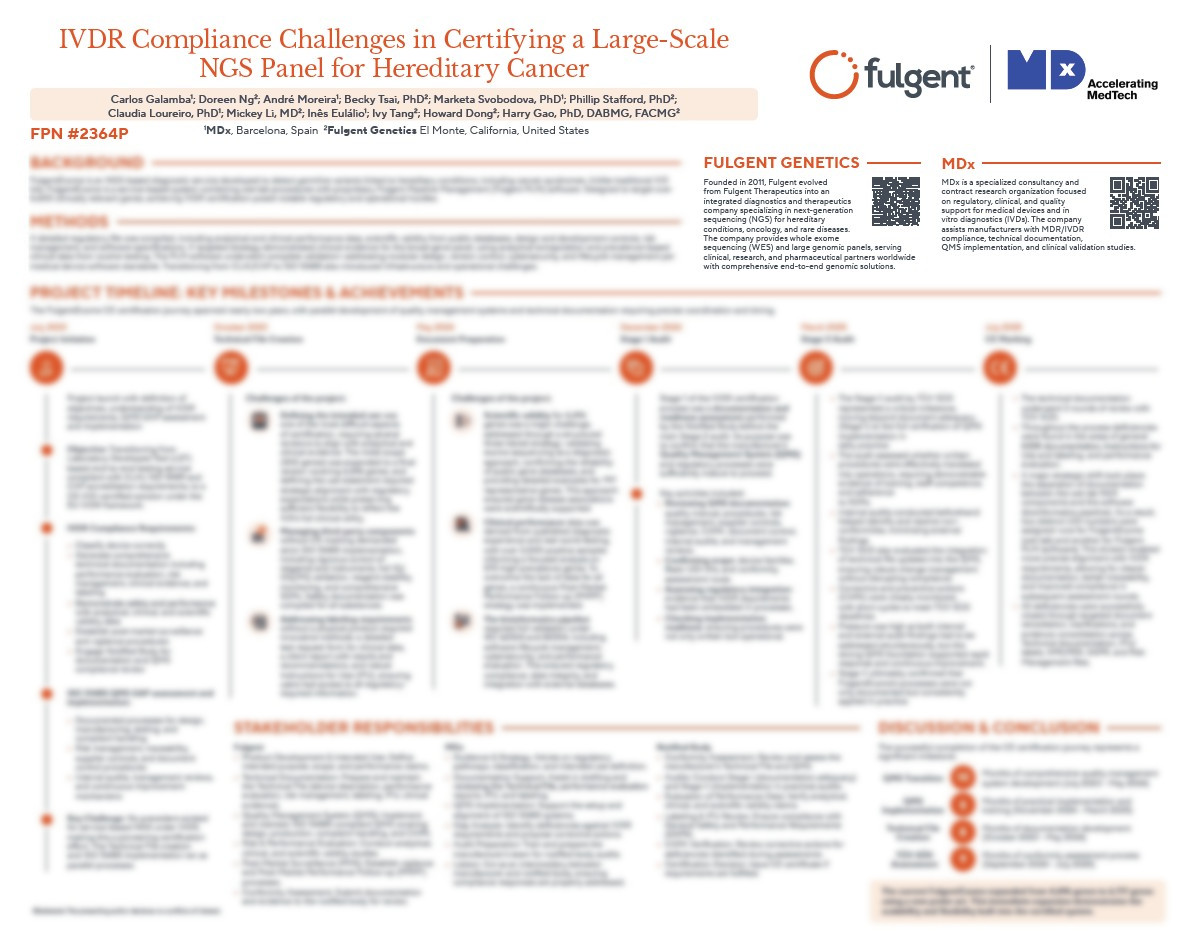
Fulgent and MDx ESMO 2025 poster about Certifying Large-Scale NGS panels for hereditary cancer

Why this matters

Large NGS panels pose unique IVDR hurdles: non-uniform clinical evidence across thousands of genes, evolving variant knowledge, third-party components without CE marking, and the need to validate bioinformatics as SaMD. By sharing a repeatable pathway and the pitfalls we overcame, this poster offers concrete guidance to shorten timelines without compromising quality or compliance.

When and where to find us

ESMO Congress 2025 takes place 17–21 October in Berlin, Germany. We will publish our poster board number and presentation time here as soon as the session logistics are confirmed by the organizers. If you’re attending, we’d love to meet to discuss your IVDR roadmap.

Read the background

For context on the underlying program and its market impact, explore the public write-ups:

Plan a meeting

Ready to talk IVDR CE marking for your NGS product?

Use our contact form to request a 30-minute slot with our regulatory and bioinformatics leads during ESMO 2025, or schedule a virtual follow-up the week after the congress.

Industry Insights & Regulatory Updates

IVDR CE marking NGS: MDx Case Study with Fulgent

At a glance

  • Outcome: CE mark granted by TÜV SÜD for an end-to-end Class C germline NGS solution (wet lab + bioinformatics).
  • Scope: Furthermore, panel covering 4,600+ clinically relevant genes with a validated PLM (Pipeline Manager) software component; later expanded to >7,000 genes using a new probe set.
  • What we did: Specifically, we built an ISO 13485 QMS from the ground up, prepared full Annex II + III technical documentation, validated bioinformatics under IEC 62304/82304, split documentation into two Basic UDI-DIs (wet lab vs. software), and guided Stage I/II audits.
  • Why it matters: Ultimately, this demonstrates a repeatable pathway to IVDR certification for large NGS services and software—something that had no clear precedent.

Read the announcements: For details, read the Fulgent press release and Citeline case study.

The challenge: certifying a service-based, large-scale NGS system under IVDR

To begin with, FulgentExome is a service-based NGS solution that integrates wet-lab workflows with the Fulgent PLM bioinformatics pipeline. As a result, pursuing IVDR certification meant converting a mature CLIA/CAP testing service into a CE-marked IVD system with robust evidence across scientific validity, analytical performance, and clinical performance—for thousands of genes. In particular, key hurdles included: defining intended use at scale; validating third-party components; proving scientific validity across 4,600+ genes; above all fully validating the bioinformatics pipeline under medical device software standards.

MDx approach: a playbook for complex NGS + software

1) Build the right QMS, fast

First, we performed an IVDR GAP assessment. Next, we designed and implemented an ISO 13485-compliant QMS with risk management, supplier control, document control, internal audits, and management review—migrating from a CLIA/CAP model to IVDR-ready operations.

2) Engineer a defensible intended use

Meanwhile, the intended-use statement evolved iteratively—from an initial ~300-gene scope to whole-exome, finally landing on 4,600+ genes aligned to available clinical and analytical evidence. In the end, the final language was future-proofed to support rapid updates as evidence expands.

3) Split wet lab and software into two regulated products

Afterward, following round 1 review feedback, we separated the documentation into two Basic UDI-DIs—FulgentExome (wet lab) and Fulgent PLM (software)—to align with IVDR expectations for traceability and lifecycle control. Consequently, this restructuring sharpened conformity assessment and accelerated subsequent approvals.

4) Validate the informatics stack like a medical device

In parallel, we validated PLM under IEC 62304/82304, including architecture, version control, cybersecurity, verification/validation, and integration with external databases. Therefore, the result was a fully evidence-backed bioinformatics pipeline capable of reproducible, high-confidence variant calling and reporting.

5) Make “evidence at scale” practical

  • First, Scientific validity: Three-tier strategy combining validation of exome sequencing as an approach, reliance on curated public databases, and deep exemplars for a large subset of genes.
  • Second, Clinical performance: Leveraged routine testing experience (thousands of positives) to focus clinical evidence on high-prevalence genes, and instituted a robust PMPF strategy to continuously strengthen low-prevalence areas.

6) Orchestrate TÜV SÜD audits to success

  • Initially, Stage I confirmed documentation readiness, scope, Basic UDI-DIs and integration of IVDR processes into daily practice.
  • Subsequently, Stage II verified on-the-floor implementation of SOPs, training, competence, CAPA and change control—closing findings on short cycles to hit NB timelines.

Results that move the market

  • CE mark granted for FulgentExome & Fulgent PLM—among the first end-to-end Class C germline NGS solutions under IVDR.
  • Certified scope covers 4,600+ genes, positioning Fulgent as a reference lab for comprehensive hereditary disease testing serving European patients.
  • Post-certification, the platform scaled to >7,000 genes using a new probe set—demonstrating the inherent scalability built into the certified system (process, documentation, and change control).
  • Strengthened competitive standing in the EU diagnostics market; public communications highlight the magnitude of this achievement for large NGS panels.

Read more in the Fulgent press release and Citeline’s in-depth article.

What this means for labs and IVD developers planning large NGS submissions

If you operate an LDT today: you’ll need to translate CLIA/15189 practices into an ISO 13485 framework, document design controls, and produce a full PER (PEP/PER), APR, SVR, PMS/PMPF, SSP, and labeling/IFU aligned to GSPR. Expect to validate any bioinformatics pipeline as SaMD with IEC 62304/82304 and cybersecurity controls.

If your panel is “large”: you likely won’t have uniform clinical data across every gene. A structured tiered evidence model + PMPF can satisfy Notified Bodies while keeping your roadmap scalable.

If you combine wet lab + software: plan for separate Basic UDI-DIs and documentation sets. Treat the pipeline as a product with its own requirements, verification, and risk controls.

Why MDx

  • End-to-end IVDR expertise: From regulatory strategy & classification to Annex II/III technical files, PER/SVR/APR, training, and mock NB reviews.
  • Clinical performance studies: We design, run, and report ISO 20916 studies (protocols, eTMF, monitoring, biostats, PER alignment), and we can act as delegated sponsor for multi-country submissions—100% submission success rate to date.
  • Operational scale: ISO 9001 clinical QMS, EU/US partner network, multilingual CRAs, and a repeatable process honed on 60+ performance study submissions for top IVD and pharma clients.

Project timeline

Our joint project with Fulgent spanned July 2023–July 2025, with overlapping tracks for QMS creation, technical documentation, NB review, and Stage I/II audits—a coordinated plan that allowed rapid closure of findings and post-certification scaling.

Client perspective

The program demanded evening/weekend execution across regulatory, documentation, and project management to meet Notified Body timelines—effort that, in the client’s words, made all the difference in achieving what initially “seemed almost impossible.

Planning IVDR for your NGS panel? Here’s a quick readiness checklist

  • Intended use aligned to evidence (and future updates)
  • ISO 13485 QMS with software lifecycle integration
  • PER (PEP/PER), SVR, APR mapped to gene-level strategy
  • PLM/DR pipeline validated per IEC 62304/82304 (+cybersecurity)
  • Separate documentation/UDI for wet lab vs. software (if applicable)
  • PMS/PMPF plan to mature low-prevalence evidence post-market
  • Mock NB review + Stage I/II audit readiness

(Our team can lead or co-author each artifact above.)

Talk to us

Whether you’re certifying a focused oncology panel or pushing the limits with exome-scale content, MDx brings the cross-functional regulatory, clinical, quality, and software depth to make it possible—on a timeline that keeps your business competitive.

Written by:
Carlos Galamba

Carlos Galamba

CEO

Senior regulatory leader and former BSI IVDR reviewer with deep experience in CE marking high-risk IVDs, companion diagnostics, and IVDR implementation.
Industry Insights & Regulatory Updates