EUDAMED Mandatory Timelines for MDR and IVDR

What the 2026 Deadlines Mean for Medical Device and IVD Manufacturers

EUDAMED mandatory timelines for MDR and IVDR are no longer theoretical. On 27 November 2025, the European Commission published Commission Decision (EU) 2025/2371 in the Official Journal of the European Union. This Decision confirms that four EUDAMED modules are now functional: Actor registration, UDI/Device registration, Notified Bodies and Certificates, and Market Surveillance.

Under the amended transitional rules in Regulation (EU) 2024/1860, that publication starts a six-month transition. As the Commission’s EUDAMED overview explains, from 28 May 2026 these four modules become mandatory to use for both medical devices and IVDs.

For manufacturers, authorised representatives, importers and notified bodies, this creates fixed dates that must now sit inside MDR and IVDR compliance plans.

1. How the EUDAMED Gradual Roll-Out Works

Regulation (EU) 2024/1860 amends the MDR and IVDR so that EUDAMED can go live module by module. Instead of waiting for all six modules, the Commission can audit each module or group of modules, confirm functionality, and then publish a notice in the Official Journal.

Once that notice appears, the rules change in a clear way. According to the Commission’s Q&A on the gradual roll-out of EUDAMED, the obligations and requirements linked to a given module become applicable six months after the notice is published. Until that date, the relevant provisions of the old Directives and their national transposition measures still apply for registration duties.

The same Q&A explains that some modules also come with extra time:

  • For the UDI/Device module, manufacturers have up to 12 months from the Official Journal notice to register certain devices already on the market.
  • For the Notified Bodies and Certificates module, notified bodies have up to 18 months from the notice to upload information on existing MDR and IVDR certificates.

Because the notice for the four modules appeared on 27 November 2025, the six-month period runs to 28 May 2026. After that date, the four modules are no longer optional.

2. Module-by-Module Deadlines Under MDR and IVDR

2.1 Actor Registration: SRNs Before Placement on the Market

The Actor module covers registration of economic operators. It applies to manufacturers, authorised representatives and importers that fall under Article 31 MDR and Article 28 IVDR.

The Q&A makes one point very clear. These economic operators must register as Actors and obtain a Single Registration Number before a device is placed on the market. Registration in the Actor module also unlocks other actions in EUDAMED, such as device registration and vigilance reporting.

Because the Official Journal notice for the four modules was published on 27 November 2025, use of the Actor module becomes mandatory from 28 May 2026. Manufacturers and authorised representatives can already register voluntarily and the Commission strongly encourages early registration to avoid a last-minute rush.

2.2 UDI/Device Registration: New vs. Ongoing Devices

The UDI/Device (UDI/DEV) module holds device and system/procedure pack data at the level of the UDI-DI or EUDAMED ID. The Q&A describes how the timelines work for different device situations.

First, if a medical device or IVD under the MDR or IVDR has its first sales unit placed on the EU market on or after the date when UDI/DEV becomes mandatory, the manufacturer must register the device in EUDAMED before that first placement. In practice, this means that any new MDR or IVDR device with a first unit sold on or after 28 May 2026 requires registration in UDI/DEV in advance.

Second, if the first unit of a device entered the EU market before the mandatory date, but the manufacturer will place more units on the market after that date, the device must still appear in UDI/DEV. In this case, the Q&A gives manufacturers 12 months from the publication of the Official Journal notice to register those devices. Because the notice was published on 27 November 2025, this deadline falls on 27 November 2026.

Devices that will not be placed on the market anymore when UDI/DEV becomes mandatory generally do not need registration, unless a specific post-market surveillance or vigilance action for that device occurs.

2.3 Notified Bodies and Certificates: New and Legacy Certificates

The Notified Bodies and Certificates (NB/CRF) module contains MDR and IVDR certificates and related NB decisions. The Q&A again draws a line between future and past certificates.

Once NB/CRF becomes mandatory, notified bodies must register every MDR and IVDR certificate they issue from that date onward, together with updates and certain decisions that affect these certificates. For the four modules declared functional in November 2025, this obligation starts on 28 May 2026.

For certificates that notified bodies issued before that date, the Q&A gives them more time. They must upload information on existing MDR and IVDR certificates within 18 months of the Official Journal notice, provided the related devices need to be registered in UDI/DEV. With a notice date of 27 November 2025, that 18-month period ends on 27 May 2027. Only the latest version of a certificate and the latest relevant NB decision need to appear in EUDAMED.

2.4 Market Surveillance: A New Tool for Authorities

The Market Surveillance (MSU) module supports market-surveillance work by national competent authorities. Manufacturers do not directly enter data into this module. However, they will feel its effects because it strengthens coordination between authorities and gives them a harmonised IT tool for cross-border cases.

The Q&A applies the same six-month rule to the MSU module. As a result, competent authorities must use the MSU module from 28 May 2026.

3. Practical Impact of EUDAMED Mandatory Timelines for MDR and IVDR

3.1 What Changes for Manufacturers and Authorised Representatives

For manufacturers and authorised representatives, EUDAMED becomes a central part of regulatory operations rather than a future project. Several changes now follow from the fixed dates.

First, Actor registration turns into a gatekeeper. From 28 May 2026, manufacturers, authorised representatives and importers in scope of Article 31 MDR and Article 28 IVDR need their Actor registration and Single Registration Number in place before they place devices or IVDs on the EU market. Without this registration, they cannot complete device registration or use other EUDAMED functions.

Second, device master data becomes more strategic. New MDR and IVDR devices must have device records ready before first placement after 28 May 2026. Devices that are already on the market but will continue after that date require registration by 27 November 2026. Manufacturers now need structured UDI-DI hierarchies, clear product groupings and consistent trade names across their documentation.

Third, manufacturers must align device data with certificate data. For many products, public EUDAMED information will combine UDI/device data and NB certificate data. If these do not match, authorities and customers may question the status of a device. Coordination between regulatory, quality and IT teams becomes more important than ad-hoc, product-by-product corrections.

3.2 What Changes for Notified Bodies

Notified bodies also face a significant workload. They must register all MDR and IVDR certificates issued from 28 May 2026 and bring existing certificates onto the NB/CRF module by 27 May 2027.

Because many notified bodies hold large portfolios, they will need efficient tools to manage uploads. The Commission has provided documentation for manual, bulk and machine-to-machine data exchange with EUDAMED. However, each notified body still has to implement and validate its own approach. Manufacturers should talk to their notified bodies early to understand how and when certificate information will appear in EUDAMED and how that timing aligns with their own device registrations.

3.3 Portfolio Planning and Transitional Provisions

The EUDAMED roll-out also interacts with other MDR and IVDR changes. Regulation (EU) 2024/1860 extends some IVDR transitional timelines for certain IVDs, but EUDAMED obligations apply regardless of those extensions. A device might benefit from longer time to move from IVDD to IVDR certification and still require EUDAMED registration within the new deadlines.

At the same time, the amended Articles 123 MDR and 113 IVDR help to avoid double work. Until the EUDAMED deadline for each module, national systems based on the old Directives continue to apply. Once the EUDAMED obligations become mandatory, they replace those older mechanisms and remove the risk of duplicate registrations.

For global organisations, this means EUDAMED is now a core input into portfolio and lifecycle planning, not just a technical IT project.

4. How MDx CRO Can Support EUDAMED Readiness

MDx CRO specialises in supporting medical device and IVD companies through MDR and IVDR. The new EUDAMED mandatory timelines for MDR and IVDR increase the value of structured, data-driven support.

4.1 Strategy and Gap Assessment

MDx CRO can review your product and certificate portfolio and map it against the new deadlines. This includes checking which legal entities need Actor registration, which devices will still be placed on the EU market after May 2026, and where device and certificate data must align.

We can then build a practical roadmap that sequences Actor registration, device registration and interactions with notified bodies. This approach reduces the risk of late surprises when EUDAMED becomes mandatory.

4.2 Data Preparation for UDI/DEV and NB/CRF

We help teams design clear UDI-DI structures and basic device data sets. That work supports both UDI/DEV registration and internal quality systems.

MDx CRO can also support data cleansing and consistency checks so that the information you load into EUDAMED matches your technical documentation, declarations of conformity and certificates. This preparation lowers the chance of errors and reduces back-and-forth with authorities or notified bodies.

4.3 Integration Into Clinical and Regulatory Programmes

EUDAMED should sit alongside performance evaluation, clinical data generation and labelling work, not apart from it. MDx CRO can help you embed EUDAMED milestones into your MDR and IVDR programmes so that regulatory submissions, certificate planning and EUDAMED entries move together.

We also support communication with notified bodies on certificate upload planning and with national competent authorities where clarifications are needed.

5. The Bottom Line: The EUDAMED Clock Is Now Running

With Decision (EU) 2025/2371 published and the Commission confirming that the first four modules will be mandatory from 28 May 2026, the EUDAMED project has crossed a line. The remaining time to prepare is now measured in months, not years.

For medical device and IVD manufacturers, the message is straightforward. The EUDAMED mandatory timelines for MDR and IVDR fix near-term deadlines for Actor registration, device and UDI data, certificate uploads and market-surveillance tooling. Organisations that act now will spread the workload and reduce risk. Those that wait may face crowded registries, limited notified body bandwidth and internal bottlenecks.

If you want to test your EUDAMED readiness or build a structured plan to meet the 2026 and 2027 dates, MDx CRO can support you with strategy, data preparation and regulatory execution.


Contact us today for a consultation.

Written by:
Alberto Bardají

Alberto Bardají

Head of Medical Devices

Senior med-tech expert & ex-Notified Body reviewer with deep experience in high-risk implants, orthopedics, dental & neurology.
Industry Insights & Regulatory Updates

Performance studies in gene therapy trials: from assay cut-offs to clinical impact

In gene therapy, your in-vitro diagnostic (IVD) doesn’t sit on the sidelines—it drives clinical decisions. If a result screens a participant in/out, times dosing, or informs safety management, you’re in IVDR performance study territory with ISO 20916 as the operational backbone. Treat the IVD like a product under evaluation, not a lab tool, and design a study that proves it’s fit for the exact decision your trial needs.

What actually triggers a performance study in gene therapy?

Use the simplest rule of thumb: does the assay influence patient management? If yes, plan for an IVDR Article 58 performance study in parallel with your clinical trial authorization. Typical triggers:

  • Eligibility/stratification: AAV neutralizing antibody (NAb) or total-antibody (ELISA) results that gate inclusion/exclusion or set a dosing window.
  • Patient monitoring: Assays that guide timing or continuation (e.g., changes in humoral markers relevant to vector readiness).
  • CDx trajectory: When the test is essential for safe and effective use, your evidence should be built to scale toward CDx—even if you’re not filing as CDx yet.

Treat these as combined trials (IMP + IVD). Align the performance study application with the drug CTA so approvals move together.

Build the right “assay stack” for AAV programs

Design your assay plan around the decisions your trial must make. In combined trials (IMP + IVD), that usually means separating screening, decision-making, and context/supporting activities—and documenting exactly which assay output drives which action in the CPSP and APR.

1) Screening assays

  • Purpose: Identify participants who may be eligible for dosing or further evaluation.
  • Typical methods: Total antibody (ELISA) and/or neutralizing antibody (NAb) assays.
  • Predefine: intended purpose, the output used for screening, cut-off, QC/controls, and invalid/repeat handling.
  • Regulatory note: If screening impacts enrollment/timing, it’s within IVDR performance study scope—reflect this in the protocol and dossier.

2) Decision-making assays

  • Purpose: Provide the result that directly guides patient management (e.g., eligibility for AAV dosing or readiness after a waiting/intervention period).
  • Typical method: Cell-based NAb assay when the decision depends on functional inhibition of transduction.
  • Predefine: a validated cut-off and how it’s applied at the decision point; acceptance criteria (controls/repeats), handling of invalid/borderline results, and any repeat-testing logic.

3) Context/supporting assays

  • Purpose: Provide supporting information (e.g., PCR/NGS for inclusion criteria or other exploratory markers) without driving patient management unless explicitly pre-specified.
  • Governance: These may be exploratory assays; do not let them influence decisions unless pre-declared.

Designing the CPSP: endpoints that matter (and survive small-N)

Tie endpoints to the decision you must defend. In rare diseases, power is constrained—precision and transparency carry weight.

Primary, decision-linked endpoints (illustrative):

  • Proportion below cut-off at the dosing/decision point.
  • Time-to-negativity (post-intervention or natural decline).
  • Duration of sustained negativity.
  • Change from baseline in NAb titers.

Key secondaries (analytical + feasibility + safety):

  • Analytical performance in operations: run-level QC pass rate, invalid/repeat rate, assay deficiencies/deviations.
  • Feasibility: turnaround time from collection to result, pre-analytical robustness (freeze–thaw, transport windows, matrix effects), stability.
  • Safety: AEs from sample collection/device use as per IVDR performance study reporting.

Correlative (pre-specified, descriptive):
Relate NAb kinetics to other humoral markers (e.g., total IgG, capsid-specific antibodies) where it clarifies the biology without over-claiming.

When your IVD sample size is constrained by the gene therapy protocol, say so. Set precision targets for agreement or proportions and specify how you’ll treat indeterminates/missing—regulators prefer realistic clarity over decorative p-values.

From LDT to IVDR: documentation that actually wins

Many gene therapy assays start as lab-developed tests or adapted RUO methods. Under IVDR you need an Analytical Performance Report (APR), not just a conventional validation report. The APR:

  • Maps analytics to intended purpose and clinical decision.
  • Uses a structured narrative per characteristic: Purpose → Study design → Statistics → Acceptance criteria → Results → Conclusion.
  • References applicable frameworks (IVDR, ISO, MDCG) and integrates ICH Q2(R2)/Q14 principles within the IVDR lens.
  • Justifies non-applicable GSPR requirements explicitly instead of hiding them.

What reviewers expect to “see on the page”

  • Analytical sensitivity: LoD/LoQ with methods, not just point estimates.
  • Analytical specificity: cross-reactivity, interference, matrix effects—demonstrated, not assumed.
  • Accuracy (trueness/bias): vs. reference materials/known concentrations across the measuring range.
  • Precision: repeatability, reproducibility and intermediate precision (operators, days, instruments).
  • Measuring interval/reportable range: tied to clinical decisions.
  • Robustness & stability: small-parameter changes; specimen/reagent stability across the actual logistics.
  • Traceability: metrological traceability to reference materials or SI units wherever feasible.

Bridging without back-tracking

If you migrate platforms or laboratories, pre-declare equivalence boundaries, commutable panels, and the statistical approach before you switch. Link the APR to the Design History File and ultimately to the Performance Evaluation Report to keep evidence audit-ready.

Operational blueprint: lab-centric, ISO 20916–aligned execution

Programs that run smoothly accept a basic truth: lab operations are clinical operations when an assay drives decisions.

  • Risk-based monitoring (ISO 20916): Prioritize calibration records, control runs, instrument logs, sample accountability, LIMS audit trails, and lab-critical SDV.
  • Clear RACI across stakeholders: pharma sponsor, diagnostic partner, central lab, CRO(s). Assign a single “owner of truth” for eligibility calls and a documented adjudication path for gray-zone results.
  • Sample governance: pre-analytical controls (shipping, temperature, freeze–thaw limits), redraw/retest SLAs, and chain-of-custody that survives inspection.
  • Safety integration: define device-side AE/device-deficiency flows and their handshakes with the IMP SAE process—who reports what, where, when—and hold joint drills before FPI.

Common pitfalls (and the fix)

Copy-pasting a validation report into IVDR—without showing how analytics support the clinical decision.

  • Fix: Rewrite into an APR aligned to the intended purpose; connect every analytic claim to the use case.

Pretending power exists in tiny cohorts.

  • Fix: Pre-specify precision not power; make QC-forward primary endpoints; keep clinical associations descriptive.

Letting exploratory assays creep into decision-making ad hoc.

  • Fix: Lock the assay stack and decision logic in the CPSP; label everything else exploratory.

Underplaying pre-analytical risk.

  • Fix: Measure it (transport windows, freeze–thaw), set acceptance criteria, and track at run-level.

Ambiguity in roles and safety.

  • Fix: Publish a RACI and an integrated safety matrix early; rehearse escalations.

Sponsor checklist

  • Decide early if the assay changes patient management → if yes, plan an IVDR performance study.
  • Lock claims, cut-offs, and gray zones; write the CPSP to those decisions.
  • Choose your study model (prospective/retrospective/bridging) to match real sample access and clinical trial needs.
  • Produce an APR with complete traceability and justified non-applicable requirements.
  • Stand up lab-centric monitoring (ISO 20916), eTMF rigor, and LIMS auditability.
  • Align device and drug safety reporting—on paper and in practice.
  • Embrace small-N: set precision goals, prioritize QC endpoints, and keep associations descriptive.
  • Think CDx-ready: structure today’s evidence so tomorrow’s filing doesn’t start from zero.

How MDx CRO accelerates combined gene therapy studies

We run the device side of your combined trial end-to-end: strategy, CPSP/APR/PER authorship, submissions, ISO 20916-aligned operations, lab-centric monitoring and SDV, data/biostats, and inspection-ready traceability. We design performance studies that mirror real clinical decisions, so approvals and operations move in lockstep.

Let’s co-design your performance study

Speak with our IVD & gene therapy team

Industry Insights & Regulatory Updates

Spanish IVD Regulation 2025 – New Royal Decree Updates for IVD Manufacturers, Sponsors, and Labs

On 21 October 2025, the Council of Ministers approved Spain’s new Royal Decree for in vitro diagnostic devices. AEMPS confirmed the approval and explained that the decree complements IVDR (EU) 2017/746, strengthens patient protection, and adds national rules on language, in-house manufacturing, performance studies, and vigilance. This development anchors the Spanish IVD Regulation 2025 and sets clear obligations for manufacturers, sponsors, and laboratories. (Official announcement: AEMPS)

Spanish IVD Regulation 2025: What Changed and Why It Matters

The Spanish IVD Regulation 2025 replaces Royal Decree 1662/2000. It clarifies how IVDR applies in Spain and fills Member-State choices, including competent authority, language regime, Article 5(5) in-house devices, genetic testing and counseling, a national marketing register, performance study authorization, and vigilance and market control.

The regulation aims to raise quality, ensure traceability, and speed up corrective actions. It also improves access to certain self-tests through pharmacy channels.

Quick Guide for Busy Teams (Manufacturers, Sponsors, Labs)

  • Confirm what the Spanish IVD Regulation 2025 changes for your role.
  • Map licensing, registration, language, Article 5(5), ISO 15189, performance studies, and vigilance to owners and deadlines.
  • Prepare Spanish-language materials and set up traceability and incident reporting workflows.
  • Labs should plan ISO 15189 and Article 5(5) notifications to AEMPS.

Competent Authority and Language Rules under the Spanish IVD Regulation 2025

AEMPS is the competent authority for IVDs in Spain. Under the Spanish IVD Regulation 2025, user-facing materials for devices marketed in Spain must appear in Spanish. That includes labels, IFU, and safety notices. Regulatory submissions to AEMPS should include Spanish content. Co-official languages may be added, but Spanish is mandatory.

Facility Licensing: Manufacturers, Sterilizers, and Importers

The Spanish IVD Regulation 2025 requires operating licenses for manufacturers, sterilizers, and importers before they place devices on the market. AEMPS evaluates facilities, personnel, and quality systems.

Each site must appoint a Technical Responsible Person (national role) and meet IVDR oversight led by a PRRC. One qualified person can cover both if they meet the criteria.

Transitional rule: Existing third-party manufacturers get up to one year from entry into force to secure the new license. Existing licenses remain valid until renewal or change, which then follow the new procedure.

Marketing Register and Traceability

The decree creates a Spanish marketing register for devices placed on the market. Manufacturers, authorized representatives, and importers must notify product information to support traceability and market surveillance. The register complements EUDAMED and UDI.

Transitional rule: Spain will activate notifications when the register is operational. Until then, use existing national channels.

In-House Devices (Article 5(5) IVDR): What Labs Must Do Now

Scope and intent

The Spanish IVD Regulation 2025 regulates in-house IVDs made and used within the same health institution. Labs must justify need: a commercial CE-marked device cannot meet the specific clinical need. No industrial-scale production. No commercial supply to third parties.

Quality and documentation

In-house devices must meet IVDR GSPRs. Labs should keep a technical file (intended purpose, risk management, analytical and clinical performance, V&V, SOPs, and labeling for internal use).

ISO 15189 accreditation

Labs that manufacture in-house devices must obtain ISO 15189 accreditation for the manufacturing scope. Spain ties this to the transitional schedule.

Notification to AEMPS

Before starting in-house manufacture, labs must notify AEMPS and submit the Article 5(5) declaration. They must designate a responsible person for the in-house manufacturing process.

Genetic Testing: Information and Counseling

The Spanish IVD Regulation 2025 requires clear information and appropriate counseling for genetic testing. Health professionals must explain limits, implications, and result interpretation. This duty applies before and after testing.

Health professionals and centers must obtain explicit informed consent from individuals before performing a genetic test. The patient must be made aware of the nature and purpose of the test and consent in writing (except where law may exempt certain public health screening). This goes beyond standard consent, recognizing the personal and familial implications of genetic data.

Before the test, patients should be informed about what the test can and cannot tell them, and after the test, a qualified professional should explain the results and any recommended follow-up. This requirement ensures genetic tests (such as those for hereditary disease risk) are not delivered without context or support, helping patients make informed decisions.

These obligations apply to genetic IVDs regardless of whether they are done in-house or as commercial tests. For example, a direct-to-consumer genetic test kit (if allowed on the market) would need to be accompanied by processes that ensure the purchaser gets necessary information and counseling. However, most genetic tests are administered in clinical settings; the decree effectively standardizes the practice of genetic counseling as part of testing.

Performance Studies in Spain

All performance studies in Spain must first obtain a favorable opinion from an accredited Research Ethics Committee (REC) and authorization from the health center’s management where the study will be conducted. This applies to any study using human specimens or data for evaluating an IVD’s performance, ensuring ethical considerations (informed consent, data protection, etc.) are addressed early.

When you need authorization

Interventional clinical performance studies and other studies involving risks require AEMPS authorization before first participant. Ethics approval remains mandatory.

What sponsors must prepare

  • Spanish protocol (CPSP), Investigator’s Brochure, and informed consent.
  • Insurance/indemnity for participants and a clear liability framework. The decree explicitly requires compensation for damages and defines the liability regime for sponsors. Sponsors should budget for a clinical trial insurance policy and follow the decree’s rules on coverage minimums and conditions (similar to drug trial insurance requirements in Spain).
  • Monitoring, data management, and safety reporting plans aligned with IVDR. Upon study completion, results (whether positive, negative, or inconclusive) should be documented and may need to be reported in the public database or to AEMPS.

Studies with CE-marked devices

If the study adds invasive or burdensome procedures or goes outside intended use, sponsors should request authorization and notify AEMPS.

Vigilance and Market Control

The Spanish IVD Regulation 2025 reinforces vigilance. Manufacturers must report serious incidents and FSCAs to AEMPS. Healthcare professionals and institutions should also report incidents. Authorities will coordinate inspections and market control actions.

For instance, if an IVD test yields false results that lead to patient harm, the manufacturer has to notify AEMPS and submit a Spanish-language safety notice so that users in Spain can be adequately informed. This ensures critical safety information is effectively communicated and mitigated in the local context.

The decree emphasizes that healthcare professionals, health institutions, and even patients/users have a responsibility to report any suspected serious incidents to AEMPS. Spain is thus bolstering a culture of vigilance: a lab that encounters a device malfunction or a clinician who notices a pattern of erroneous results should alert the authorities. The more comprehensive the reporting, the better AEMPS can intervene to prevent harm.

Self-Test Access and Pharmacy Channels

Notably, the new rules remove the prescription requirement for at-home self-testing kits (e.g. self-tests for glucose, pregnancy, COVID-19, etc.), making them more accessible. However, even without needing a prescription, these self-diagnostic products can only be sold through pharmacies (in-store or via an official pharmacy website) to ensure proper guidance on use. High-risk tests or those used for critical decisions may still require a prescription or professional administration.

Transitional Timelines You Should Track

  • Entry into force: The decree takes effect after BOE publication.
  • Licensing: Existing third-party manufacturers have up to one year to obtain the new operating license.
  • Marketing register: Notification duties start when the register goes live.
  • In-house devices: Spain applies the IVDR timelines. Labs must meet Article 5(5) conditions and ISO 15189 by the dates set in the transitional provisions and related guidance.
  • Legacy devices: Spain honors the IVDR transition for legacy IVDs and preserves specific old-rule processes until systems fully switch over.

Implications by Stakeholder

IVD manufacturers

  • Secure or update operating licenses.
  • Localize labels/IFU into Spanish.
  • Prepare marketing register data.
  • Strengthen PMS and vigilance interfaces with AEMPS.

Sponsors

  • Plan authorization for risk-involving performance studies.
  • Build Spain-ready dossiers and insurance.
  • Prepare Spanish IB, consent forms, and patient materials. Note: AEMPS may allow an english version of the IB if no objection is raised by the Ethics Committee.

Hospital and private labs

  • Confirm Article 5(5) eligibility and prepare technical documentation for the in-house test.
  • Achieve ISO 15189 for manufacturing scope.
  • Notify AEMPS and assign the in-house responsible person.
  • Update genetic testing consent and counseling SOPs.

How MDx CRO Helps You Execute

Regulatory strategy and submissions

We align IVDR with the Spanish IVD Regulation 2025 and prepare AEMPS submissions (licenses, notifications, marketing register onboarding when live).

ISO 15189 and Article 5(5)

We run gap assessments, build SOPs, and guide labs to ISO 15189 accreditation for in-house manufacture. We prepare the Article 5(5) declaration and AEMPS notification package.

Performance studies

We plan and manage interventional and risk-involving performance studies in Spain. We handle AEMPS authorization, ethics submissions, monitoring, and safety reporting. MDx can also act your IVD performance study legal representative in the EU.

Vigilance and PMS

We design Spanish-compliant PMS frameworks, incident workflows, and FSNs. We help you interface with AEMPS and prepare for inspections.

Written by:
David Tomé

David Tomé

President

Clinical research leader and MedTech entrepreneur with deep expertise in medical devices, IVDs & precision medicine, with global study experience.
Industry Insights & Regulatory Updates

MDx CRO at ESMO 2025 (Berlin): Advancing IVDR Transitions & Combined Clinical Trials

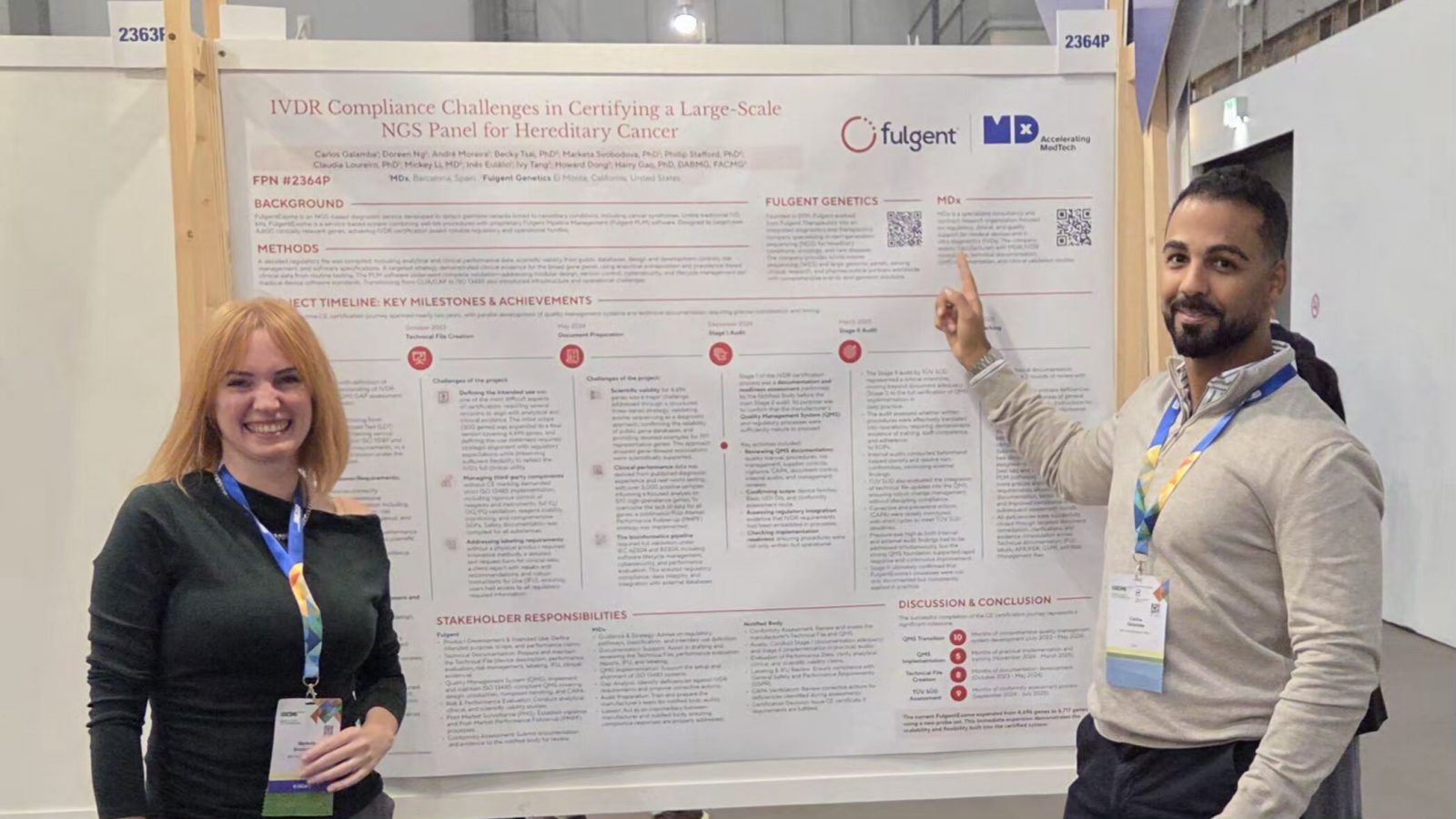
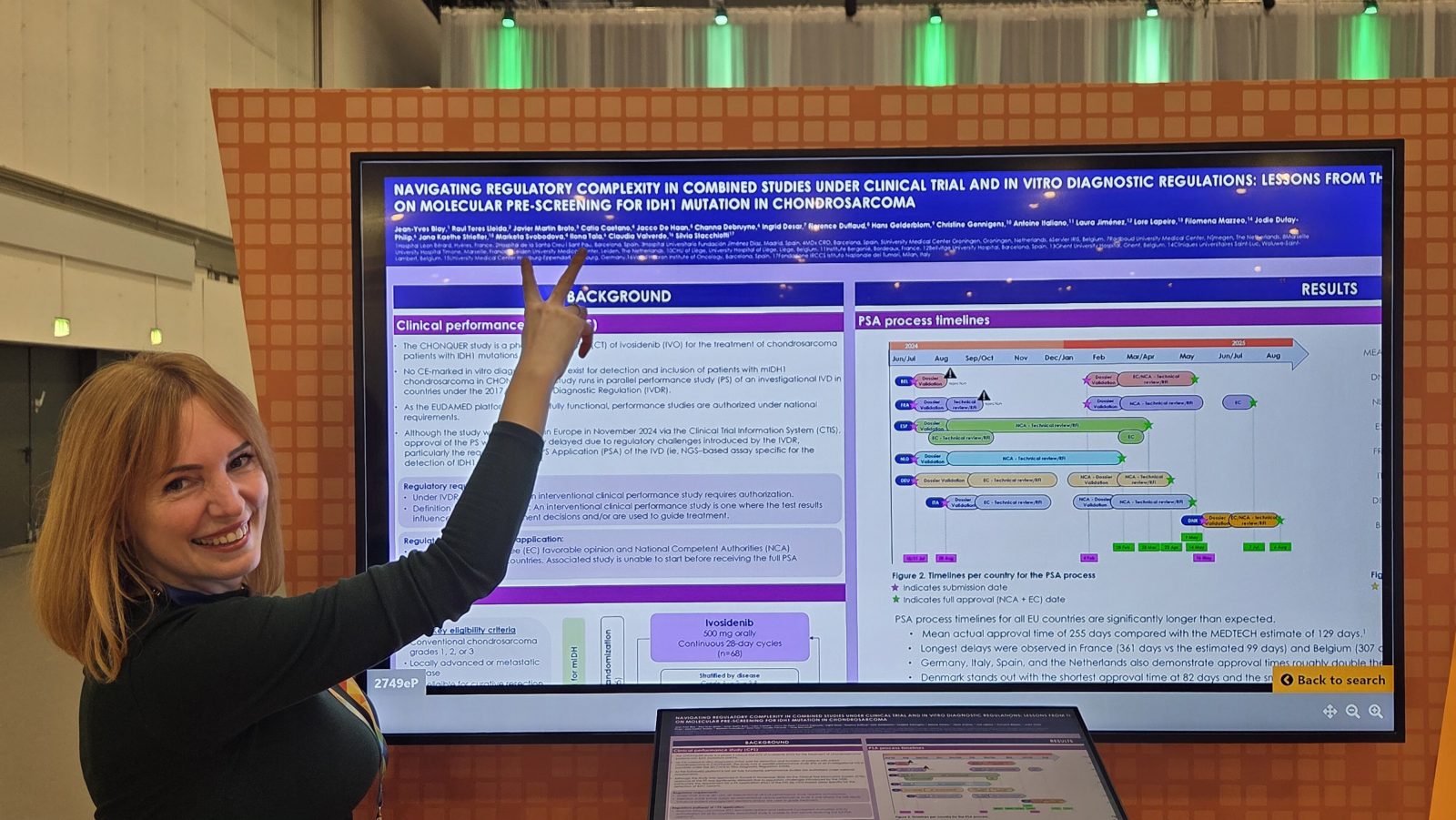
MDx CRO presented new evidence and hands‑on learnings at ESMO 2025 that reinforce our position as the partner of choice for IVDR transitions and combined clinical trials involving investigational IVDs. We were first author on a poster with Fulgent Genetics and contributors to a Servier poster—both centered on the operational and regulatory realities of bringing high‑impact oncology diagnostics into clinical practice under the EU IVDR.

Highlights from our ESMO 2025 posters

Title: IVDR Compliance Challenges in Certifying a Large‑Scale NGS Panel for Hereditary Cancer

What it covers:

  • Practical blueprint for transitioning a comprehensive, service‑based NGS hereditary cancer panel under IVDR.
  • Defining intended use and scientific validity across a large gene set; end‑to‑end technical documentation; bioinformatics validation aligned to IEC 62304/82304; and notified‑body engagement strategy.
  • Lessons on right‑sizing verification/validation and building a living evidence package to support CE‑marking.

Why it matters: Sponsors and lab developers gain an actionable path for moving complex NGS services to IVDR compliance—without slowing clinical programs.

Title: Navigating Regulatory Complexity in Combined Studies under CTR and IVDR (CHONQUER)

What it covers:

  • How combined trials (drug + investigational IVD) trigger dual oversight under CTR and IVDR and the knock‑on effects for timelines, submissions, and site activation across EU member states.
  • Operational patterns that accelerate approvals: early CPS planning, consolidated documentation, and aligned ethics/competent authority strategies.

Why it matters: Oncology sponsors can de‑risk global programs by anticipating IVDR‑specific requirements—and partnering with an IVD CRO that has worked both sides of the fence.

Key takeaways for sponsors

  • IVDR transitions—end to end. MDx CRO supports dossier strategy, clinical performance studies (ISO 20916), scientific validity, and notified‑body engagement for CE‑marking.
  • Combined trials, simplified. We design and run CPS and combined CTR + IVDR studies, harmonizing submissions across multi‑country portfolios.
  • Oncology‑ready operations. Deep experience with molecular prescreening, NGS workflows, and drug–device coordination for precision oncology.

Need a quick debrief? Contact our IVD CRO team for a walkthrough of how these findings translate to your IVDR transition or combined study plan.

FAQs

What does MDx CRO do for IVDR transitions?

We provide end‑to‑end support—from intended‑use definition and scientific validity to clinical performance studies, technical documentation, and notified‑body engagement.

How does MDx CRO support combined CTR + IVDR studies?

We plan and execute CPS and combined trials, consolidating submissions and aligning ethics/competent authority requirements to reduce delays.

Can MDx CRO help with NGS panel validation under IVDR?

Yes. We design right‑sized verification/validation programs and bioinformatics validation aligned with IEC 62304/82304.

Where can I get the ESMO 2025 posters?

Both PDFs are available at the ESMO platform; contact us for a guided readout.

Industry Insights & Regulatory Updates

TGA guidance (Oct 2025): IVD Companion Diagnostics (CDx) Requirements in Australia

What’s new

TGA IVD companion diagnostics requirements are now clearly explained in the Therapeutic Goods Administration’s guidance on IVD companion diagnostics (CDx) in Australia (updated 16 October 2025). Their revised companion diagnostics framework, adds process diagrams, a companion testing plan concept for medicine/biological sponsors, clearer clinical performance expectations, and case studies showing how the pathway works in practice.

This blog post summarises the definition of a CDx, Class 3 IVD classification, ARTG inclusion, companion testing plans, and the TGA CDx List.

What is a CDx under Australian law?

A companion diagnostic is an IVD (commercial or in‑house) that provides information essential for the safe and effective use of a corresponding medicine or biological—for patient selection, risk of serious adverse reactions, or treatment monitoring. To qualify, the test must be referenced in the Product Information (PI) for the medicine or in the Instructions for Use (IFU) of the biological. Tests used only for cell/tissue compatibility are excluded from the CDx definition.

This definition underpins the TGA IVD companion diagnostics requirements for medicines and biologicals that rely on patient selection testing.

Note: The term “a particular medicine or biological” can also cover a class of products with a similar mechanism of action, not only a single named product.

When does an indication require CDx testing?

An indication requires CDx testing when both:

  1. the medicine’s PI (or biological IFU) states that CDx testing is essential, and
  2. the CDx claims it is intended for that testing to enable use of the medicine/biological.
    This may apply to some (not all) indications of a medicine.

To aid transparency, the TGA recommends a PI “flag phrase” indicating that testing is essential and that clinical practice testing should be adequately comparable to the pivotal trial testing; the TGA also publishes a CDx List of approved tests.

How the TGA applies CDx requirements: Class 3 IVDs and ARTG inclusion

  • Classification: Under TGA IVD companion diagnostics requirements, all CDx—commercial and in-house—are Class 3 IVDs (including in‑house CDx).
  • Separate ARTG entries: Each CDx requires its own ARTG inclusion with a Unique Product Identifier (UPI) defined by the manufacturer.
  • Application audit: CDx applications are subject to a mandatory application audit unless supported by specified comparable overseas regulator documentation (e.g., EU IVDR, FDA PMA, PMDA, HSA, Health Canada).
  • Concurrent submissions: While encouraged, concurrent medicine/CDx submissions are not mandatory; however, a CDx application should only be submitted if the corresponding indication is approved or under concurrent review.

From companion testing plans to ARTG submissions, MDx CRO streamlines the end-to-end CDx pathway in Australia, aligning clinical, regulatory, and quality workstreams to the TGA’s expectations.

The companion testing plan (for medicine/biological sponsors)

Every new indication that requires CDx testing must include a companion testing plan (dated and version‑controlled) describing how Australian patients will access at least one adequate test. This is central to meeting TGA IVD companion diagnostics requirements. Four options are available:

  1. Option 1: A commercial CDx ARTG application is planned/underway (provide device submission details and sponsor contact).
  2. Option 2: An in‑house IVD CDx will be accredited under the National Pathology Accreditation Scheme (provide lab details, accreditation timeline, and quality/access reassurances).
  3. Option 3: Standard Australian testing is expected to deliver comparable clinical outcomes to the pivotal trials (provide detailed justification).
  4. Option 4: None of the above—TGA reviews full device data within the medicine dossier (appropriate when no onshore testing is expected).

If Option 4 is used, TGA may add a condition of registration requiring the sponsor to maintain and update the plan (e.g., in case of supply interruption, regulatory action, or material changes to test methodology). Approval of an indication can proceed even when no ARTG‑listed or accredited CDx is available, provided an adequate plan exists; however, a commercial CDx must be in the ARTG (or an in‑house CDx accredited) before supply in Australia.

Clinical trial assay evaluation & comparability

When an indication requires CDx testing, TGA evaluates the clinical trial assay used in the pivotal studies—reviewing scientific validity, analytical performance, clinical performance, and clinical utility. Subsequent CDx must show clinical comparability to the trial assay, typically via concordance and/or bridging studies (or other appropriate evidence) aligned to the trial assay’s core characteristics.

Responsibilities at a glance

Medicine/Biological sponsors must:

  • Use the TGA CDx identification guide to determine if CDx testing is essential.
  • Consider consequences of false positives/negatives, test failures or no result.
  • Include: (a) evidence to support evaluation of the clinical trial assay, and (b) a companion testing plan nominating at least one adequate test.
  • Note: The framework does not require a one‑to‑one link between an indication and a single proprietary CDx; it focuses on the core characteristics of testing.

Device sponsors must:

  • Submit an IVD medical device application for ARTG inclusion of the CDx (indicating the application is for a CDx and providing the UPI).
  • Demonstrate comparability to pivotal trial testing and meet Essential Principles; applications may undergo audit as above.
  • Ensure the corresponding indication is approved or under concurrent review.

In-house IVD CDx, NATA accreditation and NPAAC obligations

Pathology laboratories may develop/modify in‑house tests for use as CDx. Class 1–3 in‑house IVDs are not included in the ARTG, but require NATA accreditation, identification of CDx in the TGA notification test list, and compliance with the NPAAC standard. Under a NATA–TGA MoU, NATA can request TGA technical assistance during evaluation of in‑house CDx performance; TGA is not otherwise involved in the accreditation decision.

TGA CDx List

The TGA publishes a CDx List showing approved commercial CDx linked to corresponding indications (with in‑house CDx to be added). The list is informational (not a regulatory instrument) and may lag recent approvals by up to one month.

Transitional arrangements and change control

  • Transition: CDx previously included in the ARTG as Class 2 or 3 before 1 Feb 2020 (and certain in‑house IVDs) may continue supply until 31 Dec 2028; a new compliant application is required to continue supply thereafter.
  • Changes: Sponsors manage post‑market device changes via the TGA Device Change Request process.

Key takeaways (quick reference)

  • All CDx are Class 3 IVDs and require separate ARTG inclusion (commercial) or NATA accreditation (in‑house).
  • Every relevant medicine/biological indication must include a companion testing plan (Options 1–4).
  • TGA assesses the clinical trial assay and expects comparability evidence for subsequent CDx.
  • Approval can proceed without on‑shore CDx if a robust plan exists, but supply requires ARTG inclusion or in‑house accreditation.

FAQs

Are all CDx Class 3 IVDs in Australia?

Yes. The regulations specify all CDx (commercial and in‑house) are Class 3 IVDs.

Can an indication be approved if no Australian CDx is available yet?

Yes—if a suitable companion testing plan is in place; however, a commercial CDx must be in the ARTG (or an in‑house CDx accredited) before legal supply.

What goes into a companion testing plan?

Identify at least one adequate test and choose Option 1–4 with supporting details (e.g., ARTG application in progress, in‑house accreditation, justification that standard testing is adequate, or full device data reviewed within the medicine dossier).

Will the PI show that CDx testing is essential?

The TGA recommends a PI “flag phrase” indicating testing is essential and should be comparable to trial testing; approved tests appear on the TGA CDx List.

Written by:
Carlos Galamba

Carlos Galamba

CEO

Senior regulatory leader and advisor to top 10 global precision medicine companies with deep experience in high-risk IVDs including companion diagnostics.
Industry Insights & Regulatory Updates

MDx to Present ESMO 2025 Poster on IVDR CE Marking for Large Germline NGS Panels

Announcement

MDx will present a peer-reviewed poster at the ESMO Congress 2025 in Berlin detailing how our team helped secure IVDR CE marking for a large, service-based germline NGS solution that integrates wet-lab workflows with a validated bioinformatics pipeline. The poster distills a practical, audit-proven pathway that labs and IVD developers can apply when scaling evidence, validating software, and navigating notified-body reviews for complex NGS offerings.

What the poster covers

  • Regulatory strategy and intended use: How to right-size scope for very large panels while planning for future expansion.
  • Technical documentation: Building Annex II/III files that stand up to Stage I/II audits, including labeling/IFU for service-based models.
  • Software validation: Applying IEC 62304/82304 rigor to a bioinformatics pipeline (architecture, V&V, cybersecurity, change control).
  • Evidence at scale: A tiered approach to scientific validity and clinical performance, plus a pragmatic PMPF plan to mature low-prevalence evidence.
  • Operationalization: Supplier controls, change management, and QMS integration to sustain post-market scalability.
Fulgent and MDx ESMO 2025 poster about Certifying Large-Scale NGS panels for hereditary cancer

Why this matters

Large NGS panels pose unique IVDR hurdles: non-uniform clinical evidence across thousands of genes, evolving variant knowledge, third-party components without CE marking, and the need to validate bioinformatics as SaMD. By sharing a repeatable pathway and the pitfalls we overcame, this poster offers concrete guidance to shorten timelines without compromising quality or compliance.

When and where to find us

ESMO Congress 2025 takes place 17–21 October in Berlin, Germany. We will publish our poster board number and presentation time here as soon as the session logistics are confirmed by the organizers. If you’re attending, we’d love to meet to discuss your IVDR roadmap.

Read the background

For context on the underlying program and its market impact, explore the public write-ups:

Plan a meeting

Ready to talk IVDR CE marking for your NGS product?

Use our contact form to request a 30-minute slot with our regulatory and bioinformatics leads during ESMO 2025, or schedule a virtual follow-up the week after the congress.

Industry Insights & Regulatory Updates