EUDAMED Mandatory Timelines for MDR and IVDR

What the 2026 Deadlines Mean for Medical Device and IVD Manufacturers

EUDAMED mandatory timelines for MDR and IVDR are no longer theoretical. On 27 November 2025, the European Commission published Commission Decision (EU) 2025/2371 in the Official Journal of the European Union. This Decision confirms that four EUDAMED modules are now functional: Actor registration, UDI/Device registration, Notified Bodies and Certificates, and Market Surveillance.

Under the amended transitional rules in Regulation (EU) 2024/1860, that publication starts a six-month transition. As the Commission’s EUDAMED overview explains, from 28 May 2026 these four modules become mandatory to use for both medical devices and IVDs.

For manufacturers, authorised representatives, importers and notified bodies, this creates fixed dates that must now sit inside MDR and IVDR compliance plans.

1. How the EUDAMED Gradual Roll-Out Works

Regulation (EU) 2024/1860 amends the MDR and IVDR so that EUDAMED can go live module by module. Instead of waiting for all six modules, the Commission can audit each module or group of modules, confirm functionality, and then publish a notice in the Official Journal.

Once that notice appears, the rules change in a clear way. According to the Commission’s Q&A on the gradual roll-out of EUDAMED, the obligations and requirements linked to a given module become applicable six months after the notice is published. Until that date, the relevant provisions of the old Directives and their national transposition measures still apply for registration duties.

The same Q&A explains that some modules also come with extra time:

  • For the UDI/Device module, manufacturers have up to 12 months from the Official Journal notice to register certain devices already on the market.
  • For the Notified Bodies and Certificates module, notified bodies have up to 18 months from the notice to upload information on existing MDR and IVDR certificates.

Because the notice for the four modules appeared on 27 November 2025, the six-month period runs to 28 May 2026. After that date, the four modules are no longer optional.

2. Module-by-Module Deadlines Under MDR and IVDR

2.1 Actor Registration: SRNs Before Placement on the Market

The Actor module covers registration of economic operators. It applies to manufacturers, authorised representatives and importers that fall under Article 31 MDR and Article 28 IVDR.

The Q&A makes one point very clear. These economic operators must register as Actors and obtain a Single Registration Number before a device is placed on the market. Registration in the Actor module also unlocks other actions in EUDAMED, such as device registration and vigilance reporting.

Because the Official Journal notice for the four modules was published on 27 November 2025, use of the Actor module becomes mandatory from 28 May 2026. Manufacturers and authorised representatives can already register voluntarily and the Commission strongly encourages early registration to avoid a last-minute rush.

2.2 UDI/Device Registration: New vs. Ongoing Devices

The UDI/Device (UDI/DEV) module holds device and system/procedure pack data at the level of the UDI-DI or EUDAMED ID. The Q&A describes how the timelines work for different device situations.

First, if a medical device or IVD under the MDR or IVDR has its first sales unit placed on the EU market on or after the date when UDI/DEV becomes mandatory, the manufacturer must register the device in EUDAMED before that first placement. In practice, this means that any new MDR or IVDR device with a first unit sold on or after 28 May 2026 requires registration in UDI/DEV in advance.

Second, if the first unit of a device entered the EU market before the mandatory date, but the manufacturer will place more units on the market after that date, the device must still appear in UDI/DEV. In this case, the Q&A gives manufacturers 12 months from the publication of the Official Journal notice to register those devices. Because the notice was published on 27 November 2025, this deadline falls on 27 November 2026.

Devices that will not be placed on the market anymore when UDI/DEV becomes mandatory generally do not need registration, unless a specific post-market surveillance or vigilance action for that device occurs.

2.3 Notified Bodies and Certificates: New and Legacy Certificates

The Notified Bodies and Certificates (NB/CRF) module contains MDR and IVDR certificates and related NB decisions. The Q&A again draws a line between future and past certificates.

Once NB/CRF becomes mandatory, notified bodies must register every MDR and IVDR certificate they issue from that date onward, together with updates and certain decisions that affect these certificates. For the four modules declared functional in November 2025, this obligation starts on 28 May 2026.

For certificates that notified bodies issued before that date, the Q&A gives them more time. They must upload information on existing MDR and IVDR certificates within 18 months of the Official Journal notice, provided the related devices need to be registered in UDI/DEV. With a notice date of 27 November 2025, that 18-month period ends on 27 May 2027. Only the latest version of a certificate and the latest relevant NB decision need to appear in EUDAMED.

2.4 Market Surveillance: A New Tool for Authorities

The Market Surveillance (MSU) module supports market-surveillance work by national competent authorities. Manufacturers do not directly enter data into this module. However, they will feel its effects because it strengthens coordination between authorities and gives them a harmonised IT tool for cross-border cases.

The Q&A applies the same six-month rule to the MSU module. As a result, competent authorities must use the MSU module from 28 May 2026.

3. Practical Impact of EUDAMED Mandatory Timelines for MDR and IVDR

3.1 What Changes for Manufacturers and Authorised Representatives

For manufacturers and authorised representatives, EUDAMED becomes a central part of regulatory operations rather than a future project. Several changes now follow from the fixed dates.

First, Actor registration turns into a gatekeeper. From 28 May 2026, manufacturers, authorised representatives and importers in scope of Article 31 MDR and Article 28 IVDR need their Actor registration and Single Registration Number in place before they place devices or IVDs on the EU market. Without this registration, they cannot complete device registration or use other EUDAMED functions.

Second, device master data becomes more strategic. New MDR and IVDR devices must have device records ready before first placement after 28 May 2026. Devices that are already on the market but will continue after that date require registration by 27 November 2026. Manufacturers now need structured UDI-DI hierarchies, clear product groupings and consistent trade names across their documentation.

Third, manufacturers must align device data with certificate data. For many products, public EUDAMED information will combine UDI/device data and NB certificate data. If these do not match, authorities and customers may question the status of a device. Coordination between regulatory, quality and IT teams becomes more important than ad-hoc, product-by-product corrections.

3.2 What Changes for Notified Bodies

Notified bodies also face a significant workload. They must register all MDR and IVDR certificates issued from 28 May 2026 and bring existing certificates onto the NB/CRF module by 27 May 2027.

Because many notified bodies hold large portfolios, they will need efficient tools to manage uploads. The Commission has provided documentation for manual, bulk and machine-to-machine data exchange with EUDAMED. However, each notified body still has to implement and validate its own approach. Manufacturers should talk to their notified bodies early to understand how and when certificate information will appear in EUDAMED and how that timing aligns with their own device registrations.

3.3 Portfolio Planning and Transitional Provisions

The EUDAMED roll-out also interacts with other MDR and IVDR changes. Regulation (EU) 2024/1860 extends some IVDR transitional timelines for certain IVDs, but EUDAMED obligations apply regardless of those extensions. A device might benefit from longer time to move from IVDD to IVDR certification and still require EUDAMED registration within the new deadlines.

At the same time, the amended Articles 123 MDR and 113 IVDR help to avoid double work. Until the EUDAMED deadline for each module, national systems based on the old Directives continue to apply. Once the EUDAMED obligations become mandatory, they replace those older mechanisms and remove the risk of duplicate registrations.

For global organisations, this means EUDAMED is now a core input into portfolio and lifecycle planning, not just a technical IT project.

4. How MDx CRO Can Support EUDAMED Readiness

MDx CRO specialises in supporting medical device and IVD companies through MDR and IVDR. The new EUDAMED mandatory timelines for MDR and IVDR increase the value of structured, data-driven support.

4.1 Strategy and Gap Assessment

MDx CRO can review your product and certificate portfolio and map it against the new deadlines. This includes checking which legal entities need Actor registration, which devices will still be placed on the EU market after May 2026, and where device and certificate data must align.

We can then build a practical roadmap that sequences Actor registration, device registration and interactions with notified bodies. This approach reduces the risk of late surprises when EUDAMED becomes mandatory.

4.2 Data Preparation for UDI/DEV and NB/CRF

We help teams design clear UDI-DI structures and basic device data sets. That work supports both UDI/DEV registration and internal quality systems.

MDx CRO can also support data cleansing and consistency checks so that the information you load into EUDAMED matches your technical documentation, declarations of conformity and certificates. This preparation lowers the chance of errors and reduces back-and-forth with authorities or notified bodies.

4.3 Integration Into Clinical and Regulatory Programmes

EUDAMED should sit alongside performance evaluation, clinical data generation and labelling work, not apart from it. MDx CRO can help you embed EUDAMED milestones into your MDR and IVDR programmes so that regulatory submissions, certificate planning and EUDAMED entries move together.

We also support communication with notified bodies on certificate upload planning and with national competent authorities where clarifications are needed.

5. The Bottom Line: The EUDAMED Clock Is Now Running

With Decision (EU) 2025/2371 published and the Commission confirming that the first four modules will be mandatory from 28 May 2026, the EUDAMED project has crossed a line. The remaining time to prepare is now measured in months, not years.

For medical device and IVD manufacturers, the message is straightforward. The EUDAMED mandatory timelines for MDR and IVDR fix near-term deadlines for Actor registration, device and UDI data, certificate uploads and market-surveillance tooling. Organisations that act now will spread the workload and reduce risk. Those that wait may face crowded registries, limited notified body bandwidth and internal bottlenecks.

If you want to test your EUDAMED readiness or build a structured plan to meet the 2026 and 2027 dates, MDx CRO can support you with strategy, data preparation and regulatory execution.


Contact us today for a consultation.

Written by:
Alberto Bardají

Alberto Bardají

Head of Medical Devices

Senior med-tech expert & ex-Notified Body reviewer with deep experience in high-risk implants, orthopedics, dental & neurology.
Industry Insights & Regulatory Updates

How many MedTech companies are there in Europe?

Europe’s MedTech Landscape in 2025: 38,000+ Companies Driving Innovation

Europe is home to one of the world’s most dynamic and diverse medical technology ecosystems, with more than 38,000 MedTech companies operating across the continent. The vast majority—over 90%—are small and medium-sized enterprises (SMEs), playing a critical role in driving innovation, improving healthcare outcomes, and fueling economic growth .

What Defines Europe’s MedTech Industry?

According to MedTech Europe, the sector includes manufacturers of medical devices, in vitro diagnostics (IVDs), and digital health solutions, spanning everything from surgical tools to AI-powered diagnostic platforms. In total, the industry employs over 930,000 people directly, making it one of the largest employers in Europe’s life sciences space .

Why It Matters for Clinical and Regulatory Success

With the growing complexity of EU MDR and IVDR regulations, these companies—especially SMEs—face increasing pressure to:

  • Prove clinical evidence and safety of their technologies
  • Navigate Notified Body reviews and CE Marking
  • Manage post-market surveillance (PMS) and performance evaluations

That’s where MDx CRO steps in.

Supporting Europe’s MedTech Growth

At MDx CRO, we specialize in helping MedTech innovators—from start-ups to established manufacturers—successfully plan, execute, and submit their clinical and regulatory strategies across the EU and global markets. With proven expertise in:

We partner with both large diagnostic leaders and agile SMEs to deliver compliant, high-quality, and market-ready solutions.

A Pan-European Presence

With offices in Barcelona, Madrid, Lisbon, and London, and a network of CRAs and regulatory experts across Europe, MDx provides localized insight with global reach—helping MedTech companies meet requirements faster and smarter.

The Bottom Line

The European MedTech sector is growing—but so are its regulatory challenges. Whether you’re launching a new diagnostic product or preparing for a Notified Body audit, MDx CRO is here to support your success every step of the way.

Let’s talk about your next clinical or regulatory challenge.

Industry Insights & Regulatory Updates

How many new medical devices are developed per year?

In the fast-moving world of MedTech, innovators often ask: how many new medical devices are developed per year? There isn’t a single global number, but we can triangulate it using patent trends, regulatory authorizations, and industry signals grounded in current, authoritative data.

Innovation Signals: Patent Filings

Patent activity is a reliable early indicator of device development. According to the European Patent Office (EPO), medical technology led all fields in 2020 with 14,295 applications, a 2.6% increase over 2019—a reminder of the sector’s deep innovation pipeline.

More recently, medical technology remains a leading technical field. The EPO Patent Index 2024 confirms medical technology as one of the most active categories for invention. Industry analysis also highlights ~15,700 MedTech applications in 2024 across Europe’s patent system, reflecting sustained growth (MedTech Europe DataHub).

From Idea to Market: Regulatory Authorizations

Patents show invention; regulatory authorizations show how many devices actually reach patients. In the U.S., the FDA’s Center for Devices and Radiological Health (CDRH) publishes device approvals under rigorous pathways such as PMA (FDA 2023 Device Approvals).

2023 was a record year for novel authorizations, with the FDA approving 124 new devices, excluding emergency use authorizations. (MedTech Dive | Fierce Biotech). The FDA’s official CDRH Annual Report 2024 (PDF) confirms that momentum continued, with 120 novel devices authorized in 2024, keeping approvals among the highest ever recorded.

These authorizations form the conservative baseline of what counts as truly new medical devices entering the market.

Estimating “New Device Development”

Taken together, patents and regulatory approvals show the spectrum of innovation. Patent filings in the tens of thousands capture early-stage ideas and prototypes, while hundreds of annual regulatory authorizations reflect devices that complete the journey to patient use.

Depending on definition—prototype, clinical trial initiation, clearance, or market launch—the best evidence-based answer is that hundreds of new medical devices are developed per year, supported by a much larger innovation pipeline still in progress.

Why These Numbers Matter

This activity carries important implications. Competition in MedTech is intense, with medical technology consistently leading global patent activity. Yet translation remains the bottleneck: many promising inventions never reach the market due to regulatory and clinical hurdles.

For innovators, success depends not just on invention but on execution. That means robust design, evidence-driven clinical research, proactive regulatory strategy, and strong post-market surveillance. At MDx CRO, we guide teams through this entire journey—helping promising concepts become compliant, market-ready devices.

Conclusion

So, how many new medical devices are developed per year? The most defensible conclusion is that hundreds of novel devices achieve authorization annually, supported by tens of thousands of upstream inventions captured in patent data.

The MedTech field remains one of the most dynamic and competitive arenas in global innovation. For developers, the opportunity has never been greater—but so too have the challenges. To succeed, innovators must match great ideas with great execution.

If you are developing a new device and want to navigate this journey with confidence, contact MDx CRO today.

Industry Insights & Regulatory Updates

ISO 13485 Implementation Guide: How to Stand Up a World-Class QMS (and Win Faster Market Access)

For MedTech and diagnostics companies, ISO 13485:2016 is the operating system for quality. It’s the globally recognized standard that regulators and notified bodies expect you to use to design, manufacture, and maintain safe, effective devices across the full lifecycle. Implement it well and you accelerate technical documentation, reduce rework, and shorten time-to-market. Implement it poorly and every audit, change, and submission becomes harder than it should be.

There’s an additional strategic reason to act now: the U.S. FDA’s Quality Management System Regulation (QMSR) formally converges 21 CFR 820 with ISO 13485:2016. The QMSR’s effective date is February 2, 2026, with a two-year transition from the legacy QS Reg—so a robust ISO 13485 QMS positions you for both EU and U.S. expectations. (QMSR overview PDF).

What ISO 13485 actually requires (and how to build it right)

At its core, ISO 13485 demands a documented, controlled set of interrelated processes that meet regulatory requirements for medical devices—from design and production to post-market activities. Success is not about templates; it’s about process architecture, risk-based decision-making, and evidence you can defend. (ISO 13485 handbook preview).

1) Map your process architecture

Start with a top-level map that shows how design & development, purchasing/supplier control, production & service provision, software validation (for QMS and process software), vigilance, and post-market processes interact. Keep ownership clear; keep inputs/outputs traceable.

2) Make risk management the backbone

ISO 13485 expects risk-based controls throughout realization and post-market feedback. Operationalize ISO 14971:2019 (and ISO/TR 24971 guidance) so hazards, risk controls, and residual risk tie directly into design inputs, verification/validation, and change control.

3) Design controls that satisfy NB and FDA reviewers

Build a single D&D framework that covers planning, inputs/outputs, reviews, verification, validation (including clinical/performance where applicable), transfer, and DHF/Design History File traceability. Link your design plans to intended purpose/indications so your technical documentation aligns with MDR/IVDR and (when applicable) FDA submissions.

4) Supplier & software rigor

Qualify and monitor critical suppliers with risk-based controls; embed incoming inspection and performance metrics. Validate QMS/production software proportional to risk and document configuration management so you can pass objective evidence reviews.

5) Document control that scales

Use a lean document hierarchy (policy → process → work instruction → form) and number it so auditors can navigate quickly. Automate change control and training effectiveness checks; link each controlled record to the process requirement it satisfies.

6) Post-market surveillance that drives improvement

Your PMS loop should systematically capture complaints, feedback, vigilance, field actions, and real-world performance. Close the loop with CAPA and management review using trend analysis and risk re-evaluation.

7) Internal audits and management review that add value

Audit for process performance (not just procedural conformance). Track effectiveness KPIs and feed them into management review alongside regulatory metrics (e.g., NB queries, submission outcomes, vigilance timelines).

EU alignment matters: harmonized EN ISO 13485 and MDR/IVDR

In Europe, EN ISO 13485:2016 (including A11:2021 and AC:2018) is recognized as a harmonized standard supporting MDR/IVDR requirements—useful for presumption of conformity where applicable. Aligning your QMS to the harmonized edition reduces friction in notified body assessments and surveillance.

Implementation roadmap (what works in the real world)

  • Phase 1 — Gap Assessment & Plan: Benchmark current practices against ISO 13485 clauses, ISO 14971 integration points, and your market strategy (EU MDR/IVDR, FDA QMSR). Produce a prioritized remediation plan with owners and dates.
  • Phase 2 — Process Build & Evidence: Draft/revise procedures; pilot them with one product line to generate real records (design plan, risk files, supplier files, software validation, training, internal audit).
  • Phase 3 — System Activation: Roll out across programs; execute internal audit cycle and management review with measurable outcomes.
  • Phase 4 — NB/FDA Readiness: Run a mock audit; fix systemic findings; align technical documentation index to QMS records; confirm personnel qualification and training effectiveness.

Avoid the top 5 pitfalls we see

  • Building dozens of procedures without a process map (auditors get lost; so do teams).
  • Treating risk management as a document, not a process that drives design and post-market decisions.
  • Weak supplier controls for critical components and software.
  • Software validation that stops at IQ/OQ and misses real-world configurations.
  • “One-and-done” internal audits that don’t test effectiveness or feed CAPA.

How MDx CRO makes ISO 13485 implementation faster (and audit-proof)

MDx CRO designs right-sized 13485 systems for MedTech and diagnostics teams—from first-time implementations to remediation before NB or FDA inspections. We build the process architecture, author and train on lean SOPs, integrate ISO 14971 risk into day-to-day decision-making, and generate submission-ready evidence. Then we run mock audits that mirror NB/FDA styles so you walk into the real thing prepared.

Explore Regulatory & Quality Services and Clinical & Post-Market Support, or contact MDx CRO to scope your ISO 13485 program.

Industry Insights & Regulatory Updates

A Step-by-Step Guide to IEC 62366 and Usability Engineering

The usability of medical devices is not just a matter of convenience. It is a matter of safety, effectiveness, and regulatory compliance. Poor design that confuses or frustrates users can lead to use errors, adverse events, and even patient harm. To address this, the international standard IEC 62366-1:2015/Amd 1:2020 establishes a structured framework for usability engineering in medical device development.

For medical device manufacturers, understanding and applying IEC 62366 is essential. Compliance demonstrates that usability risks have been identified, reduced, and documented, which is essential for all medical devices including IVDs and Software as a Medical Device (SaMD).

What Is IEC 62366?

IEC 62366 is the internationally recognised standard that defines how to integrate usability into the design and development process.

It has two main parts:

  • IEC 62366-1:2015/Amd 1:2020 Medical devices – Application of usability engineering to medical devices: The core standard describing the usability engineering process.
  • IEC/TR 62366-2:2016 Medical devices – Guidance on the application of usability engineering to medical devices: A technical report providing guidance and examples to support implementation.

The goal is to ensure that usability engineering is applied consistently so that devices can be used safely and effectively by intended users, in intended use environments, while ensuring that use errors that could lead to harm are identified, reduced, and controlled through structured usability activities.

Why Usability Engineering Matters

Use-related errors are a leading cause of device-related adverse events. By embedding usability engineering into product development, manufacturers can:

  • Reduce use errors that could lead to harm
  • Improve patient safety and treatment outcomes
  • Satisfy regulatory requirements from the MDR, IVDR, and FDA
  • Increase user acceptance and market success
  • Lower long-term costs by avoiding redesigns or recalls

In short, usability is both a compliance requirement and a competitive advantage.

Step-by-Step Guide to Applying IEC 62366

The usability engineering process defined in IEC 62366 is systematic and iterative. It integrates into the overall product development lifecycle and risk management process in line with ISO 14971. Below is a step-by-step breakdown.

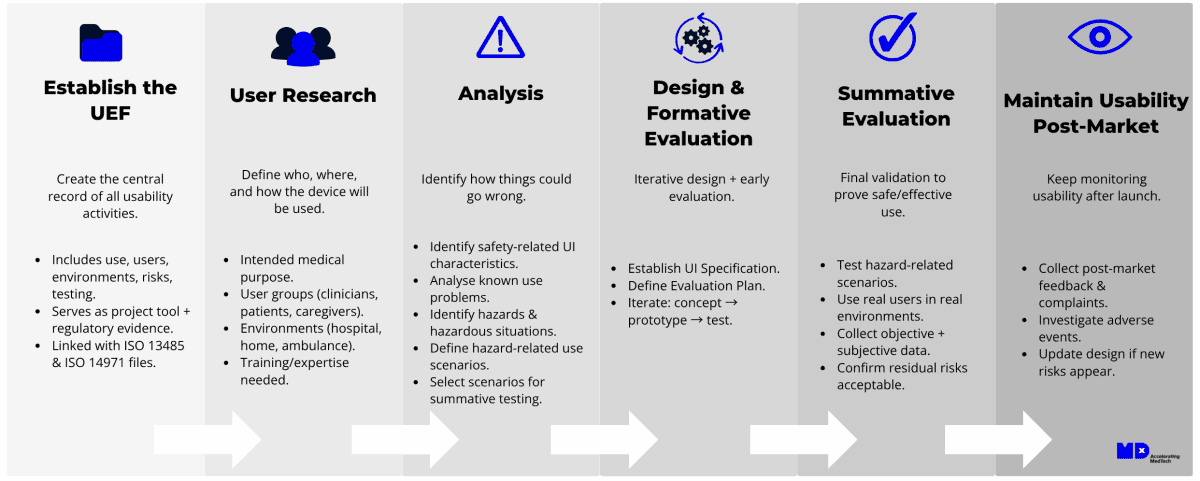
Step-by-step visual guide illustrating the IEC 62366 usability engineering process for medical devices, covering intended use definition, hazard identification, risk analysis, user interface requirements, formative evaluations, and summative usability validation, aligned with EU MDR and FDA human factors guidelines.

The UEF is the central documentation repository for all usability activities. It includes intended use, user profiles, use scenarios, hazard analysis, test results, and risk control measures. In practice, the records and other documents that form the UEF may also form part of the product design file (ISO 13485) or the risk management file (ISO 14971).

Think of the UEF as both a project management tool and evidence for regulators.

Prepare the Use Specification. This is where you define:

  • The intended medical purpose of the device
  • The user groups (e.g. clinicians, patients, laypersons, caregivers)
  • The use environments (hospitals, homes, ambulances, clinics)
  • Any training or expertise required

This forms the foundation of all subsequent usability activities.

Once you know who will use your device and where, the next step is to analyse how things could go wrong.

Activities include:

  • Identifying safety-related user interface characteristics (e.g. readability of displays, button layout, alarm visibility).
  • Reviewing post-production data and public databases for known usability issues with similar devices.
  • Identifying hazards and hazardous situations.
  • Identifying and describing hazard-related use scenarios, which describe exactly how use errors might occur and what consequences they could have.
  • Selecting hazard-related use scenarios for Summative Evaluation.

These scenarios are then prioritised to decide which will be evaluated in summative testing.

This is where design and usability testing happen in iterative cycles.

Key steps:

  1. Establish the User Interface Specification – the blueprint of all UI elements.
  2. Develop the User Interface Evaluation Plan – define how formative and summative testing will be performed.
  3. Iterative cycles of concept, prototype, and testing

The point of formative evaluation is to find usability issues early, before final validation, so changes are cheaper and less disruptive.

The final stage is a summative usability validation. This is a formal test that demonstrates to regulators that the device can be used safely and effectively by the intended users.

  • Test the hazard-related use scenarios identified earlier.
  • Use representative users in realistic environments.
  • Collect both objective performance data (task completion, error rates) and subjective feedback (ease of use, confidence).
  • Confirm that residual risks are acceptable in line with ISO 14971.

This stage provides the objective evidence regulators require to ensure compliance.

Usability engineering does not end at product launch. Post-market surveillance should collect feedback on usability issues, adverse events, and complaints. Updates or design changes may be required if new risks emerge.

Common Challenges in Applying IEC 62366

Many manufacturers encounter difficulties such as:

  • Underestimating resources needed for usability testing
  • Recruiting representative users for formative and validation studies
  • Defining realistic use scenarios that reflect actual clinical environments
  • Integrating usability with development timelines
  • Documenting evidence properly in the UEF

Failing to address these challenges can result in regulatory rejection, delays, or costly redesigns.

Best Practices for Success

  1. Start usability engineering early in the design process
  2. Involve multidisciplinary teams including engineers, clinicians, and usability experts
  3. Use a mix of qualitative and quantitative methods in evaluations
  4. Prioritise hazard-related use scenarios in validation testing
  5. Document everything thoroughly in the Usability Engineering File
  6. Where possible involve regulators early for alignment
  7. Leverage specialist expertise such as a Medical Device and IVD Consultancy with usability engineering experience

How MDx CRO Can Help

Implementing IEC 62366 in-house can strain resources. At MDx CRO we can provide:

  • Protocol development and study design for usability testing
  • Recruitment of representative users across geographies
  • Moderation of formative and validation studies
  • Integration of usability engineering with regulatory strategy
  • Preparation of all usability documentation required for submissions including FDA submissions

As a trusted Medical Device and IVD consultancy, we support manufacturers in implementing IEC 62366, running usability studies, and preparing documentation that satisfies both EU and US regulators. Whether you are starting a new project or updating an existing device, our team helps you achieve compliance and deliver safer devices to market.

Does the FDA also recognise IEC 62366?

Yes. The latest versions of the IEC 62366 standards are recognised by the FDA as consensus standards. However, the FDA has also published specific human factors engineering guidances with minor differences to IEC 62366 so it is recommended that these are also considered for FDA submissions.

When should usability testing be performed?

Throughout development. Formative evaluations identify and correct issues early, while summative validation confirms safe and effective use before market approval.

Can simulated environments be accepted in usability validation?

Yes, provided they are representative of real-world conditions and cover all critical tasks and hazard-related use scenarios.

Written by:
Floella Otudeko

Floella Otudeko

Senior QARA Specialist

Senior QA/RA consultant with MDR, IVDR, Usability/Human Factors and MDSW expertise, supporting MedTech and IVD innovation globally.
Industry Insights & Regulatory Updates

MDR Compliance Checklist: What You Need Before Submitting

A Comprehensive Pre-Submission Readiness Guide

Navigating the European Union’s (EUs) Medical Device Regulation (Regulation [EU] 2017/745; MDR) demands meticulous preparation. Submitting incomplete technical documentation to a Notified Body (NB) for review triggers lengthy review cycles and costly delays. This guide serves as a final gap analysis to ensure a robust, coherent, and compliant submission, paving a smoother path to Conformité Européenne (CE) marking.

Your technical documentation is an output of your quality management system (QMS). The NB will review your technical file and your QMS, in accordance with the requirements of Annex IX of the MDR. Other conformity assessment routes, such as those outlined in Annex X (based on type-examination) or Annex XI (based on product conformity verification), may also be selected, although they are less commonly used.

The foundational systems and roles required of all manufacturers, regardless of device classification, are as follows:

  • MDR-compliant QMS: Per MDR Article 10(9), a QMS for developing, manufacturing, and post-market monitoring is mandatory. Although certification to ISO 13485:2016 is not mandatory, it is commonly used to demonstrate compliance and is considered the most effective way to fulfil the requirements of Article 10(9) of the MDR. For all devices, the QMS should incorporate MDR-specific processes such as post-market surveillance (PMS), vigilance, and unique device identification (UDI) management.

For Class IIa, IIb, and III devices, as well as certain Class I devices placed on the market in sterile condition, with a measuring function, or intended to be reused, the QMS is typically assessed by a Notified Body as part of the conformity assessment. For other Class I devices, while a QMS is still required under Article 10(9), it does not require Notified Body involvement.

  • Risk management system: Mandated by MDR Annex I, risk management per ISO 14971 must be a continuous process implemented throughout the entire product lifecycle, ensuring risks are controlled and an acceptable benefit-risk ratio.
  • Person Responsible for Regulatory Compliance (PRRC): MDR Article 15 obliges manufacturers to designate at least one qualified PRRC permanently and continuously at their disposal. This ensures technical documentation and declarations of conformity (DoC) are prepared and maintained in compliance with the Regulation.
  • Understanding stakeholder obligations: Ensure that your organisation understands, and has communicated, the necessary information to distributors and importers, who have specific obligations under MDR Articles 13 and 14 regarding verification, storage, and complaint handling.

Your technical documentation is the core evidence dossier for your device, structured in accordance with MDR Annexes II (Technical Documentation) and III (Technical Documentation on PMS).

Technical documentation (Annex II)

Must provide comprehensive evidence that all General Safety and Performance Requirements (GSPRs) from Annex I are met.

  • Device description & specifications: Detailed description of the device, including trade name, intended purpose, users, patient population, principles of operation, and key functional elements (components, materials, software). Identification via Basic UDI-DI (per MDR Article 27 and Annex VI, Part C) or other traceable identifiers. Justification of device qualification, risk class, and applied classification rules in accordance with MDR Annex VIII. Overview of previous and similar generations of the device
  • Labelling & Instructions for Use (IFU): All labelling must comply with MDR Annex I, Chapter III. Claims made in the IFU or labelling must be consistent with, and supported by, the clinical evaluation, GSPRs, and RMF. Labels and Instructions for Use (IFU) in all applicable EU languages
  • Design and Manufacturing Information: Description of design stages, manufacturing processes, validation data, and control of critical suppliers/subcontractors.
  • GSPR checklist: Links each applicable safety and performance requirement of the device to the source of objective evidence (ie, verification & validation [V&V] reports, test data, or procedures); GSPRs not considered applicable should be justified. Reference to applied harmonised standards, common specifications (CS), or equivalent solutions.
  • Risk management file (RMF): Must demonstrate a complete lifecycle approach to risk per ISO 14971, including analysis, evaluation, control, and a report concluding a favourable benefit-risk profile.
  • V&V reports: Data supporting device safety and performance, including
    • Biocompatibility (ISO 10993 series)
    • Electrical Safety & electromagnetic compatibility (IEC 60601 series)
    • Software V&V (IEC 62304 for lifecycle processes)
    • Stability and shelf-life testing
    • Sterilisation validation
    • Performance and safety testing relevant to intended use

Clinical Evaluation (Annex XIV)

Includes a clinical evaluation report (CER) based on a compliant clinical evaluation plan (CEP), providing sufficient clinical evidence to demonstrate device safety, performance, and a favourable benefit-risk ratio. It must also:

  • critically appraise data from manufacturer clinical investigations or an equivalent device (if claimed according to strict MDR criteria);
  • be updated continuously throughout the device’s lifecycle with post-market data.

PMS & vigilance (Annex III)

The Post-Market Surveillance (PMS) Documentation ensures continuous evaluation of device performance and compliance throughout its lifecycle, through the following documents.

  • A PMS plan: Proactively and systematically collects and analyses post-market data on device quality, performance, and safety.
  • A post-market clinical follow-up (PMCF) plan: Actively gathers clinical data post-market, required unless exclusion is justified.
  • Vigilance System: Robust procedures for reporting Serious Incidents and Field Safety Corrective Actions to competent authorities per MDR Article 87.
  • PMS reporting: Preparation of a Periodic Safety Update Report (PSUR) (Article 86) or Post-Market Surveillance Report (PMSR) (Article 85), depending on device class

Step 3: Pre-Submission – Administrative and Conformity Assessment Planning

Final checks before NB engagement.

  • Conformity assessment: Based on device classification, the correct conformity assessment procedure (detailed in MDR Annexes IX-XI) must be followed.
  • EU DoC (Annex IV): A draft DoC must be prepared, listing all applicable regulations and standards, signed after the NB grants CE certification.
  • Summary of Safety and Clinical Performance (SSCP): For implantable and Class III devices; must be written in clear, layperson language and must be consistent with the CER and IFU.
  • CRITICAL STEP – Internal Consistency Review: A cross-functional review to ensure the device name, intended purpose, indications, and key performance claims are consistent across documentation.
  • NB Engagement:
    • Designation Scope: Confirm your chosen NB is officially designated for your device type and classification.
    • HIGHLY RECOMMENDED – Pre-Submission Meeting: Discuss your strategy and the NB’s expectations through structured dialogues, de-risking the formal submission process.

Supporting Documents and Guidance

  • ISO 13485:2016 (QMS)
  • ISO 14971:2019 (Risk Management)
  • ISO 14155:2020 (Clinical Investigations)
  • MEDDEV 2.7/1 Rev. 4 (Clinical Evaluation: A Guide for Manufacturers and Notified Bodies)
  • MDCG 2020-6 (Clinical evidence needed for medical devices previously CE marked under Directives 93/42/EEC or 90/385/EEC: A guide for manufacturers and notified bodies)
  • MDCG 2020-7 (Post-market clinical follow-up [PMCF] Plan Template: A guide for manufacturers and notified bodies)
  • MDCG 2020-8 (Post-market clinical follow-up [PMCF] Evaluation Report Template: A guide for manufacturers and notified bodies)
  • MDCG 2019-9 (Summary of safety and clinical performance: A guide for manufacturers and notified bodies)

Key Takeaway

MDR compliance transcends document creation. It is about building a coherent, evidence-based narrative weaving together quality management, risk analysis, clinical data, and post-market vigilance into a single, compelling story of your device’s safety and performance. Using this comprehensive checklist to perform a final, critical gap analysis ensures your story is not only complete but also clear, consistent, and readily verifiable, paving a smoother path to successful CE marking under the MDR.

Contact us today for a consultation with our medical devices team.

Written by:
Grace Chia, PhD

Grace Chia, PhD

RA Specialist

Regulatory Affairs Specialist in MDR & IVDR with expertise in CERs, SVRs, literature review, and regulatory compliance.
Industry Insights & Regulatory Updates