MDx CRO at MPP 2025: Aligning Companion Diagnostics and Drug Development under IVDR

Precision medicine needs alignment, not lighter rules

Europe’s precision medicine ecosystem advances when diagnostics and medicines move in lockstep. The real bottleneck is not regulation itself; it is the structural divergence between the Clinical Trials Regulation and the IVDR. In our work across oncology and rare disease programmes, we repeatedly see how separate clocks, committees, documentation and reporting streams create avoidable friction. Our message at MPP 2025 was simple: bring both tracks together from the start and design one plan that satisfies clinical utility and regulatory rigor at the same time.

CDx and drug trials: bridging IVDR and CTR

When a biomarker guides enrolment or treatment and the assay is not CE-marked for that purpose, Article 58 triggers a performance study alongside the medicinal trial. That study’s endpoints, analytical validation and risk–benefit narrative must be coherent with the drug protocol, because outcomes like PFS, OS and ORR depend on the test defining the right population. Misalignment costs time; EFPIA’s 2023 evidence shows many sponsors facing six to twelve-month delays linked to IVDR requirements, which ultimately pushes patient access further out.

What MDx CRO presented at MPP 2025

At the Medtech & Pharma Platform Annual Conference on 16 September 2025 at the Novartis Campus in Basel, Carlos Galamba, CEO at MDx CRO, joined the session “IVDs, CDx & Personalized Medicine: Moving from Compliance to Innovation,” chaired by Fatima Bennai-Sanfourche of Bayer and Andreas Emmendoerffer of Roche. The panel brought together Antonella Baron from the European Medicines Agency, Heike Möhlig-Zuttermeister of TÜV SÜD, and patient advocate David Haerry of Positive Council Switzerland, alongside MDx.

Evidence on delays and the impact on patients

The data are unambiguous: EFPIA’s survey indicates 43 percent of companies estimated six to twelve-month delays due to IVDR, with downstream consequences for trial starts and patient inclusion across major disease areas. Every month lost to mis-sequenced processes or unclear governance is a month patients wait for targeted therapies.

Signals from regulators, notified bodies, and patient advocates

The discussion reflected a clear appetite for convergence. EMA perspectives on embedding companion diagnostics under IVDR, TÜV SÜD’s insights on conformity assessment for CDx, and the patient community’s call for earlier access all point in the same direction: coordinated planning and earlier dialogue across agencies, notified bodies and sponsors.

Key insights from the MPP panel and fellow presenters

Compliance versus innovation is the wrong debate. The practical path forward is compliance and innovation together: a single evidence plan, shared endpoints, and a unified risk–benefit narrative that treats the diagnostic and the drug as interdependent elements of one therapy journey. That is how companion diagnostics under IVDR accelerate, rather than delay, precision medicine.

How MDx CRO accelerates CDx from design to approval

MDx builds one cross-functional plan from day one, aligning clinical and device protocols, mapping Article 58 triggers, and sequencing submissions so site start-up and “first sample tested” are not held back by documentation gaps. Our teams scrutinise analytical validation, prepare CPSPs and Annex XIV packages aligned to ISO 20916, and train investigators on device-specific safety reporting and sample flows across multilingual EU sites. This integrated approach has delivered a consistent approval track record for CDx submissions.

Operational playbook for combined studies in Europe

Effective combined studies require clear governance between drug and device sponsors, modular and wave submissions across Member States, separate informed consents for the CDx component where appropriate, and proactive scientific advice with EMA or NCAs for borderline cases. With local regulatory intelligence and language capability across Europe, we coordinate roles and documentation so CTR and IVDR remain synchronised throughout the study lifecycle.

Acknowledgment to MPP and our co-presenters

Our thanks to the Medtech & Pharma Platform Association for convening this timely discussion and to the session chairs and speakers who brought regulatory, conformity assessment and patient perspectives to the same table: Fatima Bennai-Sanfourche, Andreas Emmendoerffer, Antonella Baron, Heike Möhlig-Zuttermeister and David Haerry.

Partner with MDx CRO to make CDx work under IVDR

If your programme depends on biomarker-driven enrolment or treatment decisions, partner with a team that speaks CTR and IVDR fluently. MDx CRO compresses timelines, de-risks submissions and delivers companion diagnostics that make precision medicine real for the patients who need it most


Industry Insights & Regulatory Updates

MDx CRO at ESMO 2025 (Berlin): Advancing IVDR Transitions & Combined Clinical Trials

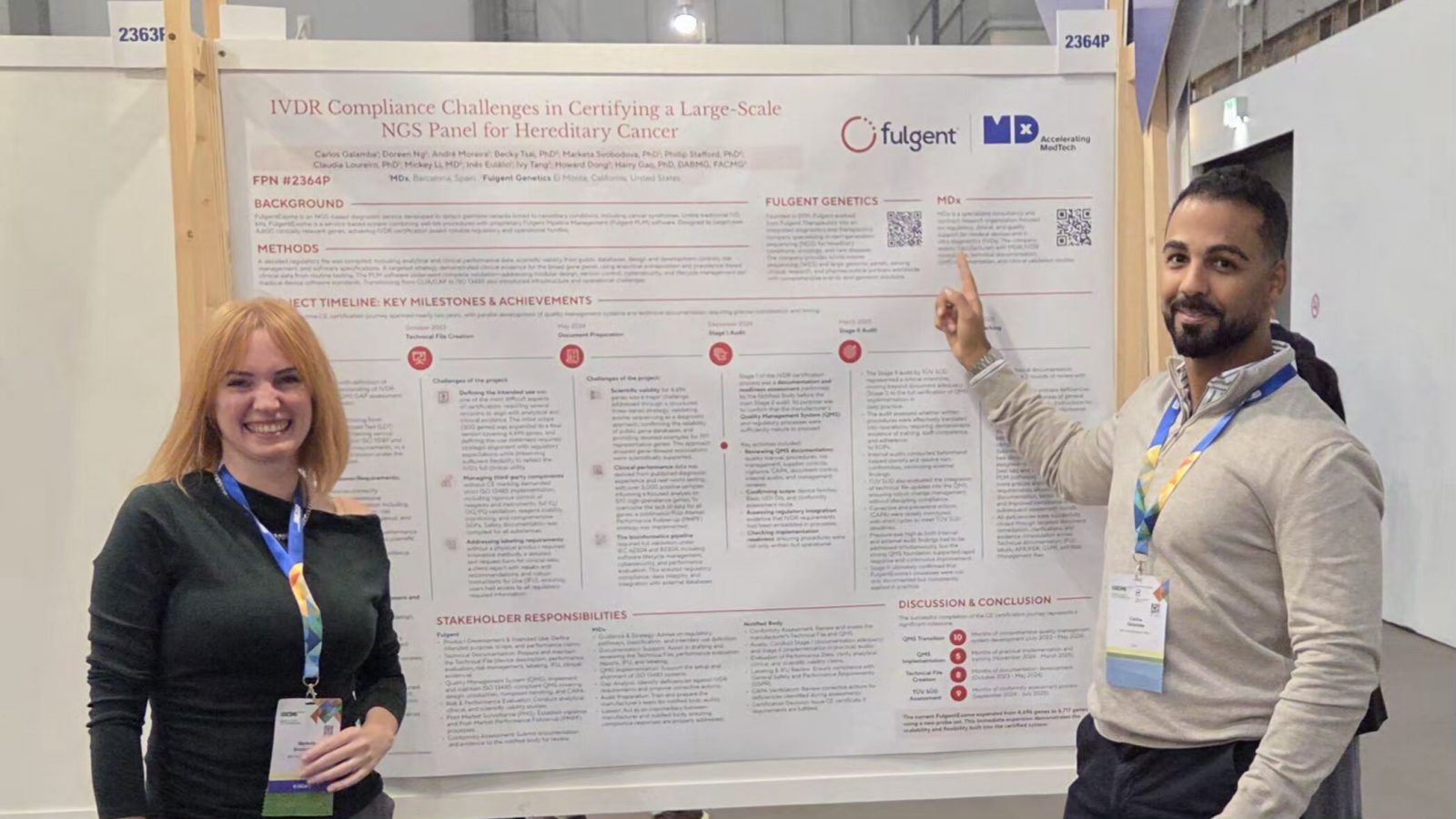
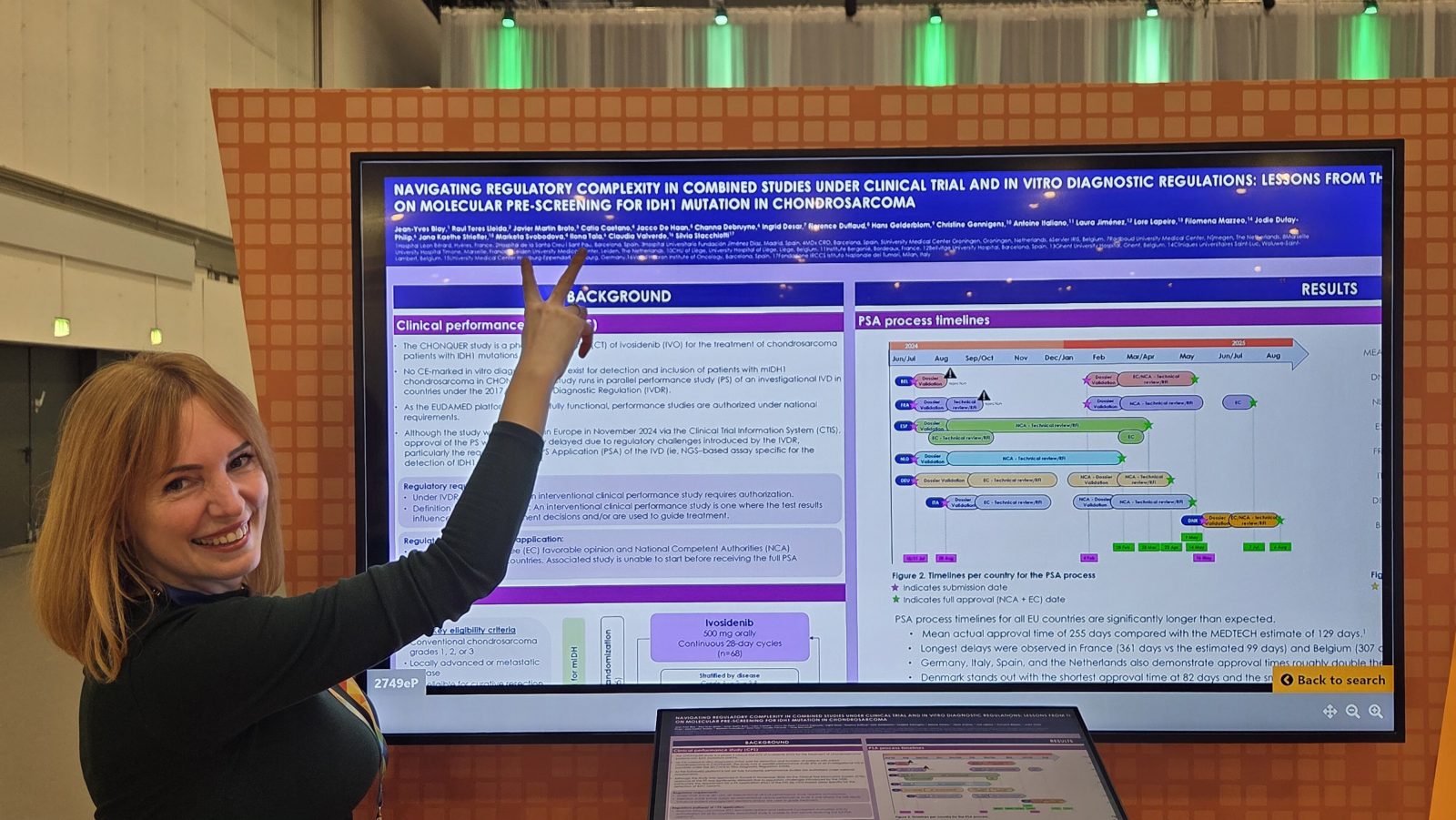
MDx CRO presented new evidence and hands‑on learnings at ESMO 2025 that reinforce our position as the partner of choice for IVDR transitions and combined clinical trials involving investigational IVDs. We were first author on a poster with Fulgent Genetics and contributors to a Servier poster—both centered on the operational and regulatory realities of bringing high‑impact oncology diagnostics into clinical practice under the EU IVDR.

Highlights from our ESMO 2025 posters

Title: IVDR Compliance Challenges in Certifying a Large‑Scale NGS Panel for Hereditary Cancer

What it covers:

  • Practical blueprint for transitioning a comprehensive, service‑based NGS hereditary cancer panel under IVDR.
  • Defining intended use and scientific validity across a large gene set; end‑to‑end technical documentation; bioinformatics validation aligned to IEC 62304/82304; and notified‑body engagement strategy.
  • Lessons on right‑sizing verification/validation and building a living evidence package to support CE‑marking.

Why it matters: Sponsors and lab developers gain an actionable path for moving complex NGS services to IVDR compliance—without slowing clinical programs.

Title: Navigating Regulatory Complexity in Combined Studies under CTR and IVDR (CHONQUER)

What it covers:

  • How combined trials (drug + investigational IVD) trigger dual oversight under CTR and IVDR and the knock‑on effects for timelines, submissions, and site activation across EU member states.
  • Operational patterns that accelerate approvals: early CPS planning, consolidated documentation, and aligned ethics/competent authority strategies.

Why it matters: Oncology sponsors can de‑risk global programs by anticipating IVDR‑specific requirements—and partnering with an IVD CRO that has worked both sides of the fence.

Key takeaways for sponsors

  • IVDR transitions—end to end. MDx CRO supports dossier strategy, clinical performance studies (ISO 20916), scientific validity, and notified‑body engagement for CE‑marking.
  • Combined trials, simplified. We design and run CPS and combined CTR + IVDR studies, harmonizing submissions across multi‑country portfolios.
  • Oncology‑ready operations. Deep experience with molecular prescreening, NGS workflows, and drug–device coordination for precision oncology.

Need a quick debrief? Contact our IVD CRO team for a walkthrough of how these findings translate to your IVDR transition or combined study plan.

FAQs

What does MDx CRO do for IVDR transitions?

We provide end‑to‑end support—from intended‑use definition and scientific validity to clinical performance studies, technical documentation, and notified‑body engagement.

How does MDx CRO support combined CTR + IVDR studies?

We plan and execute CPS and combined trials, consolidating submissions and aligning ethics/competent authority requirements to reduce delays.

Can MDx CRO help with NGS panel validation under IVDR?

Yes. We design right‑sized verification/validation programs and bioinformatics validation aligned with IEC 62304/82304.

Where can I get the ESMO 2025 posters?

Both PDFs are available at the ESMO platform; contact us for a guided readout.

Industry Insights & Regulatory Updates

Companion Diagnostic Clinical Trial Case Study

Regulatory Turnaround for a Phase 3 Global CDx Clinical Trial (Annex XIV)

A global biopharma company faced a critical delay in a phase 3 clinical trial in oncology. The study required an NGS-based companion diagnostic (CDx) assay to detect a specific mutation and pre-screen patients for eligibility. Several EU authorities initially rejected or stalled the Clinical Performance Study (CPS/PSA) due to assay validation concerns and fragmented IVDR processes. MDx CRO mobilized a specialized cross-functional team, redesigned the documentation package, and re-submitted in six EU countries within three months, clearing all RFIs and enabling on-time trial initiation. This case study has been accepted for presentation at ESMO 2025 in Berlin.

The Challenge

  • Early rejection and major RFIs: EU bodies questioned assay validation and risk management, threatening the trial start.
  • Dual-regulation complexity: The trial combined CT and IVDR CPS submissions with different national portals, templates, and timelines.
  • Harmonization gaps: With EUDAMED not fully operational, CPS authorizations varied widely by Member State, creating long and unpredictable timelines.

What was at stake: lost recruitment windows, protocol amendments, cost escalation, and missed milestones tied to major scientific congresses.

MDx CRO Approach

1) Rapid diagnostic and plan

  • Completed a 48-hour gap analysis across the submission: CDx protocol, analytical performance package, CER/PER linkages, IFU, training, and risk files.
  • Mapped country-specific expectations (EC vs NCA) to pre-empt common RFIs: informed consent, site/PI suitability, device training, and performance datasets.

2) Targeted re-engineering

  • Revised the clinical performance study protocol (CPSP) for the CDx assay to clarify endpoints, eligibility flows, and pre-screening logistics.
  • Overhauled analytical performance evidence (accuracy, precision, LoD, reproducibility) and tightened traceability to risk controls.
  • Redeveloped risk management documentation to align hazards, mitigations, and verification with Annex I GSPRs.
  • Strengthened usability & training to address EC concerns on user competence and patient protection.

3) Country-by-country execution

  • Sequenced six EU CPS submissions to match national review modalities (combined, parallel, or sequential EC/NCA), reducing idle time between waves.
  • Built a rapid RFI response playbook so sponsors and sites could respond in days, not weeks.

Results & Impact

  • All RFIs resolved: Delivered clear, evidence-backed answers across EC and NCA questions, including consent, site suitability, training, and performance data.
  • Approvals secured quickly: The re-submission strategy compressed timelines and returned the program to the original start path despite EU-wide CPS delays.
  • Trial initiation preserved: Sites opened on schedule, enabling screening with the NGS CDx pre-screen.
  • Scientific visibility: Study learnings and regulatory insights are accepted for presentation at ESMO 2025, showcasing efficient navigation of combined CT/IVDR frameworks.

Why It Matters

The IVDR raised the bar for pre-market CDx and investigational IVDs used in drug trials. Sponsors now need diagnostic-grade evidence, strong risk-benefit narratives, and country-aware submission execution. MDx CRO bridges those gaps with integrated clinical, regulatory, and diagnostics expertise so drug–diagnostic programs stay on track.

What We Delivered

  • Regulatory rescue for a phase 3 global CDx trial in oncology (Annex XIV).
  • Six-country CPS re-submission under IVDR with country-specific strategies.
  • Protocol refinement for CDx use, analytical performance reinforcement, and risk-file re-mapping to GSPRs.
  • RFI playbook & rapid responses covering EC and NCA priorities (consent, training, site suitability; analytical/clinical evidence, CPS plan).
  • On-time site activation and screening with an NGS CDx assay.

Client Outcome

“MDx CRO restored regulatory confidence and protected our timelines. Their team aligned clinical, diagnostic, and regulatory workstreams and cleared every RFI with precision.”

Ready to Accelerate Your CDx Trial?

Running an EU drug–diagnostic study under IVDR? We can accelerate CPS authorizations, clear RFIs fast, and keep your trial on schedule.

Industry Insights & Regulatory Updates

IVDR CE marking NGS: MDx Case Study with Fulgent

At a glance

  • Outcome: CE mark granted by TÜV SÜD for an end-to-end Class C germline NGS solution (wet lab + bioinformatics).
  • Scope: Furthermore, panel covering 4,600+ clinically relevant genes with a validated PLM (Pipeline Manager) software component; later expanded to >7,000 genes using a new probe set.
  • What we did: Specifically, we built an ISO 13485 QMS from the ground up, prepared full Annex II + III technical documentation, validated bioinformatics under IEC 62304/82304, split documentation into two Basic UDI-DIs (wet lab vs. software), and guided Stage I/II audits.
  • Why it matters: Ultimately, this demonstrates a repeatable pathway to IVDR certification for large NGS services and software—something that had no clear precedent.

Read the announcements: For details, read the Fulgent press release and Citeline case study.

The challenge: certifying a service-based, large-scale NGS system under IVDR

To begin with, FulgentExome is a service-based NGS solution that integrates wet-lab workflows with the Fulgent PLM bioinformatics pipeline. As a result, pursuing IVDR certification meant converting a mature CLIA/CAP testing service into a CE-marked IVD system with robust evidence across scientific validity, analytical performance, and clinical performance—for thousands of genes. In particular, key hurdles included: defining intended use at scale; validating third-party components; proving scientific validity across 4,600+ genes; above all fully validating the bioinformatics pipeline under medical device software standards.

MDx approach: a playbook for complex NGS + software

1) Build the right QMS, fast

First, we performed an IVDR GAP assessment. Next, we designed and implemented an ISO 13485-compliant QMS with risk management, supplier control, document control, internal audits, and management review—migrating from a CLIA/CAP model to IVDR-ready operations.

2) Engineer a defensible intended use

Meanwhile, the intended-use statement evolved iteratively—from an initial ~300-gene scope to whole-exome, finally landing on 4,600+ genes aligned to available clinical and analytical evidence. In the end, the final language was future-proofed to support rapid updates as evidence expands.

3) Split wet lab and software into two regulated products

Afterward, following round 1 review feedback, we separated the documentation into two Basic UDI-DIs—FulgentExome (wet lab) and Fulgent PLM (software)—to align with IVDR expectations for traceability and lifecycle control. Consequently, this restructuring sharpened conformity assessment and accelerated subsequent approvals.

4) Validate the informatics stack like a medical device

In parallel, we validated PLM under IEC 62304/82304, including architecture, version control, cybersecurity, verification/validation, and integration with external databases. Therefore, the result was a fully evidence-backed bioinformatics pipeline capable of reproducible, high-confidence variant calling and reporting.

5) Make “evidence at scale” practical

  • First, Scientific validity: Three-tier strategy combining validation of exome sequencing as an approach, reliance on curated public databases, and deep exemplars for a large subset of genes.
  • Second, Clinical performance: Leveraged routine testing experience (thousands of positives) to focus clinical evidence on high-prevalence genes, and instituted a robust PMPF strategy to continuously strengthen low-prevalence areas.

6) Orchestrate TÜV SÜD audits to success

  • Initially, Stage I confirmed documentation readiness, scope, Basic UDI-DIs and integration of IVDR processes into daily practice.
  • Subsequently, Stage II verified on-the-floor implementation of SOPs, training, competence, CAPA and change control—closing findings on short cycles to hit NB timelines.

Results that move the market

  • CE mark granted for FulgentExome & Fulgent PLM—among the first end-to-end Class C germline NGS solutions under IVDR.
  • Certified scope covers 4,600+ genes, positioning Fulgent as a reference lab for comprehensive hereditary disease testing serving European patients.
  • Post-certification, the platform scaled to >7,000 genes using a new probe set—demonstrating the inherent scalability built into the certified system (process, documentation, and change control).
  • Strengthened competitive standing in the EU diagnostics market; public communications highlight the magnitude of this achievement for large NGS panels.

Read more in the Fulgent press release and Citeline’s in-depth article.

What this means for labs and IVD developers planning large NGS submissions

If you operate an LDT today: you’ll need to translate CLIA/15189 practices into an ISO 13485 framework, document design controls, and produce a full PER (PEP/PER), APR, SVR, PMS/PMPF, SSP, and labeling/IFU aligned to GSPR. Expect to validate any bioinformatics pipeline as SaMD with IEC 62304/82304 and cybersecurity controls.

If your panel is “large”: you likely won’t have uniform clinical data across every gene. A structured tiered evidence model + PMPF can satisfy Notified Bodies while keeping your roadmap scalable.

If you combine wet lab + software: plan for separate Basic UDI-DIs and documentation sets. Treat the pipeline as a product with its own requirements, verification, and risk controls.

Why MDx

  • End-to-end IVDR expertise: From regulatory strategy & classification to Annex II/III technical files, PER/SVR/APR, training, and mock NB reviews.
  • Clinical performance studies: We design, run, and report ISO 20916 studies (protocols, eTMF, monitoring, biostats, PER alignment), and we can act as delegated sponsor for multi-country submissions—100% submission success rate to date.
  • Operational scale: ISO 9001 clinical QMS, EU/US partner network, multilingual CRAs, and a repeatable process honed on 60+ performance study submissions for top IVD and pharma clients.

Project timeline

Our joint project with Fulgent spanned July 2023–July 2025, with overlapping tracks for QMS creation, technical documentation, NB review, and Stage I/II audits—a coordinated plan that allowed rapid closure of findings and post-certification scaling.

Client perspective

The program demanded evening/weekend execution across regulatory, documentation, and project management to meet Notified Body timelines—effort that, in the client’s words, made all the difference in achieving what initially “seemed almost impossible.

Planning IVDR for your NGS panel? Here’s a quick readiness checklist

  • Intended use aligned to evidence (and future updates)
  • ISO 13485 QMS with software lifecycle integration
  • PER (PEP/PER), SVR, APR mapped to gene-level strategy
  • PLM/DR pipeline validated per IEC 62304/82304 (+cybersecurity)
  • Separate documentation/UDI for wet lab vs. software (if applicable)
  • PMS/PMPF plan to mature low-prevalence evidence post-market
  • Mock NB review + Stage I/II audit readiness

(Our team can lead or co-author each artifact above.)

Talk to us

Whether you’re certifying a focused oncology panel or pushing the limits with exome-scale content, MDx brings the cross-functional regulatory, clinical, quality, and software depth to make it possible—on a timeline that keeps your business competitive.

Written by:
Carlos Galamba

Carlos Galamba

CEO

Senior regulatory leader and former BSI IVDR reviewer with deep experience in CE marking high-risk IVDs, companion diagnostics, and IVDR implementation.
Industry Insights & Regulatory Updates

IVDR Transition for Precision Medicine: How MDx CRO Enabled a Seamless Portfolio Upgrade

Introduction

IVDR transition for precision medicine programs can stall when portfolios span liquid biopsy, RNA-based sequencing, and comprehensive tumor profiling. A leading US-based precision medicine company asked MDx CRO to migrate its oncology diagnostics from self-declared IVDD and FDA pathways to full IVDR certification—without disrupting European market access. This blog shares how we planned the transition, selected the right Notified Body, rebuilt regulatory files, and safeguarded ongoing clinical and CDx development in Europe.

The Challenge

  • Convert complex files from FDA/IVDD to IVDR. Multiple assay types (liquid biopsy, RNA-seq, tumor profiling) required re-evidence and restructuring under IVDR Annexes.
  • Select the optimal Notified Body. The client needed a partner capable of reviewing a diverse portfolio efficiently and cost-effectively.
  • Regulatory documentation lift. We had to redevelop key documents: analytical & clinical performance (including CPS reports), risk and design files, and labeling—while maintaining business continuity.

MDx CRO’s Approach

1) Strategic IVDR roadmap and portfolio triage

We assessed intended purpose, risk class, and evidence gaps for each product, then prioritized quick-win files to protect revenue while scheduling deeper re-verification work for complex assays. This created a clear IVDR transition for precision medicine timeline across the portfolio.

2) Notified Body strategy

Leveraging our knowledge of NB capacity and focus areas, we strategically selected a Notified Body that balanced approval probability, cost, and credibility. Early technical consultations reduced surprises and kept reviews on track.

3) Robust regulatory files

We generated comprehensive IVDR documentation:

  • Analytical and clinical performance reports, including scientific validity and performance evaluation reports
  • Risk management aligned to Annex I GSPRs
  • Design and development files with clear traceability
  • Usability and labeling aligned with intended purpose and user context

4) Operational partnership and sponsor duties

The client expanded our role into delegated sponsor responsibilities for clinical studies. We served as EU Legal Representative, oversaw clinical operations, and implemented streamlined processes for biomarker and CDx study submissions across Europe.

Results

  • Successful IVDR transition for priority diagnostics with uninterrupted market access in Europe.
  • Competitive advantage: stronger operational readiness helped the client attract pharma partners for clinical trial biomarker testing and CDx development.
  • Ongoing partnership: MDx CRO manages clinical studies, maintains sponsor duties, and continues the portfolio-wide IVDR journey.

Client Testimonial

“Working with MDx’s Precision Medicine Team has been a pleasure. As a U.S.-based company operating in Europe, I consider them our EU extension. Their expertise and responsiveness keep us ahead in a dynamic market, and the consistency of their delivery has shaped our current and future plans.”

Why This Matters

IVDR raises expectations for evidence, documentation, and lifecycle controls—especially for precision medicine diagnostics. Success requires portfolio triage, NB strategy, and regulatory files that stand up to scrutiny while your teams continue running trials and supporting pharma partnerships. MDx CRO brings integrated regulatory, clinical, and diagnostic know-how to keep your transition moving.

Call to Action

Planning an IVDR transition for precision medicine diagnostics? Let’s protect your market access, cut RFI cycles, and ready your files for Notified Body review.

Industry Insights & Regulatory Updates

A CRO’s Guide to IVD Analytical Validation: Best Practices & Common Pitfalls

Mastering IVD Analytical Validation Under IVDR

Analytical validation is the cornerstone of in vitro diagnostic (IVD) development. Under the European Union’s In Vitro Diagnostic Regulation (IVDR; EU 2017/746), it provides evidence that an IVD device performs as intended—accurately, reliably, and consistently within its defined scope. For both CE-marking manufacturers and laboratories operating under Article 5(5), analytical validation sits at the center of the performance evaluation framework in Article 56 and Annex XIII.

Core Parameters of Analytical Performance

The IVDR requires a full demonstration of the analytical performance characteristics in Annex I, Section 9.1(a). These include:

  • Trueness (Bias): Closeness of agreement between measured values and a reference (ISO 5725-1; JCGM 200:2012).
  • Precision: Repeatability and reproducibility across instruments, operators, and time (CLSI EP05-A3; ISO 20776-2).
  • Accuracy: Combination of trueness and precision; essential for reliable results.
  • Analytical Sensitivity (Limit of Detection, LoD): Smallest analyte amount distinguishable from background (CLSI EP17; MM06).
  • Analytical Specificity: Ability to measure only the target analyte, avoiding cross-reactivity and interference (ISO 15193; CLSI MM09, MM26).
  • Linearity: Proportional response across a defined concentration range (CLSI EP06, EP10).
  • Limit of Quantification (LoQ): Minimum (and where relevant maximum) concentrations quantifiable with acceptable error.
  • Cut-off Values: Thresholds separating positive from negative results (CLSI EP12, EP24).
  • Reportable Range: Span of values that the assay can report reliably.
  • Metrological Traceability: Link results to references through a documented calibration chain (JCGM 200:2012).
  • Stability: Shelf-life and in-use stability (ISO 18113-1; EN ISO 23640).
  • Specimen Type & Stability: Validate all relevant sample types and storage conditions (CLSI M47).

If a parameter does not apply, provide robust justification. Regulators expect clear reasoning. Use harmonized standards and consistent definitions wherever possible. The CLSI Harmonized Terminology Database helps align terminology across documents and communications.

Challenges and Common Pitfalls

  • Ambiguity in Intended Use: Vague claims misalign studies and weaken evidence.
  • Suboptimal Study Design: Studies should be statistically powered with predefined acceptance criteria.
  • Uncontrolled Pre-analytical Variables: Validate collection, transport, and storage; justify them in the Performance Evaluation Plan (PEP).
  • Software Validation Gaps: Algorithm-driven IVDs require software lifecycle controls (IEC 62304; IEC 82304-1).
  • Inadequate Traceability: Link raw data to the Analytical Performance Report (APR) and Performance Evaluation Report (PER).
  • Lifecycle Oversight: Changes to reagents, software, or protocols may trigger revalidation. Maintain PMS and PMPF to stay compliant.

Strategic Solutions

At MDx CRO, teams combine regulatory, scientific, and statistical expertise to streamline analytical validation. Key services include:

  • Gap assessments against IVDR, MDCG, and CLSI guidance.
  • Custom analytical study design aligned with ISO 13485 and Annex XIII.
  • Software validation support with cybersecurity oversight.
  • Technical file preparation for Notified Body review.
  • Integration of PMS and PMPF into performance lifecycle management.

Conclusion

Analytical validation is more than a regulatory obligation—it forms the foundation of diagnostic credibility. When executed well, it shows that an IVD is accurate, safe, and clinically effective. With IVDR bringing heightened scrutiny, manufacturers should use clear definitions, rigorous justifications, and harmonized standards to achieve strong validation and long-term market success.

Need help building audit-ready analytical validation under IVDR? MDx CRO designs compliant studies, strengthens traceability, and prepares technical files for faster, smoother reviews. Contact us today.

Written by:
Marketa Svobodova, PhD

Marketa Svobodova, PhD

Regulatory Director, Precision Medicine

Expert in Precision Medicine, NGS & CDx, combining technical and regulatory expertise to guide IVDs through CE certification
Industry Insights & Regulatory Updates