MDx CRO at ESMO 2025 (Berlin): Advancing IVDR Transitions & Combined Clinical Trials

MDx CRO presented new evidence and hands‑on learnings at ESMO 2025 that reinforce our position as the partner of choice for IVDR transitions and combined clinical trials involving investigational IVDs. We were first author on a poster with Fulgent Genetics and contributors to a Servier poster—both centered on the operational and regulatory realities of bringing high‑impact oncology diagnostics into clinical practice under the EU IVDR.

Highlights from our ESMO 2025 posters

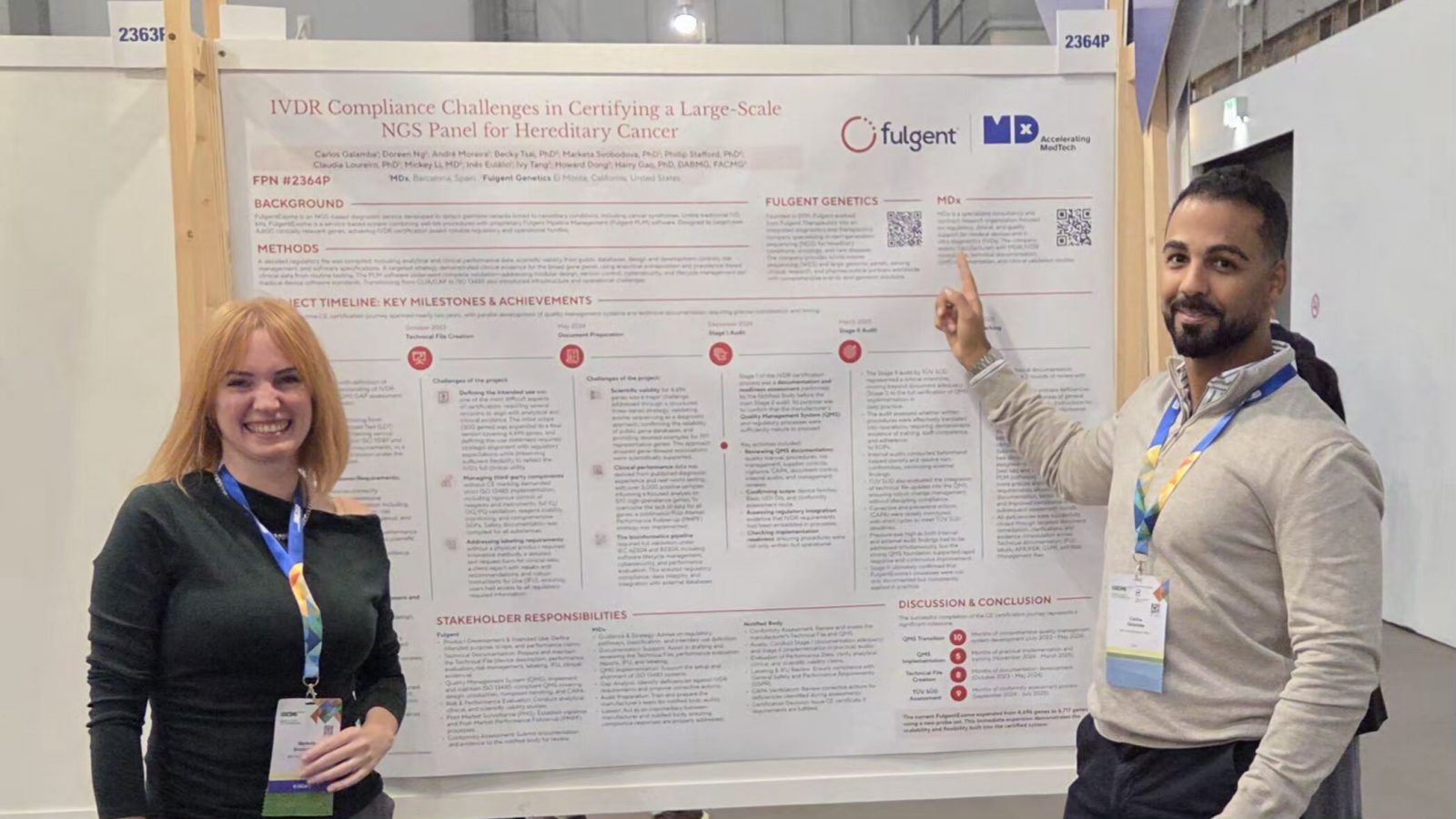
Title: IVDR Compliance Challenges in Certifying a Large‑Scale NGS Panel for Hereditary Cancer

What it covers:

  • Practical blueprint for transitioning a comprehensive, service‑based NGS hereditary cancer panel under IVDR.
  • Defining intended use and scientific validity across a large gene set; end‑to‑end technical documentation; bioinformatics validation aligned to IEC 62304/82304; and notified‑body engagement strategy.
  • Lessons on right‑sizing verification/validation and building a living evidence package to support CE‑marking.

Why it matters: Sponsors and lab developers gain an actionable path for moving complex NGS services to IVDR compliance—without slowing clinical programs.

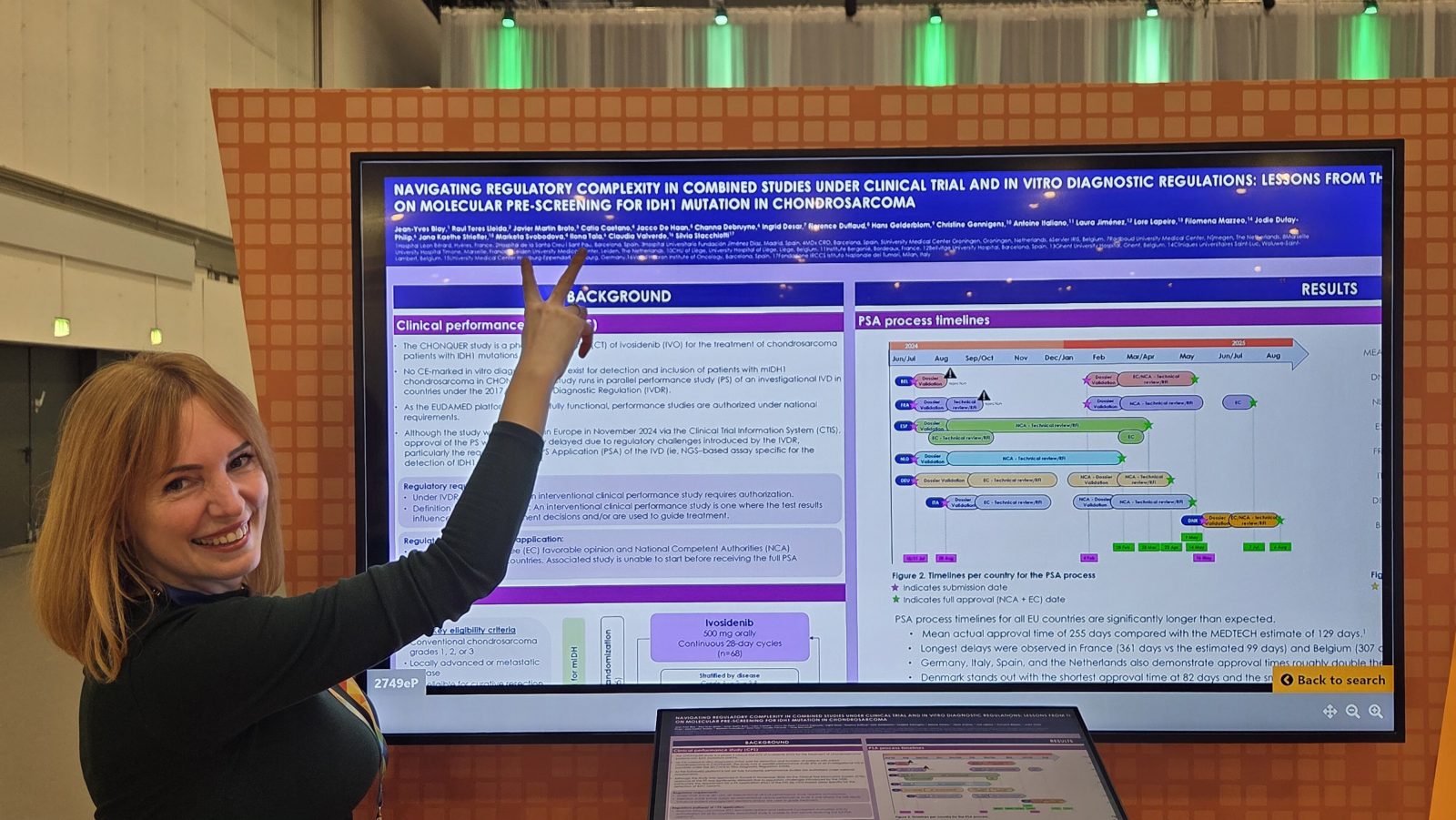
Title: Navigating Regulatory Complexity in Combined Studies under CTR and IVDR (CHONQUER)

What it covers:

  • How combined trials (drug + investigational IVD) trigger dual oversight under CTR and IVDR and the knock‑on effects for timelines, submissions, and site activation across EU member states.
  • Operational patterns that accelerate approvals: early CPS planning, consolidated documentation, and aligned ethics/competent authority strategies.

Why it matters: Oncology sponsors can de‑risk global programs by anticipating IVDR‑specific requirements—and partnering with an IVD CRO that has worked both sides of the fence.

Key takeaways for sponsors

  • IVDR transitions—end to end. MDx CRO supports dossier strategy, clinical performance studies (ISO 20916), scientific validity, and notified‑body engagement for CE‑marking.
  • Combined trials, simplified. We design and run CPS and combined CTR + IVDR studies, harmonizing submissions across multi‑country portfolios.
  • Oncology‑ready operations. Deep experience with molecular prescreening, NGS workflows, and drug–device coordination for precision oncology.

Need a quick debrief? Contact our IVD CRO team for a walkthrough of how these findings translate to your IVDR transition or combined study plan.

FAQs

What does MDx CRO do for IVDR transitions?

We provide end‑to‑end support—from intended‑use definition and scientific validity to clinical performance studies, technical documentation, and notified‑body engagement.

How does MDx CRO support combined CTR + IVDR studies?

We plan and execute CPS and combined trials, consolidating submissions and aligning ethics/competent authority requirements to reduce delays.

Can MDx CRO help with NGS panel validation under IVDR?

Yes. We design right‑sized verification/validation programs and bioinformatics validation aligned with IEC 62304/82304.

Where can I get the ESMO 2025 posters?

Both PDFs are available at the ESMO platform; contact us for a guided readout.

Industry Insights & Regulatory Updates

TGA guidance (Oct 2025): IVD Companion Diagnostics (CDx) Requirements in Australia

What’s new

TGA IVD companion diagnostics requirements are now clearly explained in the Therapeutic Goods Administration’s guidance on IVD companion diagnostics (CDx) in Australia (updated 16 October 2025). Their revised companion diagnostics framework, adds process diagrams, a companion testing plan concept for medicine/biological sponsors, clearer clinical performance expectations, and case studies showing how the pathway works in practice.

This blog post summarises the definition of a CDx, Class 3 IVD classification, ARTG inclusion, companion testing plans, and the TGA CDx List.

What is a CDx under Australian law?

A companion diagnostic is an IVD (commercial or in‑house) that provides information essential for the safe and effective use of a corresponding medicine or biological—for patient selection, risk of serious adverse reactions, or treatment monitoring. To qualify, the test must be referenced in the Product Information (PI) for the medicine or in the Instructions for Use (IFU) of the biological. Tests used only for cell/tissue compatibility are excluded from the CDx definition.

This definition underpins the TGA IVD companion diagnostics requirements for medicines and biologicals that rely on patient selection testing.

Note: The term “a particular medicine or biological” can also cover a class of products with a similar mechanism of action, not only a single named product.

When does an indication require CDx testing?

An indication requires CDx testing when both:

  1. the medicine’s PI (or biological IFU) states that CDx testing is essential, and
  2. the CDx claims it is intended for that testing to enable use of the medicine/biological.
    This may apply to some (not all) indications of a medicine.

To aid transparency, the TGA recommends a PI “flag phrase” indicating that testing is essential and that clinical practice testing should be adequately comparable to the pivotal trial testing; the TGA also publishes a CDx List of approved tests.

How the TGA applies CDx requirements: Class 3 IVDs and ARTG inclusion

  • Classification: Under TGA IVD companion diagnostics requirements, all CDx—commercial and in-house—are Class 3 IVDs (including in‑house CDx).
  • Separate ARTG entries: Each CDx requires its own ARTG inclusion with a Unique Product Identifier (UPI) defined by the manufacturer.
  • Application audit: CDx applications are subject to a mandatory application audit unless supported by specified comparable overseas regulator documentation (e.g., EU IVDR, FDA PMA, PMDA, HSA, Health Canada).
  • Concurrent submissions: While encouraged, concurrent medicine/CDx submissions are not mandatory; however, a CDx application should only be submitted if the corresponding indication is approved or under concurrent review.

From companion testing plans to ARTG submissions, MDx CRO streamlines the end-to-end CDx pathway in Australia, aligning clinical, regulatory, and quality workstreams to the TGA’s expectations.

The companion testing plan (for medicine/biological sponsors)

Every new indication that requires CDx testing must include a companion testing plan (dated and version‑controlled) describing how Australian patients will access at least one adequate test. This is central to meeting TGA IVD companion diagnostics requirements. Four options are available:

  1. Option 1: A commercial CDx ARTG application is planned/underway (provide device submission details and sponsor contact).
  2. Option 2: An in‑house IVD CDx will be accredited under the National Pathology Accreditation Scheme (provide lab details, accreditation timeline, and quality/access reassurances).
  3. Option 3: Standard Australian testing is expected to deliver comparable clinical outcomes to the pivotal trials (provide detailed justification).
  4. Option 4: None of the above—TGA reviews full device data within the medicine dossier (appropriate when no onshore testing is expected).

If Option 4 is used, TGA may add a condition of registration requiring the sponsor to maintain and update the plan (e.g., in case of supply interruption, regulatory action, or material changes to test methodology). Approval of an indication can proceed even when no ARTG‑listed or accredited CDx is available, provided an adequate plan exists; however, a commercial CDx must be in the ARTG (or an in‑house CDx accredited) before supply in Australia.

Clinical trial assay evaluation & comparability

When an indication requires CDx testing, TGA evaluates the clinical trial assay used in the pivotal studies—reviewing scientific validity, analytical performance, clinical performance, and clinical utility. Subsequent CDx must show clinical comparability to the trial assay, typically via concordance and/or bridging studies (or other appropriate evidence) aligned to the trial assay’s core characteristics.

Responsibilities at a glance

Medicine/Biological sponsors must:

  • Use the TGA CDx identification guide to determine if CDx testing is essential.
  • Consider consequences of false positives/negatives, test failures or no result.
  • Include: (a) evidence to support evaluation of the clinical trial assay, and (b) a companion testing plan nominating at least one adequate test.
  • Note: The framework does not require a one‑to‑one link between an indication and a single proprietary CDx; it focuses on the core characteristics of testing.

Device sponsors must:

  • Submit an IVD medical device application for ARTG inclusion of the CDx (indicating the application is for a CDx and providing the UPI).
  • Demonstrate comparability to pivotal trial testing and meet Essential Principles; applications may undergo audit as above.
  • Ensure the corresponding indication is approved or under concurrent review.

In-house IVD CDx, NATA accreditation and NPAAC obligations

Pathology laboratories may develop/modify in‑house tests for use as CDx. Class 1–3 in‑house IVDs are not included in the ARTG, but require NATA accreditation, identification of CDx in the TGA notification test list, and compliance with the NPAAC standard. Under a NATA–TGA MoU, NATA can request TGA technical assistance during evaluation of in‑house CDx performance; TGA is not otherwise involved in the accreditation decision.

TGA CDx List

The TGA publishes a CDx List showing approved commercial CDx linked to corresponding indications (with in‑house CDx to be added). The list is informational (not a regulatory instrument) and may lag recent approvals by up to one month.

Transitional arrangements and change control

  • Transition: CDx previously included in the ARTG as Class 2 or 3 before 1 Feb 2020 (and certain in‑house IVDs) may continue supply until 31 Dec 2028; a new compliant application is required to continue supply thereafter.
  • Changes: Sponsors manage post‑market device changes via the TGA Device Change Request process.

Key takeaways (quick reference)

  • All CDx are Class 3 IVDs and require separate ARTG inclusion (commercial) or NATA accreditation (in‑house).
  • Every relevant medicine/biological indication must include a companion testing plan (Options 1–4).
  • TGA assesses the clinical trial assay and expects comparability evidence for subsequent CDx.
  • Approval can proceed without on‑shore CDx if a robust plan exists, but supply requires ARTG inclusion or in‑house accreditation.

FAQs

Are all CDx Class 3 IVDs in Australia?

Yes. The regulations specify all CDx (commercial and in‑house) are Class 3 IVDs.

Can an indication be approved if no Australian CDx is available yet?

Yes—if a suitable companion testing plan is in place; however, a commercial CDx must be in the ARTG (or an in‑house CDx accredited) before legal supply.

What goes into a companion testing plan?

Identify at least one adequate test and choose Option 1–4 with supporting details (e.g., ARTG application in progress, in‑house accreditation, justification that standard testing is adequate, or full device data reviewed within the medicine dossier).

Will the PI show that CDx testing is essential?

The TGA recommends a PI “flag phrase” indicating testing is essential and should be comparable to trial testing; approved tests appear on the TGA CDx List.

Written by:
Carlos Galamba

Carlos Galamba

CEO

Senior regulatory leader and advisor to top 10 global precision medicine companies with deep experience in high-risk IVDs including companion diagnostics.
Industry Insights & Regulatory Updates

Companion Diagnostic Clinical Trial Case Study

Regulatory Turnaround for a Phase 3 Global CDx Clinical Trial (Annex XIV)

A global biopharma company faced a critical delay in a phase 3 clinical trial in oncology. The study required an NGS-based companion diagnostic (CDx) assay to detect a specific mutation and pre-screen patients for eligibility. Several EU authorities initially rejected or stalled the Clinical Performance Study (CPS/PSA) due to assay validation concerns and fragmented IVDR processes. MDx CRO mobilized a specialized cross-functional team, redesigned the documentation package, and re-submitted in six EU countries within three months, clearing all RFIs and enabling on-time trial initiation. This case study has been accepted for presentation at ESMO 2025 in Berlin.

The Challenge

  • Early rejection and major RFIs: EU bodies questioned assay validation and risk management, threatening the trial start.
  • Dual-regulation complexity: The trial combined CT and IVDR CPS submissions with different national portals, templates, and timelines.
  • Harmonization gaps: With EUDAMED not fully operational, CPS authorizations varied widely by Member State, creating long and unpredictable timelines.

What was at stake: lost recruitment windows, protocol amendments, cost escalation, and missed milestones tied to major scientific congresses.

MDx CRO Approach

1) Rapid diagnostic and plan

  • Completed a 48-hour gap analysis across the submission: CDx protocol, analytical performance package, CER/PER linkages, IFU, training, and risk files.
  • Mapped country-specific expectations (EC vs NCA) to pre-empt common RFIs: informed consent, site/PI suitability, device training, and performance datasets.

2) Targeted re-engineering

  • Revised the clinical performance study protocol (CPSP) for the CDx assay to clarify endpoints, eligibility flows, and pre-screening logistics.
  • Overhauled analytical performance evidence (accuracy, precision, LoD, reproducibility) and tightened traceability to risk controls.
  • Redeveloped risk management documentation to align hazards, mitigations, and verification with Annex I GSPRs.
  • Strengthened usability & training to address EC concerns on user competence and patient protection.

3) Country-by-country execution

  • Sequenced six EU CPS submissions to match national review modalities (combined, parallel, or sequential EC/NCA), reducing idle time between waves.
  • Built a rapid RFI response playbook so sponsors and sites could respond in days, not weeks.

Results & Impact

  • All RFIs resolved: Delivered clear, evidence-backed answers across EC and NCA questions, including consent, site suitability, training, and performance data.
  • Approvals secured quickly: The re-submission strategy compressed timelines and returned the program to the original start path despite EU-wide CPS delays.
  • Trial initiation preserved: Sites opened on schedule, enabling screening with the NGS CDx pre-screen.
  • Scientific visibility: Study learnings and regulatory insights are accepted for presentation at ESMO 2025, showcasing efficient navigation of combined CT/IVDR frameworks.

Why It Matters

The IVDR raised the bar for pre-market CDx and investigational IVDs used in drug trials. Sponsors now need diagnostic-grade evidence, strong risk-benefit narratives, and country-aware submission execution. MDx CRO bridges those gaps with integrated clinical, regulatory, and diagnostics expertise so drug–diagnostic programs stay on track.

What We Delivered

  • Regulatory rescue for a phase 3 global CDx trial in oncology (Annex XIV).
  • Six-country CPS re-submission under IVDR with country-specific strategies.
  • Protocol refinement for CDx use, analytical performance reinforcement, and risk-file re-mapping to GSPRs.
  • RFI playbook & rapid responses covering EC and NCA priorities (consent, training, site suitability; analytical/clinical evidence, CPS plan).
  • On-time site activation and screening with an NGS CDx assay.

Client Outcome

“MDx CRO restored regulatory confidence and protected our timelines. Their team aligned clinical, diagnostic, and regulatory workstreams and cleared every RFI with precision.”

Ready to Accelerate Your CDx Trial?

Running an EU drug–diagnostic study under IVDR? We can accelerate CPS authorizations, clear RFIs fast, and keep your trial on schedule.

Industry Insights & Regulatory Updates

MDx to Present ESMO 2025 Poster on IVDR CE Marking for Large Germline NGS Panels

Announcement

MDx will present a peer-reviewed poster at the ESMO Congress 2025 in Berlin detailing how our team helped secure IVDR CE marking for a large, service-based germline NGS solution that integrates wet-lab workflows with a validated bioinformatics pipeline. The poster distills a practical, audit-proven pathway that labs and IVD developers can apply when scaling evidence, validating software, and navigating notified-body reviews for complex NGS offerings.

What the poster covers

  • Regulatory strategy and intended use: How to right-size scope for very large panels while planning for future expansion.
  • Technical documentation: Building Annex II/III files that stand up to Stage I/II audits, including labeling/IFU for service-based models.
  • Software validation: Applying IEC 62304/82304 rigor to a bioinformatics pipeline (architecture, V&V, cybersecurity, change control).
  • Evidence at scale: A tiered approach to scientific validity and clinical performance, plus a pragmatic PMPF plan to mature low-prevalence evidence.
  • Operationalization: Supplier controls, change management, and QMS integration to sustain post-market scalability.
Fulgent and MDx ESMO 2025 poster about Certifying Large-Scale NGS panels for hereditary cancer

Why this matters

Large NGS panels pose unique IVDR hurdles: non-uniform clinical evidence across thousands of genes, evolving variant knowledge, third-party components without CE marking, and the need to validate bioinformatics as SaMD. By sharing a repeatable pathway and the pitfalls we overcame, this poster offers concrete guidance to shorten timelines without compromising quality or compliance.

When and where to find us

ESMO Congress 2025 takes place 17–21 October in Berlin, Germany. We will publish our poster board number and presentation time here as soon as the session logistics are confirmed by the organizers. If you’re attending, we’d love to meet to discuss your IVDR roadmap.

Read the background

For context on the underlying program and its market impact, explore the public write-ups:

Ready to talk IVDR CE marking for your NGS product?

Use our contact form to request a 30-minute slot with our regulatory and bioinformatics leads during ESMO 2025, or schedule a virtual follow-up the week after the congress.

Industry Insights & Regulatory Updates

IVDR CE marking NGS: MDx Case Study with Fulgent

IVDR CE marking NGS at a glance

  • Outcome: CE mark granted by TÜV SÜD for an end-to-end Class C germline NGS solution (wet lab + bioinformatics).
  • Scope: Furthermore, panel covering 4,600+ clinically relevant genes with a validated PLM (Pipeline Manager) software component; later expanded to >7,000 genes using a new probe set.
  • What we did: Specifically, we built an ISO 13485 QMS from the ground up, prepared full Annex II + III technical documentation, validated bioinformatics under IEC 62304/82304, split documentation into two Basic UDI-DIs (wet lab vs. software), and guided Stage I/II audits.
  • Why it matters: Ultimately, this demonstrates a repeatable pathway to IVDR certification for large NGS services and software, something that hadno clear precedent.

Read the announcements: For details, read the Fulgent press release and Citeline case study.

0+

Genes Certified

Class C

IVDR Classification

0 mo

To CE Mark

0+

Post-Cert Scale

The challenge: certifying a service-based, large-scale NGS system under IVDR

To begin with, FulgentExome is a service-based NGS solution that integrates wet-lab workflows with the Fulgent PLM bioinformatics pipeline. As a result, pursuing IVDR certification meant converting a mature CLIA/CAP testing service into a CE-marked IVD system with robust evidence across scientific validity, analytical performance, and clinical performance, for thousands of genes. In particular, key hurdles included: defining intended use at scale; validating third-party components; proving scientific validity across 4,600+ genes; above all fully validating the bioinformatics pipeline under medical device software standards.

MDx approach: a playbook for complex NGS + software

1) Build the right QMS, fast

First, we performed an IVDR GAP assessment. Next, we designed and implemented an ISO 13485-compliant QMS with risk management, supplier control, document control, internal audits, and management review—migrating from a CLIA/CAP model to IVDR-ready operations.

2) Engineer a defensible intended use

Meanwhile, the intended-use statement evolved iteratively, from an initial ~300-gene scope to whole-exome, finally landing on 4,600+ genes aligned to available clinical and analytical evidence. In the end, the final language was future-proofed to support rapid updates as evidence expands.

3) Split wet lab and software into two regulated products

Afterward, following round 1 review feedback, we separated the documentation into two Basic UDI-DIs, FulgentExome (wet lab) and Fulgent PLM (software) to align with IVDR expectations for traceability and lifecycle control. Consequently, this restructuring sharpened conformity assessment and accelerated subsequent approvals.

4) Validate the informatics stack like a medical device

In parallel, we validated PLM under IEC 62304/82304, including architecture, version control, cybersecurity, verification/validation, and integration with external databases. Therefore, the result was a fully evidence-backed bioinformatics pipeline capable of reproducible, high-confidence variant calling and reporting.

5) Make “evidence at scale” practical

  • First, Scientific validity: Three-tier strategy combining validation of exome sequencing as an approach, reliance on curated public databases, and deep exemplars for a large subset of genes.
  • Second, Clinical performance: Leveraged routine testing experience (thousands of positives) to focus clinical evidence on high-prevalence genes, and instituted a robust PMPF strategy to continuously strengthen low-prevalence areas.

6) Orchestrate TÜV SÜD audits to success

  • Initially, Stage I confirmed documentation readiness, scope, Basic UDI-DIs and integration of IVDR processes into daily practice.
  • Subsequently, Stage II verified on-the-floor implementation of SOPs, training, competence, CAPA and change control—closing findings on short cycles to hit NB timelines.

Results that move the market

  • CE mark granted for FulgentExome & Fulgent PLM, among the first end-to-end Class C germline NGS solutions under IVDR.
  • Certified scope covers 4,600+ genes, positioning Fulgent as a reference lab for comprehensive hereditary disease testing serving European patients.
  • Post-certification, the platform scaled to >7,000 genes using a new probe set, demonstrating the inherent scalability built into the certified system (process, documentation, and change control).
  • Strengthened competitive standing in the EU diagnostics market; public communications highlight the magnitude of this achievement for large NGS panels.

Read more in the Fulgent press release and Citeline’s in-depth article.

What this means for labs and IVD developers planning large NGS submissions

If you operate an LDT today: you’ll need to translate CLIA/15189 practices into an ISO 13485 framework, document design controls, and produce a full PER (PEP/PER), APR, SVR, PMS/PMPF, SSP, and labeling/IFU aligned to GSPR. Expect to validate any bioinformatics pipeline as SaMD with IEC 62304/82304 and cybersecurity controls.

If your panel is “large”: you likely won’t have uniform clinical data across every gene. A structured tiered evidence model + PMPF can satisfy Notified Bodies while keeping your roadmap scalable.

If you combine wet lab + software: plan for separate Basic UDI-DIs and documentation sets. Treat the pipeline as a product with its own requirements, verification, and risk controls.

Why MDx

  • End-to-end IVDR expertise: From regulatory strategy & classification to Annex II/III technical files, PER/SVR/APR, training, and mock NB reviews. Read more about our NGS regulatory services.
  • Clinical performance studies: We design, run, and report ISO 20916 studies (protocols, eTMF, monitoring, biostats, PER alignment), and we can act as delegated sponsor for multi-country submissions—100% submission success rate to date.
  • Operational scale: ISO 9001 clinical QMS, EU/US partner network, multilingual CRAs, and a repeatable process honed on 60+ performance study submissions for top IVD and pharma clients.

Project timeline

Our joint project with Fulgent spanned July 2023–July 2025, with overlapping tracks for QMS creation, technical documentation, NB review, and Stage I/II audits, a coordinated plan that allowed rapid closure of findings and post-certification scaling.

Client perspective

The program demanded evening/weekend execution across regulatory, documentation, and project management to meet Notified Body timelines, effort that, in the client’s words, made all the difference in achieving what initially “seemed almost impossible.

Planning IVDR for your NGS panel? Here’s a quick readiness checklist

  • Intended use aligned to evidence (and future updates)
  • ISO 13485 QMS with software lifecycle integration
  • PER (PEP/PER), SVR, APR mapped to gene-level strategy
  • PLM/DR pipeline validated per IEC 62304/82304 (+cybersecurity)
  • Separate documentation/UDI for wet lab vs. software (if applicable)
  • PMS/PMPF plan to mature low-prevalence evidence post-market
  • Mock NB review + Stage I/II audit readiness

(Our team can lead or co-author each artifact above.)

Talk to us

Whether you’re certifying a focused oncology panel or pushing the limits with exome-scale content, MDx brings the cross-functional regulatory, clinical, quality, and software depth to make it possible—on a timeline that keeps your business competitive.

How long does IVDR CE marking take for an NGS panel?

For a large, complex NGS panel (thousands of genes, wet lab + bioinformatics software), expect 18 to 24 months from project kickoff to CE mark, assuming you need to build a QMS from scratch. If you already have an ISO 13485-certified QMS and partial technical documentation, the timeline can shorten to 12 to 16 months. The main variables are: the scope of the panel (more genes = more validation work), whether the bioinformatics pipeline needs IEC 62304 validation from zero, Notified Body capacity and review cycles, and the maturity of your clinical evidence. In the Fulgent case, the full project spanned 24 months (July 2023 to July 2025), including QMS creation, full Annex II/III technical documentation, and TÜV SÜD Stage I and Stage II audits.

What IVDR class are NGS diagnostic panels?

Most NGS-based IVDs classify as IVDR Class C under Annex VIII classification rules, because they typically provide information used to determine patient predisposition or individual risk for serious conditions (e.g., hereditary cancer panels, germline disease testing). NGS panels intended for infectious disease detection with high public health risk (e.g., HIV, hepatitis) may classify as Class D. Companion diagnostic NGS panels co-developed with a therapeutic product also typically fall under Class C. Classification depends on the specific intended use and clinical claims, not the technology itself. All Class C and D IVDs require Notified Body conformity assessment.

Do you need separate UDI identifiers for NGS software under IVDR?

Yes, when the bioinformatics pipeline qualifies as standalone software (SaMD) or is a distinct regulated component, IVDR requires a separate Basic UDI-DI. In the Fulgent case, MDx split the documentation into two Basic UDI-DIs: one for FulgentExome (the wet-lab component) and one for Fulgent PLM (the bioinformatics pipeline). This separation aligns with IVDR expectations for traceability, lifecycle control, and independent conformity assessment. Each Basic UDI-DI has its own technical documentation, risk management file, and performance evaluation. This approach also makes post-market updates easier, a software update does not trigger re-review of the entire wet-lab documentation.

Can a CLIA/CAP-accredited laboratory use its existing QMS for IVDR CE marking?

No, CLIA/CAP accreditation and ISO 15189 certification are not equivalent to ISO 13485, which is the QMS standard required for IVDR CE marking. While CLIA/CAP provides a strong operational foundation (proficiency testing, personnel qualifications, quality control), it does not cover medical device design controls, supplier management, CAPA, post-market surveillance, or the device lifecycle documentation that IVDR demands. Laboratories transitioning from CLIA/CAP to IVDR must implement an ISO 13485-compliant QMS and document design inputs, outputs, verification, validation, and change control for each IVD product.

What is the tiered evidence strategy for scientific validity of large NGS panels?

For panels targeting thousands of genes, it is typically not feasible to generate individual clinical evidence for every gene-disease association. A tiered approach addresses this: Tier 1 validates the underlying sequencing technology (e.g., exome sequencing as a methodology) with evidence from published literature and peer-reviewed validation studies. Tier 2 relies on curated public databases such as ClinVar, OMIM, and HGMD to establish gene-disease associations at scale. Tier 3 provides deep exemplar evidence (including analytical and clinical performance data) for a representative subset of high-prevalence genes. Genes with limited data are supported through a Post-Market Performance Follow-up (PMPF) plan that progressively strengthens evidence after CE marking. This strategy was accepted by TÜV SÜD in the Fulgent certification.

Written by:
Carlos Galamba

Carlos Galamba

CEO

Senior regulatory leader and former BSI IVDR reviewer with deep experience in CE marking high-risk IVDs, companion diagnostics, and IVDR implementation.
Industry Insights & Regulatory Updates

IVDR Transition for Precision Medicine: How MDx CRO Enabled a Seamless Portfolio Upgrade

Introduction to IVDR Transition for Precision Medicine

IVDR transition for precision medicine programs can stall when portfolios span liquid biopsy, RNA-based sequencing, and comprehensive tumor profiling. A leading US-based precision medicine company asked MDx CRO to migrate its oncology diagnostics from self-declared IVDD and FDA pathways to full IVDR certification—without disrupting European market access. This blog shares how we planned the transition, selected the right Notified Body, rebuilt regulatory files, and safeguarded ongoing clinical and CDx development in Europe.

The Challenge and how MDx CRO Enables a Seamless Portfolio Upgrade

  • Convert complex files from FDA/IVDD to IVDR. Multiple assay types (liquid biopsy, RNA-seq, tumor profiling) required re-evidence and restructuring under IVDR Annexes.
  • Select the optimal Notified Body. The client needed a partner capable of reviewing a diverse portfolio efficiently and cost-effectively.
  • Regulatory documentation lift. We had to redevelop key documents: analytical & clinical performance (including CPS reports), risk and design files, and labeling—while maintaining business continuity.

MDx CRO’s Approach to IVDR Transition

1) Strategic IVDR roadmap and portfolio triage

We assessed intended purpose, risk class, and evidence gaps for each product, then prioritized quick-win files to protect revenue while scheduling deeper re-verification work for complex assays. This created a clear IVDR transition for precision medicine timeline across the portfolio.

2) Notified Body strategy

Leveraging our knowledge of NB capacity and focus areas, we strategically selected a Notified Body that balanced approval probability, cost, and credibility. Early technical consultations reduced surprises and kept reviews on track.

3) Robust regulatory files

We generated comprehensive IVDR documentation:

  • Analytical and clinical performance reports, including scientific validity and performance evaluation reports
  • Risk management aligned to Annex I GSPRs
  • Design and development files with clear traceability
  • Usability and labeling aligned with intended purpose and user context

4) Operational partnership and sponsor duties

The client expanded our role into delegated sponsor responsibilities for clinical studies. We served as EU Legal Representative, oversaw clinical operations, and implemented streamlined processes for biomarker and CDx study submissions across Europe.

Results

  • Successful IVDR transition for priority diagnostics with uninterrupted market access in Europe.
  • Competitive advantage: stronger operational readiness helped the client attract pharma partners for clinical trial biomarker testing and CDx development.
  • Ongoing partnership: MDx CRO manages clinical studies, maintains sponsor duties, and continues the portfolio-wide IVDR journey.

Client Testimonial

“Working with MDx’s Precision Medicine Team has been a pleasure. As a U.S.-based company operating in Europe, I consider them our EU extension. Their expertise and responsiveness keep us ahead in a dynamic market, and the consistency of their delivery has shaped our current and future plans.”

Why This Matters

IVDR raises expectations for evidence, documentation, and lifecycle controls—especially for precision medicine diagnostics. Success requires portfolio triage, NB strategy, and regulatory files that stand up to scrutiny while your teams continue running trials and supporting pharma partnerships. MDx CRO brings integrated regulatory, clinical, and diagnostic know-how to keep your transition moving.

Planning an IVDR transition for precision medicine diagnostics? Let’s protect your market access, cut RFI cycles, and ready your files for Notified Body review.

Industry Insights & Regulatory Updates

IVDR for NGS Assays: 7 Key Compliance Challenges (and How to Solve Them)

TL;DR | What You Need to Know

NGS-based IVDs face unique IVDR compliance challenges, from validating bioinformatics pipelines under IEC 62304 to demonstrating scientific validity across thousands of genes. Most NGS assays classify as IVDR Class C or D, requiring Notified Body review, comprehensive performance evaluation, and lifecycle documentation. This article covers the 7 critical challenges and practical solutions, informed by MDx’s experience CE-marking one of the world’s first 4,600+ gene panels under IVDR.

Next-Generation Sequencing (NGS) has revolutionized molecular diagnostics by enabling simultaneous analysis of hundreds or thousands of genes across diverse clinical applications. These include germline testing for hereditary disorders, somatic mutation profiling in oncology, infectious disease characterization, and transcriptomic gene expression analysis.

A particularly impactful advancement is liquid-biopsy NGS, which allows non-invasive detection of tumor-derived nucleic acids, such as circulating tumor DNA (ctDNA) or RNA, from blood or other bodily fluids. This method now supports cancer screening, minimal residual disease monitoring, and therapy stratification.

NGS also powers Comprehensive Genomic Profiling (CGP). These assays assess a wide spectrum of biomarkers, single nucleotide variants (SNVs), insertions and deletions (indels), copy number alterations (CNAs), copy number losses (CNLs), gene fusions, and splicing events, across large panels in a single run. Many workflows also integrate microsatellite instability (MSI) and tumor mutational burden (TMB).

Assays can range from targeted panels to whole exome sequencing (WES) or whole genome sequencing (WGS). Each format carries unique validation needs and bioinformatics requirements. The mix of technologies, analytes, sample types (e.g., blood, plasma, FFPE, cfDNA, RNA), and clinical contexts increases regulatory complexity.

Under the EU In Vitro Diagnostic Regulation (IVDR; EU 2017/746), you must define each intended use clearly and support it with comprehensive evidence of scientific validity, analytical performance, and clinical performance. That requirement calls for a holistic, coordinated validation and documentation strategy.

For CE-marking manufacturers and clinical laboratories operating under Article 5(5), IVDR demands structured validation, clear documentation, and lifecycle management. For NGS-based assays, compliance becomes even more demanding due to scientific, technical, and operational intricacies.

Key Challenges in IVDR Compliance for NGS

1) Complex Gene Panels & Variant Diversity

NGS panels often include multiple genes and variant types, each with distinct performance characteristics. You must demonstrate analytical performance—sensitivity, specificity, LoD, and robustness—per variant class. This tailoring increases the scale and complexity of testing.

2) Defining a Clear Intended Use

A precise, testable intended purpose statement anchors the program. Define analytes, clinical context, sample types, output format, and role in patient care. Any ambiguity risks misclassification or validation gaps.

3) Scientific Validity Across Many Analytes and Conditions

Establishing scientific validity grows challenging when one test targets dozens or hundreds of genes. Under IVDR, link each analyte to a clinically relevant condition. That linkage often requires extensive literature review, database referencing, and written justification for inclusion.

4) Clinical Performance Evidence

With broad genomic scope, comprehensive clinical studies may be infeasible. A pragmatic approach combines routine diagnostic data, published literature, and a clear link to Post-Market Performance Follow-up (PMPF) plans to support claims over time.

5) Complex Bioinformatics Pipelines

Bioinformatics sits at the core of NGS diagnostics. Validate every step—from base calling to variant annotation. Implement version control, clear revalidation triggers, and change management to maintain consistent performance after software updates.

6) Use of Third-Party Reagents and Instruments

NGS workflows often incorporate off-the-shelf reagents and platforms not originally CE-marked as part of the IVD system. Document compatibility, performance, and traceability of third-party components to meet IVDR expectations.

7) Labelling Without a Physical Device

Many NGS assays function as software-driven services or LDTs without a packaged device. You still must meet Annex I labelling and Instructions for Use (IFU) requirements—even without physical labels or packaging.

How MDx CRO Supports Your IVDR Journey

MDx CRO brings specialized expertise to guide NGS programs through IVDR across the full lifecycle:

  • Gap Assessments: Identify regulatory shortfalls and prioritize remediation.
  • Performance Evaluation Plan (PEP): Craft PEPs that balance analytical rigor with operational feasibility.
  • Analytical Study Oversight: Design statistically robust studies tailored to complex panels.
  • Bioinformatics Validation: Map and validate each software component under IEC 62304 and ISO 13485.
  • QMS Integration: Build audit-ready documentation, risk management, and traceability.
  • PMS & PMPF Strategies: Establish real-world evidence systems that sustain compliance and support clinical claims.

Frequently Asked Questions

What IVDR class are NGS-based diagnostic tests?

Most NGS-based diagnostic tests fall into IVDR Class C because they typically provide high-risk individual patient information (e.g., germline disease or somatic mutation profiling). NGS assays used for infectious disease with high public health risk may classify as Class D. Classification depends on the specific intended use, clinical claims, and risk profile of each test.

How do you validate an NGS bioinformatics pipeline for IVDR compliance?

Under IVDR, bioinformatics pipelines must be validated as medical device software following IEC 62304 and IEC 82304-1. This includes documenting the software architecture, implementing version control and change management, verifying variant calling accuracy at each step (base calling, alignment, variant annotation), and establishing revalidation triggers for software updates. Risk management per ISO 14971 must also be integrated into the software lifecycle.

How do you demonstrate scientific validity for a large NGS gene panel under IVDR?

For large panels covering hundreds or thousands of genes, a tiered evidence strategy is recommended. This combines validation of exome sequencing as a methodology, reliance on curated public databases (e.g., ClinVar, OMIM) for gene-disease associations, and deep exemplar evidence for high-prevalence genes. Low-prevalence genes are supported through a structured Post-Market Performance Follow-up (PMPF) plan that matures evidence over time.

Do clinical laboratories running NGS LDTs need to comply with IVDR?

Yes. Under IVDR Article 5(5), EU health institutions manufacturing and using in-house IVDs (including NGS-based laboratory-developed tests) must meet six specific conditions: justification that no equivalent CE-marked device meets patient needs, ISO 15189-compliant QMS, alignment with IVDR General Safety and Performance Requirements, documentation of design and manufacture, and publication of a public declaration. Laboratories that cannot meet these conditions must pursue CE marking.

What are the biggest challenges in achieving IVDR compliance for NGS assays?

The seven key challenges are: (1) demonstrating analytical performance across complex gene panels and diverse variant types, (2) defining a precise intended use statement, (3) establishing scientific validity across many analytes, (4) generating clinical performance evidence at scale, (5) validating bioinformatics pipelines as medical device software, (6) documenting third-party reagents and instruments not originally CE-marked, and (7) meeting IVDR labelling requirements for software-based or service-based assays without a physical device.”

Conclusion

Achieving IVDR compliance for NGS assays poses a multi-dimensional challenge that blends regulatory discipline with scientific depth. From defining intended use to managing software changes and clinical claims, every step benefits from clarity, structure, and foresight.

MDx CRO partners with diagnostics developers and clinical laboratories to turn regulatory complexity into actionable validation strategies, accelerating time to market while protecting long-term compliance and patient safety.

Related Reading

Written by:
Marketa Svobodova, PhD

Marketa Svobodova, PhD

Regulatory Director, Precision Medicine

Expert in Precision Medicine, NGS & CDx, combining technical and regulatory expertise to guide IVDs through CE certification.
Industry Insights & Regulatory Updates

MDx CRO co-authors Journal of Liquid Biopsy paper on EU–US collaboration for IVDR-ready liquid biopsy validation

MDx CRO is proud to have contributed to the peer-reviewed article, “BLOODPAC’s collaborations with European Union liquid biopsy initiatives,” published in The Journal of Liquid Biopsy (Vol. 10, Article 100321; open access). The paper outlines practical pathways to align analytical validation, clinical performance evidence, and data standards that can accelerate European adoption of liquid biopsy under IVDR.

Carlos Galamba (CEO, MDx CRO) is listed among the authors, contributing European IVDR and clinical evidence expertise to this multi-stakeholder effort.

What the paper delivers (and why it matters)

  • Convergence on validation & evidence: It maps BLOODPAC’s US-developed minimum technical data elements and analytical validation protocols to EU needs—supporting more consistent clinical performance packages for IVDR submissions.
  • Data standards for reproducibility: The paper emphasizes fit-for-purpose standards and pre-competitive data sharing to improve comparability across clinical research for liquid biopsy, from cfDNA/ctDNA assay development to clinical use.
  • Practical EU–US collaboration: It proposes guidance and collaboration routes that can reduce variability across Member States and shorten time to patient access—without compromising IVDR rigor.

A broad coalition behind the work

The author affiliations span leading precision-medicine organizations and networks, including MDx CRO, Labcorp, Tempus AI, Natera, Exact Sciences, AstraZeneca, GSK, Bristol Myers Squibb, Johnson & Johnson, MSD, Thermo Fisher Scientific, TECAN, IQN Path, ELBS, EUCOPE, ISLB, Cancer Patients Europe, and BLOODPAC—a clear reflection of the field’s momentum toward shared, usable guidance.

MDx CRO’s contribution and perspective

Through our CEO, Carlos Galamba, MDx CRO contributed to this multi-stakeholder paper outlining practical EU–US collaboration to accelerate liquid biopsy adoption under IVDR. Our perspective aligns with the paper’s focus on:

  • IVDR-first evidence architecture that cleanly links intended use → analytical validation → clinical performance requirements for ctDNA/cfDNA assays.
  • Harmonized validation expectations by mapping BLOODPAC frameworks and data elements to EU evidence needs, supporting consistent submissions.
  • Clearer regulatory narratives that connect validation outcomes to performance claims and real-world clinical implementation.

“This contribution reflects MDx’s commitment to turning shared frameworks into credible, IVDR-ready evidence that speeds responsible patient access” – Carlos Galamba, CEO

For IVD developers: immediate takeaways

Think trans-Atlantic. Where appropriate, re-use US learnings and BLOODPAC frameworks to reduce duplication—while meeting EU requirements.

Design for IVDR from day zero. Lock pre-analytical variables and analytical validation plans that ladder to clinical performance claims.

Adopt shared data elements. Standardized data models future-proof submissions and enable cross-study comparisons for regulators and payers.

How we execute: turning frameworks into IVDR-ready evidence

1) Study architecture (IVDR-first)

We design from intended use → analytical validationclinical performance so claims, endpoints, and statistics line up from day one. For liquid biopsy (cfDNA/ctDNA), we predefine fit-for-purpose metrics (e.g., LoD/LoQ, precision, interference) and clinical endpoints (e.g., PPA/NPA, sensitivity/specificity).

2) Multisite execution (ISO 20916 aligned)

Feasibility and qualification of sites/labs, standardized pre-analytical controls (collection tubes, processing windows, storage), specimen logistics and chain-of-custody, risk-based monitoring, and documented deviation/CAPA management across centers.

3) Data you can trust (eCRF + eTMF)

We build validated eCRFs, enforce edit checks and audit trails, and maintain a complete eTMF/regulatory binder. Data dictionaries align with study objectives and, where appropriate, community data elements used in clinical research for liquid biopsy.

4) Analytical validation to clinical performance—without gaps

We run or coordinate liquid biopsy validation workstreams (method comparisons, reproducibility, cross-site concordance) and transition seamlessly into clinical performance studies so the evidence package is coherent under IVDR.

5) Reporting & regulatory narrative

IVDR-compliant documentation (Analytical Performance Report, Performance Evaluation Plan/Report, study reports), plus clear narratives that connect results to performance claims and labeling.

6) Governance & quality

Project governance with milestone dashboards, risk logs, vendor oversight, and audit-ready files under an ISO-driven clinical QMS.

Outcome: faster, cleaner submissions for IVDR liquid biopsy validation—and evidence that stands up to scrutiny.

Plan a study? Let’s map your assay’s intended use to the analytical validation and clinical performance evidence you’ll need.

Industry Insights & Regulatory Updates

COMBINE Programme: Streamlining EU Combined Studies for Medicines, Devices, and Diagnostics

Introduction to the COMBINE Programme

The European Union has taken a significant step towards streamlining combined studies involving medicinal products, medical devices, and in vitro diagnostics (IVDs) through the COMBINE Programme. Endorsed by national authorities across Member States, the programme aims to address long-standing challenges that hinder the efficiency of clinical trials and regulatory approvals under the Clinical Trials Regulation (CTR), Medical Device Regulation (MDR), and In Vitro Diagnostic Regulation (IVDR).

The Need for Streamlined Combined Studies

Combined studies, which investigate the use of multiple healthcare products—such as a medicinal product with a medical device or companion diagnostic—are essential for advancing patient care and supporting innovative treatments. However, the fragmented regulatory processes across the CTR, MDR, and IVDR create significant hurdles:

  • Administrative Complexity: Sponsors face parallel and often redundant assessment processes across Member States, leading to delays.
  • Ambiguities in Regulation: Overlapping requirements on reporting and classification of studies often result in confusion.
  • Harmonisation Gaps: Diverging approaches among national competent authorities slow down multi-country studies.

These challenges risk delaying the development and availability of critical healthcare solutions, impacting patients and stifling innovation.

The COMBINE Programme: A Collaborative EU Initiative

To overcome these challenges, the European Commission launched the COMBINE Programme, a cross-sector initiative designed to foster collaboration between regulatory authorities, ethics committees, and stakeholders. By unifying processes and addressing gaps at the interface of CTR, MDR, and IVDR, the COMBINE Programme sets out to:

  1. Simplify and harmonise the approval of combined studies across the EU.
  2. Improve collaboration between national competent authorities, the European Medicines Agency (EMA), ethics committees, and sponsors.
  3. Enhance Europe’s competitiveness in clinical research, aligning with the recommendations of the Draghi Report.

A Phased Approach to Change

The COMBINE Programme will be implemented over the coming years through seven cross-sector projects that focus on key areas such as piloting single assessment processes, harmonising serious adverse event (SAE) reporting, and enhancing advisory services for sponsors. The programme reflects a shared commitment to supporting innovation while ensuring patient safety and regulatory efficiency across the EU.

The Seven Cross-Sector Projects of the COMBINE Programme

The COMBINE Programme will be implemented through seven cross-sector projects, each addressing specific challenges in the regulatory landscape of combined studies. These projects represent a collaborative effort between national competent authorities, ethics committees, the European Medicines Agency (EMA), and other stakeholders to streamline processes, harmonise reporting, and improve advisory services for sponsors.

1. Piloting a Single Assessment Process for Multi-Country Combined Studies

  • Objective: Introduce a coordinated, unified assessment process for combined studies involving medicinal products, medical devices, and in vitro diagnostics across multiple EU Member States.
  • Why It Matters: Current processes require separate national submissions under different frameworks (CTR, MDR, and IVDR). This pilot project aims to reduce duplication, align timelines, and ensure a single, streamlined review process.
  • Outcome: A harmonised approach that accelerates study approvals, reduces administrative burden, and improves efficiency for sponsors conducting multinational combined studies.

2. Harmonisation of Serious Adverse Event (SAE) Reporting Processes

  • Objective: Align the reporting requirements for Serious Adverse Events (SAEs) across the CTR, MDR, and IVDR frameworks.
  • Challenges Addressed: SAEs are reported differently under each regulation, creating confusion and inefficiencies for sponsors and regulators. Lack of harmonised processes delays decision-making and impacts patient safety monitoring.
  • Outcome: A unified, consistent SAE reporting process that improves clarity, facilitates timely reporting, and ensures compliance across sectors.

3. Clarifying the Interface Between Clinical Trials and Medical Device Regulations

  • Objective: Resolve regulatory ambiguities where the Clinical Trials Regulation (CTR) intersects with the Medical Device Regulation (MDR) and IVD Regulation (IVDR).
  • Key Questions Addressed: When does a study require a Clinical Trial (CT), a Clinical Investigation (CI), or a Performance Study (PS)? How should combined studies be classified and approved under multiple regulatory frameworks?
  • Outcome: Clear, harmonised guidelines for sponsors and regulators to navigate the interface between these regulations, ensuring smoother approvals and regulatory compliance.

4. Enhancing Advisory Services for Sponsors

  • Objective: Explore new opportunities for providing coordinated, cross-sector advice to sponsors conducting combined studies.
  • Why It Matters: Sponsors often face uncertainty when designing combined studies due to fragmented regulatory advice. A lack of centralized guidance increases the risk of regulatory non-compliance and delays.
  • Outcome: Improved advisory mechanisms, such as coordinated pre-submission meetings, that help sponsors navigate regulatory complexities, streamline submissions, and accelerate study timelines.

5. Facilitating Knowledge Exchange Between National Authorities

  • Objective: Promote collaboration and knowledge sharing among national competent authorities, ethics committees, and regulatory bodies.
  • Key Actions: Establish platforms for cross-sector dialogue and exchange of best practices. Encourage joint discussions on shared challenges, such as study assessments, adverse event reporting, and ethical considerations.
  • Outcome: A stronger, more unified regulatory network capable of addressing challenges efficiently and supporting the successful implementation of combined studies across the EU.

6. Aligning Regulatory Timelines and Approval Processes

  • Objective: Harmonise the timelines and approval procedures for combined studies under the CTR, MDR, and IVDR frameworks.
  • Challenges Addressed: Variations in national processes and timelines result in delays, particularly for multi-country studies. Sponsors face inconsistent requirements, creating additional administrative burden.
  • Outcome: A coordinated approach that aligns national approval processes, ensures predictable timelines, and fosters greater consistency across Member States.

7. Strengthening Stakeholder Engagement for the COMBINE Programme

  • Objective: Foster open dialogue and collaboration with key stakeholders, including sponsors, clinicians, patient representatives, and ethics committees.
  • Why It’s Important: Involving stakeholders ensures that the solutions developed under the COMBINE Programme are practical, efficient, and patient-centric. Enhanced engagement helps address real-world challenges faced by industry and clinicians in conducting combined studies.
  • Outcome: Improved stakeholder collaboration that ensures the programme’s goals align with industry needs, supports innovation, and prioritises patient outcomes.

Driving Regulatory Innovation Through the COMBINE Programme

The seven cross-sector projects under the COMBINE Programme address the core challenges of combined studies by streamlining processes, clarifying regulatory requirements, and fostering collaboration across the EU. These efforts are essential for improving efficiency, reducing delays, and enabling the development of innovative treatments that combine medicines, medical devices, and diagnostics.

Why the COMBINE Programme Matters

The COMBINE Programme represents a pivotal step toward addressing the regulatory inefficiencies that have long challenged combined studies involving medicinal products, medical devices, and diagnostics. By introducing streamlined processes, harmonising reporting requirements, and fostering collaboration, the programme delivers tangible benefits for all stakeholders.

For Sponsors and Manufacturers: Streamlined Approval Processes

  • Simplified Submissions: The COMBINE Programme eliminates duplication by piloting a single assessment process for multi-country combined studies.
  • Reduced Administrative Burden: Sponsors will no longer have to navigate fragmented processes under the CTR, MDR, and IVDR, reducing time spent on regulatory paperwork.
  • Faster Approvals: Harmonised timelines and improved coordination across Member States will accelerate approvals for combined studies, enabling quicker market entry for innovative products.

For a sponsor conducting a clinical trial of a medicinal product alongside a performance study of an IVD, the single assessment process reduces redundant national submissions, ensuring a smoother and faster pathway to approval.

For National Competent Authorities and Ethics Committees: Improved Collaboration and Efficiency

  • Unified Approach: The programme fosters collaboration between national authorities, ethics committees, and the EMA, ensuring consistency in study evaluations.
  • Knowledge Sharing: By facilitating the exchange of best practices, authorities can address common challenges, such as adverse event reporting and interface ambiguities, more effectively.
  • Efficient Use of Resources: Coordinated assessment processes streamline workflows, reducing the strain on regulatory bodies and ensuring a more efficient allocation of resources.

For Patients: Faster Access to Innovative Treatments

  • Accelerated Innovation: By simplifying regulatory pathways, the COMBINE Programme ensures that groundbreaking treatments—such as combined therapies and diagnostics—reach patients more quickly.
  • Improved Safety: Harmonised serious adverse event (SAE) reporting enhances patient safety by ensuring timely and consistent monitoring across all regulatory sectors.
  • Personalised Medicine: Combined studies enable the development of advanced solutions, such as companion diagnostics paired with targeted therapies, leading to more tailored and effective treatment options.

In diseases like cancer, where combined studies often involve companion diagnostics and therapies, delays in approval can mean a delay in access to life-saving treatments. The COMBINE Programme aims to eliminate these delays, prioritising patient needs.

For the EU: Enhancing Global Competitiveness

  • Addressing Recommendations from the Draghi Report: The Draghi Report underscored the importance of regulatory efficiency in maintaining the EU’s leadership in clinical research and innovation. The COMBINE Programme aligns directly with these goals, strengthening Europe’s position as a global hub for clinical trials.
  • Attracting Global Studies: A streamlined, harmonised approach makes the EU more attractive for multinational combined studies, encouraging sponsors to invest in research within Europe.
  • Supporting Innovation Ecosystems: By addressing regulatory hurdles, the programme fosters an environment conducive to innovation, benefiting SMEs, manufacturers, and healthcare systems.

The COMBINE Programme positions Europe as a leader in integrated clinical research, ensuring the EU remains competitive in the rapidly evolving MedTech and pharmaceutical industries.

Driving Real-World Impact Across Sectors

By addressing the challenges of combined studies, the COMBINE Programme delivers a balanced solution that benefits all stakeholders. For sponsors, it reduces complexity and accelerates approvals. For regulators, it ensures efficiency and collaboration. Most importantly, for patients, it enables faster access to innovative treatments that improve healthcare outcomes.

The COMBINE Programme and EU Competitiveness

The COMBINE Programme is not only a solution to regulatory complexity but also a cornerstone of the EU’s broader strategy to maintain global competitiveness in clinical research and medical innovation. By streamlining processes and fostering collaboration, the programme positions Europe as a leading region for conducting combined studies that integrate medicinal products, medical devices, and diagnostics.

Addressing the Recommendations of the Draghi Report

The Draghi Report, which outlines key priorities for strengthening Europe’s economic and technological competitiveness, highlights the importance of a streamlined regulatory environment for innovation in clinical research. The COMBINE Programme directly supports these recommendations by:

  • Reducing Regulatory Complexity: Simplifying combined studies ensures a faster path from research to patient access, allowing Europe to stay ahead of global competition.
  • Promoting Innovation: A harmonised and efficient system encourages sponsors and manufacturers to invest in research and development within the EU.
  • Improving Market Access: By removing administrative barriers, new treatments can reach the market sooner, boosting Europe’s role as a leader in health innovation.

Strengthening the EU as a Global Hub for Clinical Research

1. Attracting Multinational Studies

Global sponsors often face challenges when navigating fragmented regulatory systems in the EU. The COMBINE Programme resolves these issues by:

  • Offering single, coordinated assessments for multi-country studies.
  • Harmonising timelines and reporting requirements under the CTR, MDR, and IVDR frameworks.

This streamlined approach makes the EU a more attractive destination for conducting global clinical studies, ensuring sponsors can leverage Europe’s vast expertise, resources, and patient access.

2. Fostering Cross-Sector Innovation

The growing trend of personalised medicine relies on combining medicinal products with diagnostic devices. The COMBINE Programme removes regulatory hurdles that delay the integration of:

  • Companion diagnostics: Ensuring that innovative treatments are paired with advanced diagnostics for targeted patient care.
  • Advanced therapies: Supporting innovative combined treatments for diseases such as cancer, cardiovascular conditions, and rare diseases.

By addressing these challenges, the EU fosters a dynamic environment where innovation can thrive across sectors, benefiting both industry and patients.

3. Supporting Small and Medium Enterprises (SMEs)

The COMBINE Programme simplifies regulatory pathways, which is particularly critical for SMEs in the MedTech and pharmaceutical sectors. These companies often face resource constraints when navigating complex regulations. By providing:

  • Clear guidance on the interface between CTR, MDR, and IVDR.
  • Access to advisory services for combined studies.
  • Predictable timelines through harmonised processes.

The programme ensures SMEs can bring innovative products to market faster, strengthening Europe’s innovation ecosystem.

Delivering Economic and Healthcare Benefits

The successful implementation of the COMBINE Programme will not only drive regulatory efficiency but also deliver far-reaching benefits across Europe:

Economic Growth:

  • Attracting more clinical trials and combined studies generates investments in research and development, boosting the EU economy.
  • Improved innovation pathways strengthen the global competitiveness of EU-based manufacturers and sponsors

Healthcare Advancements:

  • Patients benefit from accelerated access to cutting-edge treatments that combine medicinal products, medical devices, and diagnostics.
  • A harmonised system ensures safer, more effective healthcare solutions reach the market efficiently.

For a European SME developing an innovative therapy paired with a diagnostic IVD, the streamlined approval process reduces delays, allowing faster market entry and broader patient access.

The EU’s Vision for Clinical Research Leadership

Through the COMBINE Programme, the European Union reaffirms its commitment to fostering innovation, supporting collaboration, and maintaining its position as a global leader in clinical research. By addressing regulatory inefficiencies and harmonising processes, the programme ensures that Europe remains an attractive hub for sponsors, manufacturers, and researchers driving the next generation of medical advancements.

Key Takeaway

The COMBINE Programme is a critical initiative that strengthens Europe’s competitive edge in clinical research. By simplifying pathways for combined studies, fostering innovation, and aligning with strategic goals outlined in the Draghi Report, the programme sets the stage for economic growth, global leadership, and improved patient outcomes across the EU.

Implementation and Next Steps for the COMBINE Programme

The successful roll-out of the COMBINE Programme requires a structured, phased approach to ensure that its ambitious goals are achieved efficiently and effectively. By leveraging cross-sector collaboration, pilot projects, and continuous evaluation, the programme sets the stage for lasting regulatory improvements across the EU.

COMBINE Programme Phased Rollout

The COMBINE Programme will be implemented in three key stages over the coming years:

1. Stage 1: Pilot and Early Initiatives (2024–2025)

Key Focus:

  • Launch the pilot for a single assessment process for combined studies involving medicinal products and medical devices across multiple Member States.
  • Initiate harmonisation efforts for Serious Adverse Event (SAE) reporting, streamlining processes under the CTR, MDR, and IVDR

Actions:

  • Identify candidate combined studies for the single assessment pilot.
  • Establish cross-functional task forces to develop and test harmonised SAE reporting frameworks.

Outcome: Early learnings from pilot initiatives will inform best practices and provide actionable insights for scaling solutions across the EU.

2. Stage 2: Scaling and Integration (2025–2026)

Key Focus:

  • Expand successful pilot initiatives, integrating the single assessment process into broader multi-country studies.
  • Strengthen cross-sector collaboration by enhancing knowledge exchange between national authorities and ethics committees.

Actions:

  • Roll out the harmonised assessment framework to additional Member States.
  • Launch training programmes to support national authorities, ethics committees, and sponsors in implementing new processes.
  • Develop and publish clear interface guidance to resolve ambiguities between CTR, MDR, and IVDR.

Outcome: A more unified and harmonised approach to combined studies across Member States, improving regulatory efficiency and reducing delays.

3. Stage 3: Full Implementation and Evaluation (2026–2027)

Key Focus:

  • Achieve full implementation of the programme’s objectives, ensuring long-term sustainability and continuous improvement.
  • Monitor progress and evaluate the impact of the COMBINE Programme on EU clinical research and innovation.

Actions:

  • Conduct comprehensive evaluations of the programme’s milestones, assessing its success in streamlining combined studies and supporting stakeholders.
  • Strengthen engagement with sponsors, clinicians, and patient representatives to identify opportunities for further refinement.
  • Publish progress reports to share achievements, challenges, and next steps.

Outcome: A fully harmonised regulatory framework that makes the EU a global leader in supporting combined studies of medicinal products, medical devices, and diagnostics.

Key Stakeholders Driving Implementation

The successful implementation of the COMBINE Programme depends on collaboration among a wide range of stakeholders, including:

  • National Competent Authorities (NCAs): Leading the development and execution of pilot initiatives and harmonised frameworks at the Member State level.
  • European Medicines Agency (EMA): Providing regulatory expertise, scientific consultation, and coordination for multi-country studies.
  • Ethics Committees: Aligning ethical review processes with the programme’s streamlined assessment objectives.
  • Sponsors and Manufacturers: Engaging in pilot studies, providing feedback, and adopting new processes to improve study timelines and regulatory compliance.
  • Clinicians and Patient Representatives: Contributing real-world perspectives to ensure that the programme prioritises patient safety and healthcare innovation.

Monitoring Progress and Ensuring Accountability

To ensure the COMBINE Programme delivers its objectives, robust monitoring and evaluation mechanisms will be implemented:

  • Regular Progress Reports: Published at key milestones to assess the programme’s impact, identify challenges, and showcase achievements.
  • Feedback Loops: Stakeholder input, including sponsors, NCAs, and ethics committees, will be collected to refine processes and address emerging issues.
  • Performance Metrics: Defined to measure success, including:
    • Reduction in approval timelines for multi-country combined studies.
    • Increased consistency in serious adverse event reporting.
    • Improved clarity on the interface between clinical trials and medical device regulations.

Building a Sustainable Future for Combined Studies

The COMBINE Programme is not just a short-term solution but a long-term framework for driving innovation and efficiency in EU clinical research. By fostering collaboration, aligning processes, and prioritising continuous improvement, the programme ensures that Europe remains at the forefront of healthcare innovation.

What’s Next for Stakeholders?

As the COMBINE Programme progresses, stakeholders can expect:

  1. Opportunities to Participate in Pilots: Sponsors and manufacturers are encouraged to engage with pilot projects for the single assessment process.
  2. Clearer Guidance: Publication of harmonised frameworks and interface clarifications to reduce regulatory ambiguity.
  3. Improved Communication: Enhanced dialogue between regulators, sponsors, ethics committees, and patient representatives.

By working together, all stakeholders can contribute to the success of the COMBINE Programme, ensuring it delivers its vision of a harmonised, streamlined regulatory environment for combined studies.

Key Takeaway: The phased implementation of the COMBINE Programme marks a transformative shift in the EU’s approach to combined studies. Through pilots, collaboration, and continuous evaluation, the programme sets the foundation for faster, more efficient approvals that benefit sponsors, regulators, and—most importantly—patients.

Conclusion: A Unified Vision for Combined Studies

The COMBINE Programme marks a pivotal step in the European Union’s commitment to creating a harmonised, efficient, and collaborative regulatory framework for combined studies. By addressing long-standing challenges at the intersection of the Clinical Trials Regulation (CTR), Medical Device Regulation (MDR), and In Vitro Diagnostic Regulation (IVDR), the programme sets a clear path toward innovation, competitiveness, and improved patient care.

Transforming Regulatory Efficiency

Through its seven cross-sector projects, the COMBINE Programme delivers concrete solutions to streamline combined studies:

  • Simplifying approvals with a single assessment process for multi-country studies.
  • Aligning serious adverse event (SAE) reporting across sectors to ensure safety and consistency.
  • Clarifying regulatory interfaces to resolve ambiguities between clinical trials and device regulations.
  • Fostering collaboration among national competent authorities, ethics committees, and stakeholders to promote knowledge exchange and efficiency.

These efforts reduce administrative burdens, harmonise timelines, and improve access to clear, actionable regulatory guidance.

COMBINE Programme Supporting Innovation and Competitiveness

By eliminating regulatory fragmentation and ensuring consistent, coordinated processes, the COMBINE Programme positions the EU as a global leader in clinical research and medical innovation.

  • Sponsors and manufacturers benefit from faster approvals and streamlined pathways, enabling them to bring innovative treatments to market more efficiently.
  • Patients gain quicker access to integrated healthcare solutions, including advanced therapies, medical devices, and companion diagnostics.
  • National authorities and ethics committees operate within a more efficient, harmonised framework, reducing duplication and ensuring safety.

In alignment with the Draghi Report recommendations, the COMBINE Programme strengthens Europe’s competitive edge, attracting global investment and driving economic growth in the MedTech and pharmaceutical sectors.

Looking Ahead: A Future of Innovation and Collaboration

The COMBINE Programme is more than a regulatory initiative; it is a transformative vision for the future of clinical research in the EU. By fostering collaboration, harmonising processes, and streamlining combined studies, the programme paves the way for a new era of healthcare innovation.

As Europe continues to lead the charge in medical and clinical advancements, the COMBINE Programme will play a critical role in ensuring that innovative treatments reach patients faster, safer, and more effectively.

Key Takeaway: The COMBINE Programme unifies the efforts of regulators, stakeholders, and innovators to streamline combined studies, strengthen Europe’s leadership in clinical research, and deliver groundbreaking healthcare solutions to patients across the EU.

Call to Action for the COMBINE Programme

Are you planning or conducting a combined study involving medicines, medical devices, or diagnostics? The MDx team is here to help you navigate the complexities of the COMBINE framework. Contact us today to streamline your regulatory strategy and ensure the success of your combined study.

Get in touch with the MDx team now to accelerate innovation and bring your study to life!

Industry Insights & Regulatory Updates 2