Making IVDR Work in Combined Studies: Scientific & Operational Lessons from 40+ Programs

Combined studies, clinical trials that simultaneously investigate a medicinal product and an IVD under both the Clinical Trials Regulation (CTR) and the IVDR, are among the most complex regulatory challenges in precision medicine today. The lack of a coordinated EU assessment means sponsors face separate national submissions, divergent NCA interpretations, and timelines that can stretch 6-12 months beyond what was planned.

Last week, I presented at the 16th Clinical Biomarkers & Companion Diagnostics Summit Europe in London, sharing data and lessons from over 40 combined programs that MDx CRO has managed across 20+ EU countries. This article distils the key findings from that presentation: what triggers IVDR performance study requirements, why the same protocol can get three different answers from three NCAs, the top RFIs we see across programs, and how the regulatory landscape is evolving with MDCG 2025-5 and the December 2025 Health Services Pack.

Whether you are a pharmaceutical sponsor planning your first combined study, or a regulatory affairs professional navigating the dual-track CTR/IVDR submission process, this article gives you the operational intelligence that no guidance document provides.

Name
Checkboxes

The Combined Studies Bottleneck: Why This Matters Now

The numbers tell the story. According to the EU COMBINE Analysis Report 2024, there were 402 combined study applications across the EU, of which 343 were CTR/IVDR combinations, and 86% of those were multinational. The mean approval time was 137 days, but the range was enormous: 45 to 267 days depending on the country, the submission pathway, and the quality of the initial dossier.

The root cause is structural. There is no coordinated IVDR assessment across Member States. Each country evaluates the performance study component independently, using national portals, national forms, and critically, national interpretations of the same regulation. For sponsors running multinational oncology trials with a companion diagnostic, this means multiplicative complexity: every additional country adds not just a submission, but a potentially different regulatory conclusion about whether a Performance Study Application (PSA) is even required.

And the volume is growing. Industry estimates project over 3,000 IVD submissions expected by 2029 as more CDx-driven oncology programs reach the EU. The system is already under strain.

This is the environment in which every combined study sponsor now operates. The question is not whether you will encounter divergent NCA opinions, it is how you prepare for them.

Same protocol, same device, three different answers.

The case presented at CDx Europe involved a pharmaceutical sponsor planning a multinational Phase 1b/2 oncology trial across France, Germany, and Spain. The study used a CE-marked companion diagnostic to run central testing retrospectively on leftover tumour samples, after enrolment was complete, purely as exploratory biomarker analysis. No additional invasive procedures. No impact on protocol-mandated treatment decisions. The sponsor sought pre-submission advice from three Member State competent authorities, presenting the same protocol and the same scientific rationale to each.

The three responses were incompatible.

NCA 1 concluded that no PSA was required, it accepted the sponsor’s argument that the activity was purely exploratory and non-interventional.

NCA 2 took the opposite position: because the assay was being used outside the scope of its CE-marked intended purpose, and because discrepant results would be communicated to investigators who could potentially act on them, it classified the study as interventional and required full PSA authorisation.

NCA 3 had not issued a definitive answer within the consultation period. This authority lacks a formal structured consultation procedure for performance studies and typically responds by email without fixed timelines.

When we presented this at the conference, there was an audible reaction in the room. Several attendees nodded immediately, this clearly resonated with their own experience. The most revealing question came from a regulatory affairs director at a mid-size pharmaceutical company who asked: “If the strictest authority changes its mind on appeal and agrees with the others, do we then need to explain to the permissive authority why we did something they told us we didn’t need to do?”

That question captures the operational absurdity of the current system perfectly. Sponsors are caught between harmonising upward, following the strictest requirement everywhere, which creates unnecessary burden in permissive jurisdictions, and harmonising downward, which creates compliance risk in the strictest one.

How Was It Resolved?

No harmonised consensus was reached between the three authorities. The sponsor appealed to the strictest authority in late 2025, providing additional justification and citing the fact that the most permissive authority had accepted the same protocol without any submission. By early 2026, the sponsor was cautiously optimistic that the appeal would succeed.

In parallel, they prepared contingency documentation for a dual-track approach: a full PSA in the country requiring it, a Performance Study Notification (PSN) in the country where the outcome remained uncertain, and no submission in the country that had cleared the protocol outright. Each country would effectively follow its own regulatory requirement.

Timeline impact: The divergent opinions introduced approximately 4–6 months of delay to the diagnostic component of the trial, encompassing multiple pre-submission consultation rounds, country-specific dossier preparation, appeal proceedings, and the need to compile and translate Annex XIV documentation for each jurisdiction independently.

There is currently no formal escalation or conflict-resolution pathway for performance study assessments. This is precisely the structural gap the COMBINE programme’s coordinated assessment pilot is intended to address.

What Triggers IVDR Performance Study Requirements?

Understanding the regulatory pathways is critical for any combined study. The IVDR establishes three routes, and the distinction between them determines everything: your timeline, your documentation burden, and whether your study can start at all.

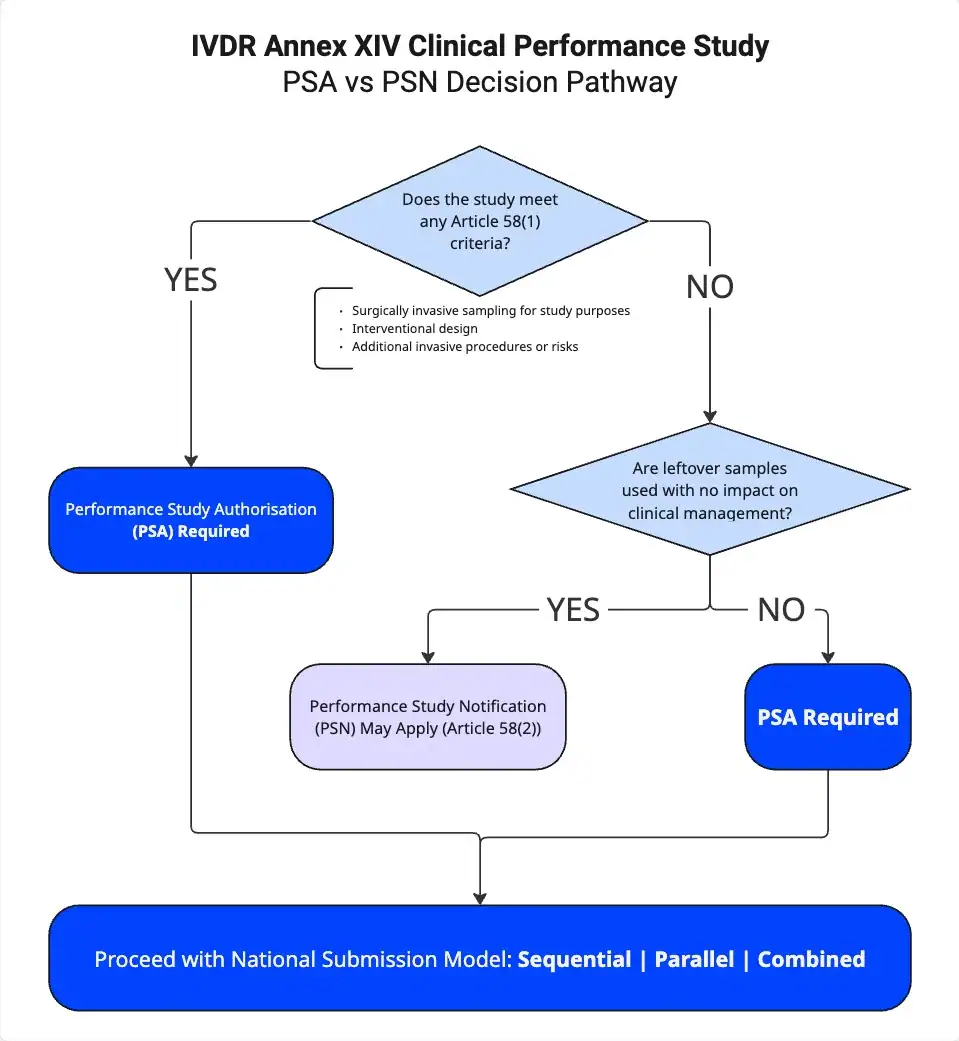
Article 58.1 Authorisation Required

This applies to non-CE-marked devices or devices used outside their intended purpose. The process involves a 25-day validation phase followed by a 45-day review. You need full PSA authorisation when the study involves surgically invasive sample-taking for study purposes only, when it is an interventional clinical performance study, or when there are additional invasive procedures or risks beyond standard care.

Article 58.2 Notification Pathway

This applies to companion diagnostics using leftover samples only, where results do not influence treatment during the trial. The pathway is immediate or NCA-dependent after validation, depending on the Member State.

Article 70 CE-Marked Devices

This is a 30-day notification route for CE-marked devices used within their intended purpose but involving additional invasive or burdensome procedures beyond normal use. A critical nuance: if a CE-marked IVD is studied outside its intended purpose, the Article 70 notification route does not apply, it must be assessed under Article 58 instead.

The Key Decision Factors

From our experience across 40+ combined programs, the questions that determine which pathway applies and where NCAs diverge, are consistent:

  • CE mark status: for the specific trial use (intended purpose) not just whether the device has a CE mark, but whether the trial use falls within the marked scope
  • Whether results impact medical management: this is the most contested threshold, as “interventional” in the IVDR context carries a different meaning from “interventional” in clinical trial legislation
  • Study design: interventional vs observational
  • Sample type: fresh vs leftover, and the level of invasiveness required to collect them
  • Risk profile: additional procedures vs standard care
  • Whether device endpoints are clearly distinguished: from drug endpoints

Top 12 RFIs From 40+ Combined Programs

This is the data MDCG guidance documents do not provide. Over 40 combined programs, these are the most frequent Requests for Information (RFIs) we have received from NCAs and Ethics Committees across Europe:

1. Insufficient analytical validation (GSPR 9.1a). The test is a clinical trial assay, prototype, or lab-developed test (LDT) and was not developed under full design control. This may be accepted in US early-phase trials but is a common reason for rejection in the EU.

2. Insufficient data supporting the chosen cut-off. A small number of samples were used for cut-off validation. NCAs expect robust, data-driven rationales, not theoretical arguments.

3. Lacking or vague definitions of primary endpoints related to IVD performance, and the absence of a statistical analysis plan for the device component.

4. Informed Consent Form (ICF) lacks performance study-specific content. This is extremely common in combined CT/PS ICFs. Authorities regularly request revision in lay-user language that clearly distinguishes participation in the drug trial from participation in the diagnostic study.

5. Inconsistent objectives between the clinical trial application and performance study documentation. When the CPSP says one thing and the CTA says another, expect an RFI.

6. Incomplete risk plans and reports, with insufficient evaluation in the Investigator’s Brochure of how inaccurate test results could impact the clinical trial, especially for high-toxicity therapies.

7. Investigator and site documentation lacking PS references, required translations, or country-specific insurance certificates.

8. Lack of consideration towards monitoring the IVD study under ISO 20916, especially in sponsor-CRO or multicentre settings.

9. Divergent views between Ethics Committees and NCAs on risk, burden, or benefit, sometimes within the same country.

10. Use of leftover samples for future research without clear documentation on traceability, consent, or ethical approval.

11. Safety monitoring procedures in the CPSP not aligned with IVDR Article 74 and MDCG 2024-4.

12. Scientific inaccuracies in the CPSP, IB, and technical documentation, simple errors that erode credibility and trigger additional scrutiny.

What “Device-Specific Endpoints” Actually Means

One of the most common mistakes we see in combined studies is sponsors relying solely on drug efficacy endpoints (ORR, PFS, OS) as evidence of IVD performance. Under the IVDR and MDCG 2025-5, performance studies must generate data that establish or confirm device performance, not drug performance.

Analytical Endpoints (Often Used in Phase 1/2 Studies)

These include reportable rate, invalid-result rate, repeat-test rate, and assay failure rate; precision and reproducibility in the clinical setting; and accuracy at clinically relevant cut-offs.

Clinical Endpoints (CDx-Type, Often Used in Phase 3 and Bridging)

These include concordance with a clinically valid reference assay (PPA, NPA, OPA); diagnostic sensitivity and specificity vs clinical status; clinical outcomes studies in the IVD-selected group linked to drug endpoints; and clinical bridging studies.

What Is Not Sufficient as a Sole Endpoint

Turnaround time alone, and drug efficacy endpoints (ORR, PFS, OS) without device-specific performance measures.

Case Study: From Rejection to 8-Country Approval

One of the programs presented in detail involved an NGS-based CDx used to detect a specific mutation for targeted therapy patient eligibility in a rare tumour indication. It was a Phase 3 global trial with an interventional combined performance study across 30+ EU sites.

The Initial Rejection

The first EU submission was rejected. The reasons were typical of what we see repeatedly:

  • Incomplete analytical performance data vs GSPR 9.1(a) at the mutation cut-off
  • Weak linkage between biomarker, clinical condition, and treatment, a scientific validity gap
  • Under-developed risk management for false negatives in a high-toxicity therapy

What We Did

MDx CRO conducted a full gap analysis and remediation covering the Scientific Validity Report (SVR), Analytical Performance Report (APR), CPSP, and risk file versus Annex XIII requirements. We rewrote the CPSP with device-specific treatment-decision endpoints, strengthened the analytical data at the decision threshold, and quantified the false-negative impact in the risk management file.

The Outcome

Harmonised resubmission to 8 Member States. All RFIs resolved. Approvals in all 8 countries, within 4 months.

This case illustrates a pattern we see consistently: the initial submission fails not because the science is weak, but because the documentation does not speak the language the NCAs expect. The same data, presented differently, achieves a completely different result.

The Most Costly Mistake Sponsors Make

The single most expensive mistake we have seen sponsors make in the IVDR portion of a combined study is treating the performance study application as an afterthought, something to be “bolted on” after the clinical trial application is already in motion.

In one program, the sponsor had not engaged with IVDR requirements until approximately three months before planned first-patient-in. At that point they discovered that a PSA was required in multiple Member States, that documentation requirements were not harmonised across those countries, and that each required different local forms, different ethics committee interactions, and in some cases certified translations.

The result was a nine-month delay to the European portion of the trial and an estimated additional cost in the range of €800,000-€1.2 million when accounting for CRO renegotiation, site re-engagement fees, amended contracts, and the opportunity cost of delayed clinical data.

This is not an outlier. Industry survey data shows that a significant proportion of sponsors experience 6–12 months of IVDR-related delay in combined programs, with some reporting delays beyond 12 months. The structural cause is always the same: the pharmaceutical team and the diagnostics team are operating on disconnected timelines, and the IVDR submission is not integrated into the master trial timeline from the outset.

Wave Planning: The Operational Playbook

Not all EU Member States are equal when it comes to combined study submissions. One of the practical tools shared at the conference was our wave planning approach, a strategic framework for sequencing country activations based on regulatory architecture, not just commercial priority.

Wave 1: Speed, Parallel/Combined Processes

Spain offers parallel review, with submission to both AEMPS via the portal and the Ethics Committee (usually via email). Total timeline: approximately 85 days.

Belgium uses a consolidated review via CESP where the NCA and EC coordinate and issue a single opinion. Timeline: approximately 60 days.

These are faster because the EC and NCA review simultaneously, not sequentially.

Wave 2: Sequential Requirements

Germany, Austria, and Hungary all require EC approval first, followed by NCA submission. This adds the full EC timeline (46–166 days) before the NCA clock even starts. Total timelines: 135–267 days.

Wave 3: Administrative Complexity

Bulgaria requires notarised and apostilled Powers of Attorney, sworn translations, and physical courier submissions.

Poland requires paper copy submissions to both the EC and NCA, including wet-ink signed site documents, sworn translations, and stricter requirements demonstrating the Sponsor’s business registration and Power of Attorney.

Ireland has non-harmonised reviewers, causing inconsistent RFI rounds.

Why Wave Planning Matters

Typically, it is strategic to avoid submitting to high-administrative-burden countries in Wave 1. For example, Poland necessitates that the entire submission package is delivered to the EC and NCA via courier in printed form with wet-ink signatures. It is more efficient to submit first to countries with accessible pathways so that feedback from RFIs and lessons learned can be incorporated from the start for the more labour-intensive submissions.

The strategy: stagger activation by submission architecture and administrative burden, not just by regulator consolidation.
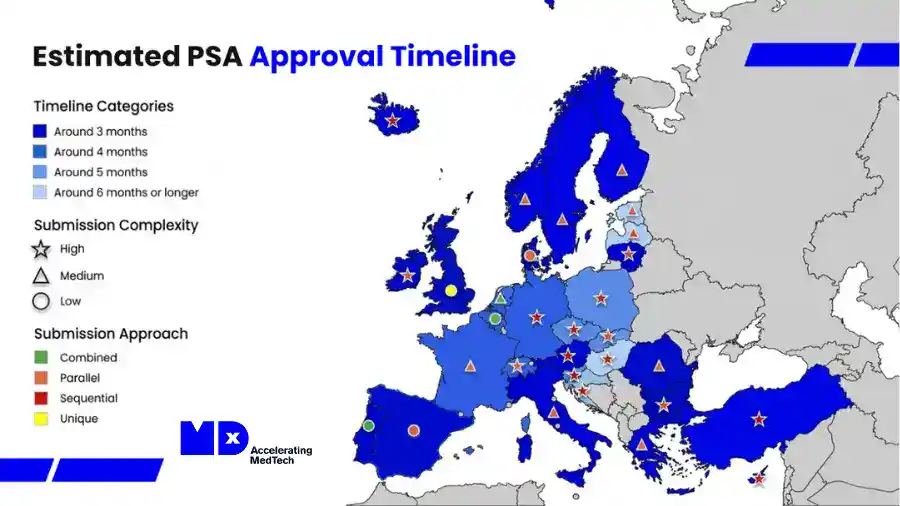
Illustration of European map showing estimated PSA approval timelines and submission complexities for MedTech products in the context of IVDR compliance.
Visual overview of European regions highlighting approval timelines and submission challenges for MedTech companies navigating IVDR requirements in combined studies.

How MDCG 2025-5 Is Changing the Landscape

MDCG 2025-5, published in June 2025, is the first dedicated Q&A guidance specifically addressing IVDR performance studies comprehensively. It covers 54 questions across topics that sponsors and NCAs have been debating since 2022, including:

  • A regulatory pathway decision tree (Appendix I) providing a structured framework for determining whether a planned activity requires a PSA, a PSN, or no submission at all
  • Clarification that “interventional” in the IVDR context meaning the results may influence patient management carries a different meaning from “interventional” as used in clinical trial legislation. This conflation has caused significant confusion
  • A working definition of “leftover samples” and the conditions under which they trigger notification rather than full application requirements
  • Guidance on combined studies including sponsor responsibilities, substantial modification handling across both the CTR and IVDR pathways, and the role of the performance study investigator

Are NCAs Following It?

Partially, and unevenly. Some authorities have begun aligning their pre-submission guidance with the decision-tree logic. Others continue applying their own interpretations, particularly on the definition of “interventional” which remains the most contested threshold.

The guidance is explicitly non-binding: MDCG 2025-5 itself states it cannot be regarded as reflecting the official position of the European Commission and that only the Court of Justice of the EU can give binding interpretations. In practice, guidance adoption across Member States typically lags publication by 12–18 months before a clear majority are operating consistently with it.

The Health Services Pack and the Biotech Act: Will It Actually Simplify Combined Studies?

In December 2025, the European Commission proposed two complementary pieces of legislation as part of a broader health services package. The first is a targeted revision of the MDR and IVDR, aimed at simplifying the existing regulatory framework. The second is the Biotech Act, which proposes amendments to the Clinical Trials Regulation that are directly relevant to combined studies.

What the Biotech Act Changes for Combined Studies

This is the more consequential development. The Biotech Act explicitly introduces a single integrated application for combined studies. Under the current framework, sponsors must seek authorisation of the clinical trial under the CTR and the performance study under the IVDR entirely independently separate portals, separate assessments, separate timelines, separate Member State interactions.

The Biotech Act proposes to eliminate that dual-track requirement. Instead, the sponsor would submit a single application covering both the investigational medicine and the IVD through a combined authorisation process managed under the CTR. That assessment would be led and coordinated by a Reporting Member State (RMS), with coordinated approvals across participating countries.

The proposal also accelerates CTR timelines generally, reducing the multinational CTA review from 106 days to 75 days, and as low as 47 days when no information request is issued.

My Assessment

This is not wishful thinking for the first time, there is a concrete legislative mechanism on the table that directly addresses the structural root cause of combined study delays. If adopted as proposed, it would be a genuine step-change.

However, three cautionary notes:

Legislative timeline. Even with political priority, realistic adoption and implementation timelines are 18–24 months from proposal. Do not expect sponsors to be able to use the single-application pathway before late 2027 at the earliest.

Implementation gap. CTIS will need to be updated to accept performance study documentation alongside the CTA, and Member State competent authorities will need to build assessment capacity for the IVD components within their CTR review teams.

The COMBINE pilot is the bridge. The COMBINE programme’s Project 1 pilot, launched on 13 June 2025, is already testing an “all-in-one” coordinated assessment approach. Sponsors who participate now are effectively rehearsing for the future framework.

The December 2025 package does have the potential to fundamentally simplify combined studies. But sponsors working in 2026 are still operating under the current framework. The practical advice remains: use the COMBINE pilot if you can, plan for Member State divergence if you can’t, and build your combined study submission strategy on the assumption that the current dual-track system will be in place until at least late 2027.

The #1 Mistake Sponsors Make in Their First Combined Study

They assume the IVDR performance study is the diagnostic manufacturer’s problem, not theirs.

The pharmaceutical sponsor designs the trial, defines the biomarker strategy, selects the assay, and writes the protocol. But when the conversation turns to the IVDR submission, they expect their diagnostic partner to handle it independently.

The reality is that under Article 2(57) of the IVDR, the “sponsor” is whichever entity takes responsibility for the initiation, management, and financing of the performance study and in a combined study, particularly in early-phase trials, that is often the pharmaceutical company itself.

This disconnect produces predictable failures:

  • The drug application is submitted through CTIS months before the PSA is even drafted
  • The diagnostic partner lacks access to the clinical trial protocol, site-level information, and country-specific documentation needed to complete the Annex XIV dossier
  • When an NCA issues an RFI at the interface between the two applications, neither team owns the response

MDCG 2022-10 is explicit: the clinical trial sponsor is responsible for overall compliance of products used in the trial, including the IVDR. Where a sponsor uses a CE-marked IVD outside its intended purpose, it assumes manufacturer responsibilities under Article 16(1).

The fix is straightforward: from Day 1 of trial design, the PSA workstream sits inside the integrated trial timeline, with a named owner, shared document management, and joint governance between pharmaceutical and diagnostics teams. Sponsors who do this avoid most problems. Sponsors who don’t are the ones calling us nine months before database lock.

How Much Time Does Expert Guidance Save?

Based on our experience across 40+ combined programs, working with a CRO that has specific IVDR and IVD regulatory expertise saves an average of 3 to 5 months compared to in-house teams or generalist CROs approaching combined studies for the first time.

The savings accumulate in three areas:

Pre-submission strategy (4–6 weeks saved). A specialist knows which Member States to sequence in Wave 1, what each authority actually expects beyond the statutory minimum, and which borderline classification questions need to be resolved before any dossier is submitted. Preventing a single misclassification avoids months of remediation.

Documentation preparation (4–8 weeks saved). Generalist CROs frequently prepare a single PSA dossier and submit it identically across all Member States. A specialist prepares country-adapted packages from the outset correct local forms, country-specific ethics committee requirements, certified translations, and portal-specific submission formats.

RFI management (2–4 weeks saved). When an NCA issues a request for information, a specialist drafts a response that also anticipates how the same question may be raised by other authorities whose reviews are still in progress preventing cascading delays across the wave.

Five Steps to De-Risk Your Next Combined Study

Based on the patterns from 40+ programs, these are the five actions that make the biggest difference:

1. Science first: do not underestimate analytical validation data. Analytical data should be traceable and robust, particularly around the cut-off. The APR and IB should be readable as standalone documents NCAs assess them that way.

2. Decide stakeholder ownership early. Sponsor vs Dx partner vs CRO for both the CTR and IVDR pathways. Ambiguous ownership is the single biggest source of delay.

3. Design device-specific endpoints upfront. Analytical and/or clinical, not just drug efficacy. If your performance study plan only lists ORR as an endpoint, expect a rejection.

4. Build the Annex XIII/XIV package early. SVR, APR, CPSP, risk management, GSPR logic evaluate internal capabilities and gaps before the submission clock starts.

5. Use structured tools for multi-country variation. Don’t rely on memory or email threads. Robust study design combined with an informed country strategy is what separates 60-day approvals from 267-day ones.

Looking Ahead: 2026–2027

From our experience, it will get slightly worse before it gets meaningfully better with the inflection point likely in late 2026 to early 2027.

The short-term pressure comes from volume. More sponsors are now aware of IVDR performance study requirements, which means more submissions entering the system. NCA capacity has not grown proportionally. Several smaller Member States still lack dedicated performance study reviewers.

The medium-term improvement will come from three converging developments: MDCG 2025-5 gradually reducing classification disputes, the COMBINE programme’s coordinated assessment pilot producing procedural lessons by mid-2026, and the December 2025 legislative revision proposal delivering structural changes by late 2027.

The biggest variable remains NCA behaviour. Regulatory guidance adoption is uneven and slow. It typically takes 12–18 months from MDCG publication before a clear majority of authorities are operating consistently with it.

For sponsors planning programs in 2026, the practical reality has not changed: plan for divergence between Member States, budget for country-specific regulatory strategies, engage the IVDR workstream at trial design not after the CTR is submitted and do not assume that what worked in one country will work in the next.

Name
Checkboxes

Need Help With Your Combined Study?

MDx CRO has managed 40+ combined programs across 20+ countries with a 100% approval rate and 90+ performance study submissions in the EU27. Our fastest program went from kick-off to full IVD Study Package Development and submission in 4 weeks.

If you are planning a combined study under the CTR and IVDR, talk to our team about how we can accelerate your path to first patient tested.

Frequently Asked Questions about IVDR Combined Studies

What triggers IVDR performance study requirements in a combined study?

IVDR performance study requirements are triggered through three pathways. Article 58.1 requires authorisation for non-CE-marked devices or devices used outside their intended purpose. Article 58.2 requires notification for companion diagnostics that use leftover samples only. Article 70 requires notification for CE-marked devices that involve additional burdensome procedures. Key decision factors include CE mark status for the specific trial use, whether results affect medical management, the study design, the sample type, and the risk profile.

How long does IVDR performance study approval take in a combined study?

Approval timelines vary by Member State. The EU COMBINE Analysis Report 2024 shows an average of 137 days, with a range of 45–267 days. Countries with parallel ethics committee and national authority review, such as Spain (~85 days) and Belgium (~60 days), are faster than those with sequential review, such as Germany, Austria, and Hungary (135–267 days).

What are the most common RFIs in IVDR combined studies?

Based on data from more than 40 combined programs, the most common RFIs include insufficient analytical validation under GSPR 9.1(a), insufficient data supporting the selected cut-off, missing device-specific endpoints in the CPSP, informed consent forms lacking performance study-specific content, and inconsistent objectives between the clinical trial application and performance study documentation.

What changed with MDCG 2025-5 for IVDR performance studies?

MDCG 2025-5, published in June 2025, is the first comprehensive Q&A guidance for IVDR performance studies. It introduces a regulatory pathway decision tree, clarifies that “interventional” in the IVDR context differs from the CTR definition, defines “leftover samples,” and addresses sponsor responsibilities in combined studies. Adoption by national authorities is uneven, and full alignment is expected within 12–18 months.

Will the December 2025 Health Services Pack simplify combined studies?

The Biotech Act proposed in December 2025 introduces a single integrated application for combined studies under the CTR framework. If adopted, it would remove the need for dual CTR and IVDR submissions. Realistic implementation is not expected before late 2027. The COMBINE programme pilot is currently testing coordinated assessment as a bridge to the future framework.


Written by:
Carlos Galamba

Carlos Galamba

CEO

Senior regulatory leader and former BSI IVDR reviewer with deep experience in CE marking high-risk IVDs, companion diagnostics, and IVDR implementation.
Industry Insights & Regulatory Updates

How to Run a CDx Performance Study Alongside a Drug Trial: Insights From 20+ Projects

When a global pharma company runs a clinical trial for a new oncology drug that requires an NGS-based companion diagnostic to pre-screen patients, two regulatory worlds collide: the Clinical Trials Regulation governs the drug, while the IVDR governs the diagnostic. In Europe, these are legally separate submissions, with different portals, timelines and authorities. Operationally, however, they form one study, with shared patients, shared sites and shared deadlines.

At MDx CRO, we have supported over 20 companion diagnostic programmes in which the CDx clinical performance study runs in parallel with a pharma-sponsored drug trial. These combined studies, involving top-10 global pharmaceutical companies and IVD manufacturers across multiple EU Member States, have shown us what works, what fails and where regulatory friction most often arises.

This article reflects operational experience and interpretation of current regulatory frameworks under the CTR and IVDR. It shares what we have learned from supporting these studies in practice.


How to Run a CDx Performance Study Alongside a Drug Trial: Insights From 20+ Projects

When a global pharma company runs a clinical trial for a new oncology drug that requires an NGS-based companion diagnostic to pre-screen patients, two regulatory worlds collide. The Clinical Trials Regulation (CTR) governs the drug, while the IVDR governs the diagnostic. In Europe, these are legally separate submissions with different portals, different timelines, and different authorities, but operationally they are one study with shared patients, shared sites, and shared deadlines.

At MDx CRO, we have supported over 20 companion diagnostic programmes where the CDx clinical performance study runs in parallel with a pharma-sponsored drug trial. These combined studies, involving top-10 global pharmaceutical companies and IVD manufacturers across multiple EU Member States, have taught us what works, what fails, and where the regulatory friction points are.

This article shares what we have learned.

What is a combined study under IVDR and CTR?

A combined study is any study where two regulated product types, a medicinal product and an in vitro diagnostic, are investigated simultaneously. In practice, this is often referred to as a ‘combined study’. This typically means a Phase 2 or Phase 3 drug trial that uses a companion diagnostic to stratify or select patients based on a biomarker.

Under EU law, the drug trial falls under Regulation (EU) 536/2014 (the Clinical Trials Regulation, or CTR), and the CDx performance study falls under Regulation (EU) 2017/746 (the IVDR). There is currently no fully integrated EU submission pathway that covers both. Sponsors must file separate applications through separate systems: the drug trial via CTIS, and the performance study via national competent authority and ethics committee routes that vary by Member State.

The European Commission launched the COMBINE programme in 2023 to address this fragmentation, and a pilot coordinated assessment process began in mid-2025. However, for the foreseeable future, sponsors will need to manage dual submissions in parallel, and that is where complexity multiplies.

Why the CDx performance study gets underestimated

One of the most consistent patterns we see across combined studies is that the clinical performance study for the companion diagnostic is treated as secondary to the drug trial.

As Yaiza Benito, Clinical Project Manager at MDx CRO, explains:

“The clinical trial is always seen as the important one, and rightly so, there is enormous investment and pressure. But the companion diagnostic has to comply with IVDR on its own terms. Each product has its own requirements and each one has to meet them. You cannot undervalue the performance study.”

In our experience working with multinational pharma sponsors, this misalignment manifests in several ways. The IVD manufacturer and the pharma partner may not be fully coordinated on timelines, with the drug trial protocol advancing while the CDx documentation lags behind. Analytical validation, which must be completed before the CDx can be used in the trial, sometimes runs late because it was deprioritised in favour of the drug development programme. And the IVDR submission requirements, including the clinical performance study protocol, the investigator’s brochure for the IVD, and the risk management documentation, may not receive the same level of scrutiny as the CTR submission package.

The result is predictable: delays. Competent authorities and ethics committees issue Requests for Information (RFIs). Submissions stall. The drug trial start date slips, not because of the drug, but because of the diagnostic.

We have learned that the single most effective intervention in a combined study is treating the CDx performance study as an equal partner from day one, not an afterthought.

The regulatory landscape: two parallel submission tracks

Understanding the practical differences between the CTR and IVDR submission tracks is essential for anyone managing a combined study.

  • The drug trial (CTR track): Applications are submitted centrally via CTIS. The process is harmonised across the EU, with coordinated assessment between the reporting Member State and concerned Member States. Timelines are defined: validation within 10 days, assessment within 45 days (Part I), with extensions possible. The framework is mature and well-understood by sponsors.
  • The CDx performance study (IVDR track): Applications are submitted individually to each Member State’s competent authority and ethics committee, through national systems, which may include separate or partially coordinated submissions depending on the Member State. There is no central submission system yet, as EUDAMED’s performance study module is not expected before 2027-2028. Each country has its own templates, timelines, and review sequence. In some Member States, processes may be sequential (e.g., ethics review preceding competent authority assessment), while others allow parallel review.

This asymmetry creates a planning challenge. The drug trial submission is coordinated; the CDx submission is fragmented. When both need to be approved before the first patient can be enrolled at a given site, the slower of the two determines the timeline, and it is in many cases, the IVDR track becomes the critical path.

What MDx does in a combined study

Our involvement in combined studies focuses on the IVDR side of the equation. We support the CDx performance study across its full lifecycle, while the pharma sponsor or a drug-focused CRO manages the CTR clinical trial.

Review and development of technical documentation.

We review the IVD manufacturer’s technical documentation to ensure it meets IVDR requirements. In many cases, the CDx manufacturer is a US-based company whose documentation was initially built for FDA submission. We assess the documentation against IVDR General Safety and Performance Requirements (GSPRs) and identify the gaps that need to be addressed before European authorities will accept it. We can also develop documentation from scratch when the manufacturer provides the underlying data.

“Normally the bulk of the documentation is the same for FDA and IVDR, but IVDR tends to be more demanding on certain points. What we do is make sure it is 100% compliant with IVDR. That is our responsibility.”

Clinical performance study protocol development. We develop the Clinical Performance Study Protocol (CPSP) in accordance with ISO 20916 and IVDR Annex XIII requirements. The protocol defines study objectives, endpoints, specimen types, statistical methodology, site requirements, and monitoring plans. In a combined study, the CPSP must align with the drug trial protocol on key elements such as patient population, specimen collection procedures, and site selection, while remaining a standalone document for IVDR purposes.

Regulatory submissions to ethics committees and competent authorities. We manage the IVDR submission process across multiple EU Member States. This includes preparing country-specific documentation packages, managing communications with national authorities, and responding to RFIs. Each country has its own expectations, and our experience across 15+ EU Member States means we know what each authority prioritises before they ask.

Global sample monitoring under ISO 20916. We provide monitoring of testing sites, specifically the laboratories where the CDx is used to test patient samples. This includes site qualification (verifying the lab has the right equipment, QMS, and trained personnel), initiation visits, ongoing monitoring (on-site and remote), and close-out visits.

“For our current programmes with major pharma companies, we are monitoring all testing sites globally, not just the ones in Europe. We apply ISO 20916 across the board. This is where we are true experts.”

Clinical performance study reporting. At study close, we develop the Clinical Performance Study Report (CPSR), which feeds into the Performance Evaluation Report (PER) required for IVDR technical documentation and Notified Body review.

Five Lessons from 20+ CDx Programmes – MDx

5 lessons from 20+ CDx programmes

Based on our experience managing the IVDR track of combined studies.

01
Strategy

Start IVDR strategy at the same time as CTR strategy

Develop the IVDR regulatory strategy in parallel with the CTR strategy from Phase 2 onwards — not after the drug trial protocol is finalised.

02
Validation

Complete analytical validation before the CDx enters the trial

Engage the validation team early — expertise in NGS, IHC, and qPCR is critical.

“When analytical validation is incomplete, competent authorities flag it immediately — RFIs can delay the study start by months.”
03
Submissions

Do not assume one submission package works for all countries

Cover letters, national forms, language and ethics requirements vary per EU Member State. Country-specific templates are essential.

04
Coordination

Align the CDx manufacturer and the pharma sponsor

Different regulatory obligations, timelines, priorities. Someone must coordinate protocol details, specimen handling & submission timelines.

“There are a lot of stakeholders involved. What we bring is agility, strong organisational capacity, and the ability to move fast.”
05
Monitoring

Risk-based monitoring must include CDx testing sites

CDx testing may happen at central labs, regional labs, or manufacturer facilities — these need qualification under ISO 20916 with remote monitoring capabilities.

Five lessons from 20+ CDx programmes

Based on our experience managing the IVDR track of combined studies, here are the five most important lessons we have learned.

1. Start the IVDR submission strategy at the same time as the CTR strategy, not after.

The most common mistake is treating the IVDR submission as something that can be figured out once the drug trial protocol is finalised. By that point, critical decisions have already been made about countries, sites, and specimen collection procedures that may not align with IVDR requirements. We recommend that the IVDR regulatory strategy is developed in parallel with the CTR strategy from Phase 2 onwards.

2. Analytical validation must be sufficiently established to support the safe and reliable use of the CDx in the clinical study

The CDx must be analytically validated before it is used to make patient selection decisions in a clinical trial. This seems obvious, but in practice we regularly see sponsors underestimate the time and resources required.

“Analytical validation is absolutely key. When it is incomplete or the documentation does not hold up, competent authorities flag it immediately, and the resulting RFIs can delay the study start by months.”

The analytical validation team, in our case a dedicated group with deep expertise in assay technologies including NGS, IHC, and qPCR, should be engaged early.

3. Do not assume one submission package works for all countries.

Each EU Member State has its own requirements for performance study applications. The core documentation may be the same, but cover letters, national forms, language requirements, and ethics committee expectations vary significantly. In some countries, you can submit in English; in others, key documents must be translated. Some authorities want the full Performance Evaluation Plan included; others do not. We maintain country-specific templates and relationship knowledge that allow us to submit with confidence across multiple markets simultaneously.

4. The CDx manufacturer and the pharma sponsor must be aligned, and someone needs to coordinate them.

In a combined study, the pharma company is typically the sponsor of the drug trial, and the IVD manufacturer is the sponsor (or legal manufacturer) of the CDx. These two entities have different regulatory obligations, different timelines, and sometimes different priorities. Someone needs to sit at the intersection and ensure alignment on protocol details, specimen handling procedures, site selection, and submission timelines.

“You have the pharma partner on one side and the IVD manufacturer on the other, and sometimes there is more than one CDx in the same study. There are a lot of stakeholders involved. What we bring is agility, strong organisational capacity, and the ability to move fast across all of them.”

5. Risk-based monitoring plans under ISO 20916 should include the CDx testing sites, not just the clinical trial sites.

Monitoring in a combined study often focuses on the clinical trial sites where patients are enrolled. But the CDx testing, where patient samples are analysed, may happen at different locations: central labs, regional labs, or the manufacturer’s own facilities. These testing sites need to be in line with ISO 20916 principles, including risk-based monitoring. We develop risk-based monitoring plans that cover both the clinical sites and the testing sites, with remote monitoring capabilities for global programmes.

The COMBINE programme and what it means for sponsors in 2026

The European Commission has initiated the COMBINE programme to explore and improve coordination between the Clinical Trials Regulation and the In Vitro Diagnostic Regulation for combined studies. The programme has identified several practical challenges, including misaligned timelines, fragmented national processes, limited coordination between competent authorities and ethics committees, and inconsistent documentation requirements.

In 2025, COMBINE activities included pilot work aimed at testing more coordinated approaches for multinational combined studies. These activities are intended to support better alignment between CTR and IVDR processes, including validation and assessment timelines, although the overall framework remains under development.

For sponsors planning combined studies in 2026 and beyond, the COMBINE programme is a positive signal. However, it is important to be realistic: the initiative is still evolving, and full harmonisation of IVDR submission processes is not expected until EUDAMED’s performance study module goes live, likely not before 2027–2028 at the earliest. In the meantime, sponsors should continue to plan for fragmented national submissions and invest in the country-specific expertise needed to manage them effectively.

Frequently asked questions

Are all companion diagnostic performance studies considered interventional?

Not necessarily. Under the IVDR, whether a CDx performance study is classified as interventional depends on whether the test results influence patient management decisions. In many combined studies, the CDx is used for patient selection (screening), and the results do directly affect care, making it interventional. However, if the CDx study uses only left-over samples and does not influence treatment, it may qualify as non-interventional, with reduced submission requirements. The classification has significant implications for the level of regulatory review required.

Can the CDx performance study use the same informed consent as the drug trial?

In some cases, yes. When the studies are fully integrated, with the same patients, the same sites, and the same specimen collection, it is possible to use a single Subject Information Sheet (SIS) that covers both the CTR and IVDR components. However, it must be very clear to participants that they are consenting to both studies. In practice, whether a single or dual consent approach is used depends on the specific study design and the requirements of the individual ethics committees involved.

Does MDx manage the drug trial side as well?

No. Our expertise is on the IVDR side: the CDx performance study, technical documentation review, regulatory submissions, and testing site monitoring. The drug trial is managed by the pharma sponsor or a drug-focused CRO. We work alongside them, ensuring the two tracks are coordinated and that the CDx programme does not become the bottleneck.

How long does it take to get IVDR approval for a CDx performance study?

Timelines vary significantly by country. In our experience, from initial submission to final approval, sponsors should plan for 3 to 6 months per country, accounting for validation, assessment, RFIs, and any required translations. Countries with sequential review processes (ethics first, then competent authority) tend to take longer. Starting the submission process early and in parallel with the CTR application is critical.

Planning a combined drug-diagnostic study in Europe?

MDx CRO manages the IVDR track of combined studies, from CDx documentation review and protocol development to multi-country submissions and ISO 20916 testing site monitoring. We work alongside your drug CRO to keep both tracks aligned and on schedule.

Written by:
Yaiza Benito

Yaiza Benito

Clinical Research Manager

Senior Clinical Research Manager and biomedical engineer, expert in study design and clinical operations, MDR/IVDR regulatory compliance, GCP, CDx, and precision medicine.
Industry Insights & Regulatory Updates

IMDRF Draft N91 2026: New Clinical Evidence Requirements for IVDs Explained

The International Medical Device Regulators Forum (IMDRF) has released a significant new draft guidance, IMDRF/CEIVD WG/N91: Clinical Evidence for IVD Medical Devices, Definitions and Principles of Performance Evaluation, open for public consultation from 4 March to 5 May 2026. For IVD manufacturers, regulatory affairs teams, and companion diagnostic developers, this is not a minor update. It is a comprehensive reset of the global reference framework for how clinical evidence is defined, generated, documented, and defended.

This article breaks down what N91 actually changes, what it means for different types of manufacturers, and based on Carlos Galamba’s experience supporting IVDR submissions and CDx programs at MDx CRO, what practical steps teams should be taking right now.

Why this matters now?

The IMDRF consultation opened on 4 March 2026 and closes on 5 May 2026. Manufacturers with products in development, legacy portfolios under review, CDx programs in progress, or AI-based IVDs in any stage should read this draft carefully, and consider submitting comments before the deadline.

IMDRF N91 is A Framework Reset, Not Just a Revision

IMDRF N91 is a draft guidance document developed by the IMDRF Clinical Evidence for IVD Devices Working Group. Its full title is Clinical Evidence for IVD Medical Devices, Definitions and Principles of Performance Evaluation, and it represents the most significant update to the global IVD clinical evidence framework since the original GHTF documents were published.

The document runs to 31 pages and introduces 17 defined terms, consolidating vocabulary that has historically been inconsistent across jurisdictions. More importantly, it establishes a lifecycle-based model for clinical evidence that goes beyond premarket evidence generation and explicitly links performance evaluation to intended purpose, state of the art, and post-market updates.

What it supersedes

IMDRF N91 replaces both:

  • GHTF/SG5/N6:2012 Clinical Evidence for IVD Medical Devices: Scientific Validity Determination and Performance Studies for IVD Medical Devices
  • GHTF/SG5/N7:2012 Clinical Evidence for IVD Medical Devices: Key Definitions and Concepts

These two documents have been the global reference point for IVD clinical evidence since 2012. Replacing them with a single updated framework is a significant consolidation.

IMDRF’s role in the regulatory landscape

IMDRF is not a legislative body. Its guidance documents are not legally binding. However, they carry significant weight because they are developed by the regulatory agencies of major markets, including the European Commission, the FDA, Health Canada, the TGA (Australia), PMDA (Japan), and others. MDCG documents (which govern EU IVDR interpretation) explicitly reference IMDRF concepts, and regulatory reviewers at Notified Bodies and competent authorities routinely use IMDRF frameworks as reference benchmarks.

In practice, this means that once an IMDRF guidance is finalized, manufacturers that are not aligned with it will increasingly face questions during technical reviews, audits, and submissions, even if the guidance is not formally cited as a legal requirement.

“In my experience, serious regulatory teams start aligning almost immediately, even before formal citation becomes routine. Active referencing in reviewer templates, training, and audit language often takes somewhere between 6 and 18 months, depending on jurisdiction and organization. My advice is not to wait for formal enforcement language, if the direction is clear, start aligning your evidence strategy now”.

Carlos Galamba, CEO MDx

The Three Pillars of Clinical Evidence Under IMDRF N91

N91 formalizes and aligns with the three-pillar structure already embedded in EU IVDR: scientific validity, analytical performance, and clinical performance. Together, these constitute the clinical evidence that manufacturers must generate, document, and maintain across the device lifecycle.

Understanding each pillar, and where manufacturers routinely fall short, is essential for teams planning their evidence strategy.

Scientific Validity: Establishing the Biomarker Association

Scientific validity addresses whether the analyte being measured is genuinely associated with the clinical condition or physiological state the device is intended to detect. For many established biomarkers, this is largely a literature-based exercise. For novel biomarkers, it is a substantial research task that must begin much earlier than most teams expect.

As Carlos Galamba notes: “In the context of CDx, this work should start as early as biomarker selection and intended-use definition. Under IVDR, the performance evaluation plan is supposed to map the development phases and the sequence for establishing scientific validity, analytical performance, and clinical performance, so this work really starts at the translational stage, not at the submission stage.”

N91 makes clear that scientific validity cannot be assumed. It must be documented, and for novel analytes without established clinical consensus, the absence of scientific validity will block the entire evidence pathway.

Analytical Performance: what IVD manufacturers Most Often Underestimate

Analytical performance covers the device’s ability to accurately and reliably detect or measure the analyte, including precision, reproducibility, cut-off justification, specimen stability, pre-analytical factors, interference, and comparability.

According to Carlos Galamba, this is the pillar that IVD manufacturers most frequently underprepare: “When dealing with clinical trial assays or CDx, teams are usually very focused on the biomarker story and the drug program, so they assume the assay can be optimized later. In reality, regulators often scrutinize analytical robustness first. IVDR itself already requires manufacturers to build the evidence case across all three pillars, not just clinical performance.”

This is a pattern MDx CRO encounters regularly, particularly in CDx programs where the clinical hypothesis is well-developed but the analytical package is treated as an afterthought. N91 reinforces that regulators, including Notified Bodies and the FDA, will assess analytical performance in depth, not simply accept it as a technical formality.

Clinical Performance: What Documentation Is Required vs. What Evidence Must Be Generated

Clinical performance refers to the device’s ability to yield results that correlate with a clinical condition in the intended patient population. N91 clarifies an important distinction that has significant operational implications: manufacturers must always document clinical performance, but they do not always need to generate new evidence through a prospective study.

Whether new evidence is required depends on the device’s risk class, novelty of the analyte, intended use population, and available published data. This mirrors the IVDR framework, where existing literature, registry data, and published experiences from routine diagnostic use can contribute to the clinical performance evidence base, if they are sufficient and methodologically sound.

For more detail on how clinical performance studies are designed and conducted under IVDR, see our guide: Running Clinical Studies Under IVDR: What You Need to Know.

Software as an IVD (SaIVD) and AI/ML: What IMDRF N91 Changes

One of the most substantive additions in N91 is its dedicated section on Software as an IVD (SaIVD), including IVDs that incorporate AI and machine learning. This reflects a genuine regulatory gap: the 2012 GHTF documents predated the widespread deployment of AI-based diagnostics, and manufacturers have been operating without a clear global framework for what clinical evidence looks like for these products.

N91 requires manufacturers of AI-based SaIVDs to address: data lifecycle traceability, performance drift monitoring, transparency of AI outputs, and documentation of the transition point at which AI recommendations are reviewed by qualified healthcare professionals. Critically, N91 affirms that final clinical decisions must always rest with qualified healthcare professionals, not with the AI system itself.

The Most Common Mistake in AI-Based IVD Evidence Packages

Carlos Galamba identifies a pattern he sees repeatedly in AI-based IVD programs: “The most common mistake is treating algorithm accuracy as if that alone were clinical evidence. For AI-based IVDs, you also need to show data provenance, representativeness, version control, performance across real-world input scenarios, monitoring for drift, and transparency about limitations. The IMDRF draft is quite clear that for AI-based SaIVD, manufacturers should document the whole data lifecycle, manage AI-specific failure modes, monitor post-market drift, and make outputs interpretable enough for human oversight.”

This is a significant operational gap for many software and AI companies entering the IVD space. Algorithm performance metrics, sensitivity, specificity, AUC, are necessary but not sufficient. N91 signals that regulators will expect a much broader evidence architecture for these products.

For related reading on IMDRF’s approach to AI in medical devices, see: IMDRF Machine Learning-enabled Medical Devices: Key Terms and Definitions.

IMDRF N91 and Companion Diagnostics: Co-Development, Cut-Off Locking, and Clinical Bridging

Companion diagnostics (CDx) receive dedicated and substantially more detailed treatment in N91 than in the 2012 GHTF documents. This reflects both the growing regulatory complexity of CDx programs globally and the specific challenges that arise when an IVD must be co-developed alongside, and validated in the context of, a therapeutic clinical trial.

N91 explicitly addresses the relationship between the CDx and its linked drug program, including clinical trial design considerations (therapy stratification vs. therapy selection), the role of the companion diagnostic in defining the eligible patient population, and the use of bridging studies to establish comparability between a clinical trial assay and the final commercial CDx.

The Hardest Practical Challenge in CDx development: Timeline Alignment

The core operational difficulty in CDx development is well-known to anyone who has run a real program. As Carlos Galamba describes it: “The hardest part is usually locking the assay and its cut-off early enough for the drug trial, while still leaving room to evolve toward the final commercial CDx. In practice, teams want flexibility during early clinical development, but regulators want traceability, reproducibility, and a defensible bridge to the final device. That tension is what makes CDx programs operationally difficult.”

N91 does not resolve this tension, but it does provide a clearer framework for documenting the development pathway, which is ultimately what Notified Bodies and regulatory authorities are looking for.

Clinical Bridging Studies: Where Evidence Packages Break Down

When a bridging study is required, linking a clinical trial assay to a subsequent commercial CDx, manufacturers frequently arrive at submission with incomplete packages. Based on Carlos Galamba’s experience with CDx submissions: “The common gaps are weak analytical comparability, poor justification for cut-off transfer, insufficient specimen representativeness, and incomplete explanation of discordant results. IMDRF N91 now directly recognizes bridging from a clinical trial assay to a subsequent CDx and says the study should establish clinical comparability using direct or indirect data.”

N91’s explicit recognition of bridging is significant because it gives regulatory teams a defined framework to reference, and it sets expectations that regulators in IMDRF member jurisdictions will increasingly apply.

For a step-by-step guide to CDx performance studies under IVDR, see: IVDR Annex XIV Performance Studies for Companion Diagnostics: A Step-by-Step Guide 2026.

IMDRF N91 vs. IVDR: What Changes for EU-Compliant Manufacturers?

A practical question for manufacturers already operating under IVDR: does N91 require significant additional work?

The short answer, according to Carlos Galamba, is no, with important nuances: “For a manufacturer that is genuinely IVDR-compliant, N91 should not feel like a reinvention. IVDR already requires clinical evidence based on scientific validity, analytical performance, and clinical performance, supported by a continuous performance-evaluation process tied to intended purpose and updated over the lifecycle. The additional work is mostly in tightening structure, terminology, and rationale, especially for software, AI, and CDx.”

The key phrase here is “genuinely IVDR-compliant.” Many manufacturers have documentation that is technically complete but not logically structured around intended use, clinical benefit, and lifecycle evidence updates, the elements N91 makes more central. For those teams, N91 is a useful diagnostic tool for identifying where their evidence architecture needs strengthening.

For EU manufacturers, it is also worth noting that IMDRF is referenced in MDCG documents, and MDCG has in some cases explicitly built on or endorsed IMDRF concepts. While IVDR remains the legally binding framework in the EU, alignment with IMDRF guidance is increasingly reflected in Notified Body expectations.

For clinical evidence requirements under IVDR specifically, see: MedTech Europe IVDR Clinical Evidence Requirements

Where additional work may be required

AreaLikely additional work for IVDR-compliant manufacturers
SaIVD / AI-based IVDsN91 adds specificity on data lifecycle documentation, drift monitoring protocols, and transparency requirements that may exceed current IVDR technical file scope
Companion diagnosticsBridging study documentation and cut-off transfer justification may need to be more formally structured against N91 requirements
Legacy portfoliosEvidence packages that are technically complete but not logically structured around intended use and clinical benefit may need restructuring
Terminology alignmentN91 introduces 17 defined terms. Ensuring internal documentation uses consistent, N91-aligned terminology will reduce reviewer friction

Who Is Most Exposed by IMDRF N91?

Not all manufacturers face the same level of exposure from N91’s new requirements. Based on Carlos Galamba’s assessment: “The most exposed are probably legacy portfolio holders and AI/software IVD developers. Legacy manufacturers often have evidence packages that are technically complete but not logically structured around intended use, clinical benefit, and lifecycle updates. AI and software companies face extra complexity because N91 explicitly addresses data lifecycle, drift, transparency, and the need for ongoing re-verification. CDx developers are also highly exposed because of the added bridging and co-development challenges.”

Startups building new products from scratch arguably face less disruption, if they build their evidence strategy around N91 from day one, they are building to the standard rather than retrofitting to it.

3 Actions to Take Before IMDRF Consultation Closes on 5 May 2026

N91 is unambiguous: clinical evidence is a lifecycle activity, not a premarket deliverable. If your organization’s evidence strategy is still organized around submission milestones rather than continuous performance evaluation and intended-use discipline, this is the moment to change that.

The IMDRF consultation for N91 is open until 5 May 2026. This is a genuine opportunity for IVD manufacturers to shape the final guidance. Carlos Galamba’s recommendation for teams reading N91 today:

“First, run a structured gap assessment against the draft using your current intended uses, performance evaluation reports, and evidence-generation plans. Second, identify where the draft creates operational friction for your products, especially if you work in CDx, AI/software, NGS, decentralized testing, or legacy portfolios, and submit concrete comments. Third, check whether your evidence strategy is truly lifecycle-based, or whether it is still a premarket-only mindset.”

How to prepare Before IMDRF Consultation Closes

  1. Run a structured gap assessment

    Map your current intended uses, performance evaluation reports, and evidence-generation plans against the N91 draft. Focus specifically on: how your three-pillar evidence is documented and whether it is genuinely tied to intended purpose; whether your SaIVD or AI products have data lifecycle and drift monitoring documentation; and whether your CDx bridging evidence is structured in a way that satisfies the comparability requirements in N91’s Section 7.

  2. Identify operational friction and submit comments

    The public consultation is a genuine opportunity to shape the final guidance. Manufacturers should identify where N91 creates operational friction for their specific product types, particularly in CDx, AI/software, NGS, decentralized testing, or legacy portfolios, and submit concrete, technically grounded comments to IMDRF before 5 May 2026

  3. Audit your evidence mindset

    N91 is unambiguous: clinical evidence is a lifecycle activity, not a premarket deliverable. If your organization’s evidence strategy is still organized around submission milestones rather than continuous performance evaluation and intended-use discipline, this is the moment to change that.

The consultation period closes 5 May 2026. Feedback can be submitted via the IMDRF consultation page.

If your team needs support conducting a structured gap assessment or preparing a pre-submission technical review, MDx CRO’s IVDR Pre-Submission Assessment service is designed exactly for this type of exercise.

How MDx Can Help

MDx CRO combines 18+ years of IVD regulatory expertise with hands-on experience at Notified Bodies, European Commission advisory roles, and operational leadership across Class C/D IVDs, CDx, NGS, and AI-based diagnostic software. Our team has supported hundreds of IVDR submissions and continues to track global regulatory developments including IMDRF consultations in real time.

Whether you are running a gap assessment against the N91 draft, building your CDx evidence strategy, preparing for IVDR submission, or developing a clinical evidence plan for an AI-based IVD, our team can provide the regulatory depth and operational experience to move efficiently.

Ready to align with IMDRF N91?

Contact MDx CRO to discuss a structured gap assessment against the N91 draft, or to review your current clinical evidence strategy before the consultation closes on 5 May 2026.

Frequently Asked Questions

What is IMDRF N91 and why does it matter for IVD manufacturers?

IMDRF N91 is the 2026 draft document Clinical Evidence for IVD Medical Devices, Definitions and Principles of Performance Evaluation. Open for public consultation from 4 March to 5 May 2026, it supersedes the 2012 GHTF N6 and N7 documents. It matters because it updates the global reference framework for how manufacturers should define, generate, document, and defend IVD clinical evidence, including for modern areas like software, AI, and companion diagnostics.

Does IMDRF N91 replace IVDR clinical evidence requirements?

No. EU IVDR 2017/746 remains the legally binding framework in the EU. IMDRF N91 is best understood as a global convergence guidance document that is highly relevant to IVDR because the core architecture is already aligned: intended purpose, scientific validity, analytical performance, clinical performance, lifecycle updating, and state of the art. IMDRF is referenced in MDCG documents, and the binding framework in the EU remains MDR/IVDR, not IMDRF itself.

What are the three pillars of clinical evidence in IMDRF N91?

Scientific validity (establishing the association between the analyte and a clinical condition), analytical performance (the ability of the IVD to detect or measure the analyte correctly), and clinical performance (the ability of the IVD to yield results that correlate with a clinical condition in the target population). All three must be addressed in an integrated performance evaluation strategy tied to the device’s intended purpose.

Does IMDRF N91 apply to AI-based diagnostic software?

Yes. N91 includes a dedicated section on Software as an IVD (SaIVD) that explicitly addresses AI and machine learning-based devices. Requirements include data lifecycle documentation, performance drift monitoring, AI transparency, version control, and the principle that final clinical decisions must rest with qualified healthcare professionals.

What is a clinical bridging study and why does N91 address it?

A clinical bridging study is used to link a new commercial CDx to an existing clinical trial assay that was used during a drug’s pivotal study. N91 formally recognizes this approach and requires that bridging studies establish clinical comparability using direct or indirect comparability data. This addresses a significant gap in the existing regulatory framework for CDx development.

When does IMDRF N91 come into effect?

N91 is currently in public consultation, which closes on 5 May 2026. The guidance will be finalized after comments are reviewed. It is not currently in force, but manufacturers who align with it proactively will be better positioned as Notified Bodies and regulatory agencies begin referencing it in reviews, training, and audit frameworks, which typically occurs 6 to 18 months after finalization.

What is a scientific validity report and is it required under IMDRF N91?

A scientific validity report (SVR) documents the established association between an analyte and a specific clinical condition, physiological state, or intended use. It forms the foundation of the clinical evidence package. Under IVDR Annex XIII, an SVR is already a mandatory component of technical documentation for IVDs. N91 reinforces this requirement globally and provides updated definitions and expectations for how scientific validity should be determined and documented.

Written by:
Carlos Galamba

Carlos Galamba

CEO

Senior regulatory leader and former BSI IVDR reviewer with deep experience in CE marking high-risk IVDs, companion diagnostics, and IVDR implementation.
Industry Insights & Regulatory Updates

FDA QMSR: How the 2026 Regulation Shift Transforms MDSAP Audits and FDA Compliance Inspections

On February 2, 2026, the U.S. Food and Drug Administration (FDA) implemented the new Quality Management System Regulation (QMSR), formally replacing the former Quality System Regulation (21 CFR Part 820). With this transition, the FDA incorporated ISO 13485:2016 by reference into U.S. law and introduced a new inspection model under Compliance Program 7382.850.

This article explains what the FDA QMSR changes in practical terms.

Specifically, it clarifies:

  • How the updated MDSAP Audit Approach aligns with QMSR
  • How FDA inspections now operate under CP 7382.850
  • Which documentation areas receive increased inspection attention
  • How manufacturers can structure a QMSR gap assessment
  • What inspection exposure points regulatory teams should proactively address

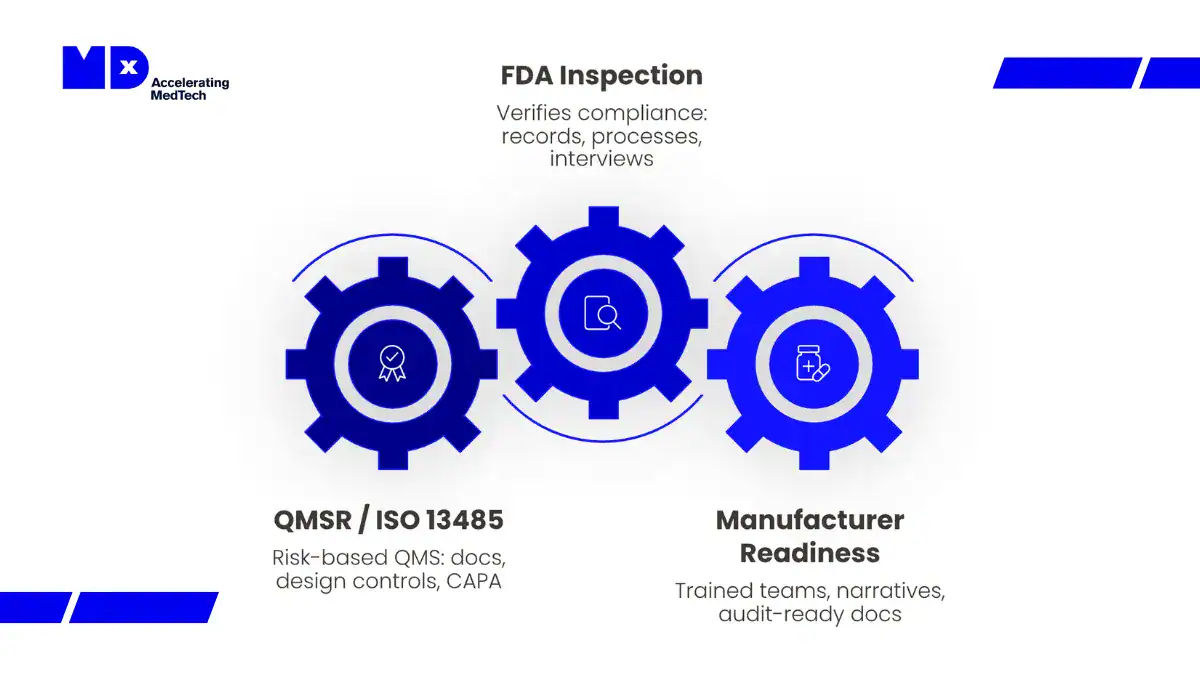
These changes are particularly relevant for manufacturers operating in complex regulatory environments, including companies developing FDA companion diagnostics. In these companies design controls, labeling, clinical evidence, and post-market monitoring must operate as an integrated lifecycle system.

Why the FDA QMSR Matters Now?

The FDA QMSR represents more than structural alignment with ISO 13485. It modernizes inspection methodology, expands documentation accessibility, and reinforces a lifecycle-based, risk-driven enforcement approach.

Under the former QSR model, inspections often focused on subsystem compliance using QSIT checklists. Under QMSR, investigators evaluate how quality processes function collectively across the total product lifecycle.

MDSAP Audit Approach 2026: How It Differs from FDA Inspections Under QMSR

MDSAP audits and FDA inspections are frequently discussed together. However, they serve fundamentally different regulatory functions.

An MDSAP audit is conducted by an FDA-recognized Auditing Organization. It provides a structured, scheduled, and standardized assessment covering ISO 13485 and the regulatory requirements of participating authorities, including the FDA. The audit focuses on conformity with harmonized quality management system requirements. Participation remains voluntary.

An FDA inspection, by contrast, is a statutory enforcement activity conducted directly by FDA investigators. Its objective is not certification, but the evaluation of compliance with U.S. legal requirements and the identification of potential violations, systemic weaknesses, or public health risks.

Under the FDA QMSR framework, this distinction remains critical.

In practical terms:

  • MDSAP is conformity-focused, scheduled, and audit-driven.
  • FDA inspections are compliance-driven, investigative, and enforceable.

Because of these structural differences:

  • MDSAP does not replace FDA’s legal authority to inspect.
  • FDA inspections are not limited by the MDSAP task structure.
  • A successful MDSAP audit does not guarantee a favorable FDA inspection outcome.

While strong MDSAP performance may influence FDA surveillance planning, it does not eliminate the possibility of routine, risk-based, or for-cause inspections.

Common Industry Assumptions That Elevate Inspection Risk Under QMSR

Despite years of MDSAP implementation and increasing alignment with ISO 13485, several structural misunderstandings remain common within regulatory teams. Under the FDA QMSR framework, these assumptions may create unintended inspection exposure.

Among the most frequent are:

“MDSAP replaces FDA inspections.”
MDSAP may inform FDA’s surveillance planning. However, it does not limit FDA’s statutory authority to conduct routine, risk-based, or for-cause inspections.

“If the MDSAP auditor did not identify it, FDA will not pursue it.”
FDA investigators are not constrained by MDSAP audit depth, sampling methodology, or task sequencing. They may pursue any line of inquiry necessary to evaluate U.S. compliance.

“MDSAP and FDA inspections evaluate the same criteria.”
MDSAP assesses conformity to harmonized quality system requirements. FDA inspections evaluate compliance with U.S. law and potential public health impact.

“ISO 13485 certification ensures FDA compliance.”
Although ISO 13485 is incorporated by reference into QMSR, FDA-specific statutory and regulatory requirements remain fully enforceable.

“MDSAP covers all U.S.-specific expectations.”
While the audit model maps U.S. requirements, FDA inspections may extend beyond mapped tasks and request additional evidence where risk or compliance concerns arise.

Collectively, these assumptions overlook a central element of the FDA QMSR transition.

QMSR vs QSR vs ISO 13485: What Actually Changed

Many organizations assume that QMSR simply “equals ISO 13485.” However, that interpretation is incomplete.

Although ISO 13485:2016 is incorporated by reference into U.S. law, FDA-specific statutory and regulatory requirements remain fully enforceable. Therefore, obligations related to UDI, Medical Device Reporting (MDR), device listing, and labeling controls continue to apply.

As a result, companies that focus solely on ISO 13485 conformity may overlook additional documentation, traceability, and enforcement expectations that FDA investigators apply during inspections.

Comparison: QSR vs QMSR vs ISO 13485

Key takeaway:
ISO 13485 alignment does not eliminate FDA-specific compliance obligations. FDA retains enforcement authority under U.S. law.

FDA Compliance Program 7382.850: How Inspections Work Under QMSR

As of February 2, 2026, FDA retired QSIT and implemented Compliance Program 7382.850.

Inspections now organize around:

Six Quality Management System (QMS) Areas:

  • Change Control
  • Design & Development
  • Management Oversight
  • Outsourcing & Purchasing
  • Production & Service Provision
  • Measurement, Analysis & Improvement

Four Other Applicable FDA Requirements (OAFRs):

  • Tracking
  • Corrections & Removals
  • Medical Device Reporting (MDR)
  • Unique Device Identification (UDI)

Under this model, FDA evaluates how quality subsystems operate as an interconnected framework rather than as isolated elements. Inspectors assess whether risk information, design decisions, post-market data, and management oversight are aligned throughout the product lifecycle.

For manufacturers of companion diagnostics, this system-level evaluation is particularly significant, as design inputs, labeling claims, clinical performance data, and post-market monitoring directly influence one another.

What FDA Inspectors Scrutinize Most Under QMSR

Based on regulatory inspection support experience, three documentation areas now present heightened exposure.

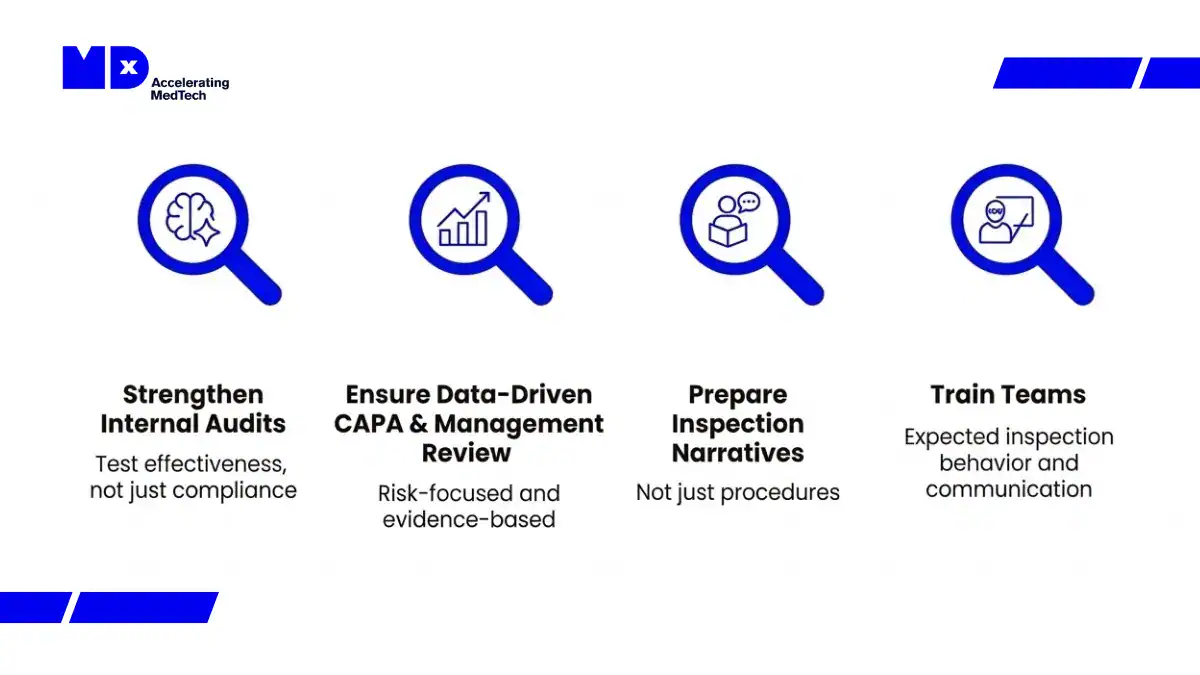
1. Internal Audits, Supplier Audits, and Management Review Records

Under QMSR, FDA inspectors may review:

  • Internal audit reports
  • Supplier audit outcomes
  • Management review records

As our QA/RA Specialist Joana Martins notes from inspection support experience, investigators increasingly evaluate whether quality processes function effectively in practice, not merely whether procedures formally exist.

Records must clearly demonstrate:

  • Identified issues
  • Root cause analysis
  • Corrective actions
  • Follow-up and documented closure

Incomplete or draft audit records increase inspection risk.

2. Design Controls and Traceability (ISO 13485 Clause 7.3)

QMSR aligns with ISO 13485 clause 7.3. However, manufacturers must demonstrate full traceability across:

  • User needs
  • Design inputs
  • Design outputs
  • Verification and validation
  • Residual risks

Traceability weaknesses frequently arise between:

  • Risk management files
  • Labeling claims
  • UDI triggers
  • MDR criteria

Inspectors expect objective evidence that these elements remain consistently aligned across documentation and decision-making processes.

For companion diagnostics, this alignment is especially critical because intended use, biomarker claims, and clinical evidence directly impact regulatory risk classification.

3. CAPA and Effectiveness Verification

CAPA remains one of the most enforcement-sensitive areas under QMSR.

A recurring weakness observed during inspection preparation is the absence of documented effectiveness verification following corrective actions. Closing a CAPA administratively is insufficient. Investigators expect objective evidence demonstrating that actions eliminated root causes and prevented recurrence.

Documented effectiveness checks are not procedural formalities, they serve as evidence that the quality system operates as intended.

Inspection Risk Indicators Under FDA QMSR

The transition to the FDA QMSR has altered not only inspection structure but also inspection depth. Under Compliance Program 7382.850, FDA investigators apply a lifecycle and risk-based model that prioritizes system effectiveness, data integrity, and management oversight.

For this reason, manufacturers should not wait until an inspection is scheduled to evaluate potential vulnerabilities. Identifying structural weaknesses in advance is critical because inspection findings under the QMSR framework increasingly derive from systemic inconsistencies rather than isolated documentation gaps.

Proactive identification of inspection risk indicators allows organizations to:

  • Reduce the likelihood of Form 483 observations
  • Prevent escalation to warning letters or enforcement action
  • Shorten remediation timelines
  • Demonstrate mature quality governance

Below are recurring inspection risk indicators observed in practice under the evolving QMSR inspection model:

Examples of Documentation Weaknesses Observed During Inspections

Risk AreaTypical Vulnerability
CAPARepeated issues without documented effectiveness verification
Design ControlsIncomplete traceability between risk analysis and design inputs
Management ReviewMinutes lacking documented decisions, metrics, or follow-up actions
Supplier OversightAbsence of risk-based justification for audit scope
Post-Market SurveillanceComplaint trends not connected to CAPA or design updates

Documentation Areas Receiving Increased Inspection Attention Under QMSR

The transition to QMSR expands the practical scope of documentation that investigators may review.

Under the former QSR, certain internal records were less frequently examined due to inspection structure and interpretative practice. Under QMSR, those same records may serve as direct evidence of whether management oversight, supplier controls, and internal audit processes operate effectively.

Investigators assess whether:

  • Issues are identified systematically
  • Root causes are documented clearly
  • Decisions are traceable
  • Corrective actions are verified for effectiveness

Inconsistent documentation, incomplete audit closure, or lack of traceability between systems may now carry greater inspection consequences than under the previous model.

QMSR Gap Assessment Framework

ISO 13485 certification does not automatically confirm FDA QMSR compliance. A structured gap assessment helps identify regulatory overlays and inspection exposure points.

A practical QMSR gap assessment should include:

1. Clause Mapping

Map ISO 13485 clauses to QMSR references and confirm terminology alignment.

2. FDA-Specific Overlay Identification

Verify incorporation of:

  • UDI requirements
  • MDR reporting triggers
  • Labeling obligations
  • Device listing controls

3. Documentation Exposure Review

Assess:

  • Internal audit completeness
  • CAPA effectiveness evidence
  • Management review decision traceability
  • Supplier risk classification

4. Inspection Simulation

Conduct mock inspections aligned with CP 7382.850 to test system coherence.

Even when corrective actions remain in progress, documented identification and remediation planning demonstrate regulatory control and transparency.

Illustration of FDA inspection process emphasizing quality management systems, risk-based audits, and manufacturer readiness in MedTech industry.

What the QMSR Means for U.S. Manufacturers and FDA Inspections

The most important U.S.-specific change is the removal of references to the former FDA Quality System Regulation (21 CFR 820). These have been replaced with references aligned to the QMSR, under which ISO 13485:2016 is now incorporated by reference into U.S. law. This does not mean that all FDA-specific requirements disappear. U.S. statutory and regulatory obligations continue to apply where relevant.

The updated MDSAP Audit Approach also reflects several U.S. regulatory updates that have been in effect since March 2024:

  • Device listing updates: Manufacturers must confirm or update their device listing information annually between October 1 and December 31, or whenever a relevant change occurs (21 CFR 807).
  • Predetermined Change Control Plans (PCCPs): The audit model now clarifies how PCCPs are assessed, particularly for software-based and AI-enabled devices, aligning with FDA’s existing change control requirements under 21 CFR 807.81 and 21 CFR 814.39.

These requirements are not new, but the 2026 MDSAP update removes inconsistencies between what auditors assess and what FDA expects.

Beyond the U.S.-specific updates, there is also a broader change that affects all participating jurisdictions. The term “critical supplier” has been removed and replaced with more practical language referring to “suppliers that should be considered for audit as part of the MDSAP audit of the organization.” This better reflects ISO 13485 risk-based thinking and reduces ambiguity around supplier oversight across different regulatory systems.

Other international changes Under the FDA’s QMSR Framework

While this article focuses on the U.S. regulatory framework, the updated audit approach also incorporates important revisions from other participating regulatory authorities:

  • Australia (TGA): Alignment with the Procedure for Recalls, Product Alerts and Product Corrections (PRAC), which came into effect in March 2025.
  • Brazil (ANVISA): Updated references to RDC 830/2023 (IVDs) and RDC 751/2022 (medical devices).

These changes ensure the audit model reflects current regulatory frameworks across all participating jurisdictions.

Practical implications for medical device manufacturers

FDA’s new compliance program significantly raises expectations for how manufacturers demonstrate quality system effectiveness during inspections:

  • FDA inspectors are evaluating how quality processes work together in practice. Making a strong emphasis on risk management, data integrity, and decision-making across the total product lifecycle.
  • Previously “internal” records are now fair game. Internal audit reports, supplier audit outcomes, and management review records may be reviewed during inspections. These documents must clearly reflect issues identified, decisions made, and actions taken.
  • Risk management must be continuous and demonstrable. FDA expects risk to be actively monitored and linked to CAPA, design changes, supplier controls, and post-market surveillance, and not treated as a static or one-time exercise.
  • Post-market data is a primary inspection focus. Complaint trends, medical device reporting, recalls, UDI, and tracking data are increasingly used to assess whether the quality system is effective and responsive to real-world performance.
  • Inspection scope may be driven by data. FDA may use pre-inspection data reviews or remote assessments to target areas of concern, increasing scrutiny where trends or inconsistencies are identified.

To summarize, manufacturers should ensure their quality systems tell a coherent, data-supported story and demonstrate not just compliance, but control and effectiveness.

What medical device manufacturers should do before their next audit or inspection

Manufacturers should:

  • Strengthen internal audits to test effectiveness, not just compliance
  • Ensure management review and CAPA are data-driven and risk-focused
  • Prepare clear inspection narratives, not just procedures
  • Train teams on inspection behavior and communication

By strengthening these foundations, manufacturers can approach their next audit or inspection with clarity, confidence, and control.

Key takeaways for companies targeting the US market

  • MDSAP remains valuable, but it is no longer sufficient on its own
  • FDA inspections are becoming more structured, consistent, and data-driven
  • Early alignment with QMSR expectactions reduces inspection risk, delays and remediation costs
Medical device quality management and inspection process with team training, data-driven review, and inspection narratives for FDA compliance.
Strategies for Modern and effective compliance.

How MDx Supports FDA QMSR Readiness: Expert Insight

Transitioning from QSR to FDA QMSR requires more than updating terminology. It demands structural alignment, inspection-oriented preparation.

Based on field experience supporting manufacturers through inspection preparation and regulatory alignment projects, Joana Martins, QA/RA Specialist at MDx, emphasizes that the most frequent vulnerabilities do not stem from missing procedures, but from insufficiently demonstrated system effectiveness.

According to Joana’s inspection readiness experience, organizations often underestimate three exposure points during FDA inspection preparation:

  • The depth of documentation review now permitted under QMSR
  • The need for traceability between risk management, design controls, and post-market data
  • The importance of documented effectiveness verification within CAPA systems

To address these exposure points, MDx supports medical device manufacturers through:

  • Independent QMSR-aligned readiness assessments focused on inspection exposure
  • Structured QMSR gap analysis incorporating FDA-specific regulatory overlays
  • Mock FDA inspections aligned with Compliance Program 7382.850
  • Strategic support for companies developing FDA companion diagnostics, where design traceability, labeling controls, and lifecycle data integration require heightened regulatory coherence

Rather than approaching FDA QMSR as a documentation update, MDx works with organizations to ensure their quality systems demonstrate operational integrity, risk-based decision-making, and inspection resilience.

Organizations preparing for FDA inspection or evaluating their QMSR alignment can benefit from early, structured assessment. Proactive evaluation reduces remediation timelines, minimizes inspection disruption, and strengthens regulatory confidence.

Frequently Asked Questions About FDA QMSR, MDSAP, and Inspections

What is the main difference between QSR and QMSR?

The main difference is structural alignment. Under QSR, FDA requirements were written directly into 21 CFR Part 820. Under QMSR, the FDA incorporates ISO 13485:2016 by reference into U.S. law while keeping FDA-specific obligations in force. In short, QMSR harmonizes structure with ISO 13485. However, it does not reduce FDA enforcement authority or eliminate U.S.-specific requirements such as MDR, UDI, or device listing.

Does ISO 13485 certification guarantee FDA compliance under QMSR?

No, it does not. Although ISO 13485 forms the backbone of QMSR, FDA-specific statutory requirements still apply. Manufacturers must comply with MDR, UDI, corrections and removals, and other U.S. obligations. Based on regulatory experience, companies often assume ISO certification closes all gaps. In practice, a targeted QMSR gap assessment is necessary to confirm full FDA alignment.

What replaced QSIT in FDA inspections?

FDA replaced QSIT with Compliance Program 7382.850, effective February 2, 2026. This new program aligns inspections with the QMSR framework. Instead of subsystem checklists, FDA now organizes inspections around six QMS areas and four Other Applicable FDA Requirements (OAFRs). As a result, inspections follow a more integrated, risk-based, lifecycle-focused approach.

Can FDA inspect internal audit reports under QMSR?

Yes. Under QMSR, FDA investigators may review internal audit reports, supplier audits, and management review records.
In practice, inspectors now verify whether issues were identified, documented, and effectively closed. They no longer focus only on whether procedures exist, they assess whether the system works as intended.
Incomplete or unverified audit actions may increase inspection risk.

What records are now receiving greater scrutiny during FDA inspections?

FDA now places greater scrutiny on:
– Internal and supplier audit reports
– Management review documentation
– Design control traceability records
– CAPA procedures and effectiveness checks
From inspection experience, CAPA effectiveness verification is a frequent weak point. Companies often implement corrective actions but fail to document objective evidence that the action resolved the root cause.
Under QMSR, effectiveness matters as much as documentation.

Why are companies that passed MDSAP still receiving FDA 483 observations?

Because MDSAP and FDA inspections serve different purposes. MDSAP evaluates conformity. FDA inspections assess legal compliance and public health risk. FDA investigators are not bound by MDSAP sampling methods or audit scope. If inspectors identify ineffective CAPA, weak traceability, or gaps between procedures and actual practice, they may issue Form 483 observations, even after a successful MDSAP audit.

How should manufacturers prepare for FDA inspections under QMSR?

Start early. Preparation often takes longer than expected. Then conduct a structured QMSR gap assessment. ISO 13485 compliance alone does not confirm full FDA alignment. Finally, train teams on Compliance Program 7382.850. Mock interviews and inspection simulations help identify weaknesses. Even documented remediation in progress demonstrates system control and reduces inspection risk.

When does FDA QMSR enforcement begin?

FDA QMSR enforcement began on February 2, 2026, when the new Quality Management System Regulation officially replaced the former Quality System Regulation (21 CFR Part 820). From that date, FDA inspections operate under Compliance Program 7382.850.

What are the FDA QMSR and ISO 13485 harmonization requirements for 2026?

Under the 2026 QMSR, ISO 13485:2016 is incorporated by reference into U.S. law. This means manufacturers must meet ISO 13485 requirements as part of FDA compliance. However, harmonization is not complete equivalence, FDA-specific obligations such as UDI, MDR reporting, device listing, and labeling controls remain fully enforceable and are not covered by ISO 13485 alone. See the QSR vs QMSR vs ISO 13485 comparison table above for a detailed breakdown.

Written by:
Joana Martins

Joana Martins

QARA Specialist

QA/RA Specialist supporting teams in clinical evaluations and regulatory compliance with ISO 13485, MDR, and international medical device requirements (FDA, Health Canada, ANVISA).
Industry Insights & Regulatory Updates

IVDR Annex XIV Performance Studies for Companion Diagnostics: A Step-by-Step Guide 2026

This IVDR Annex XIV clinical performance study guide explains how you can plan and obtain authorisation for performance studies under Annex XIV of the IVDR when it involves a companion diagnostic. It aims to be practical and aligned with current expectations of ethics committees and competent authorities in the European Union.

If you require a structured checklist, you can download the Annex XIV Performance Study Authorisation (PSA) Toolkit, including an ISO 20916 monitoring checklist, templates, and a pre-submission workplan.


IVDR Annex XIV Clinical Performance Study: When PSA vs PSN Applies for Companion Diagnostics

Companion diagnostics (CDx) often require an IVDR Annex XIV clinical performance study because these tests directly influence patient management. Therefore, understanding when a Performance Study Authorisation (PSA) or a Performance Study Notification (PSN) applies is critical for effective regulatory planning and avoiding unnecessary delays.

Why Companion Diagnostics Often Fall Under Annex XIV

Companion diagnostics frequently fall under Annex XIV of the IVDR because the test result guides key treatment decisions, including:

  • Patient selection
  • Treatment allocation
  • Therapy continuation or discontinuation

If the study design allows test results to influence clinical decisions, regulators consider the study interventional, and this classification triggers the need for a Performance Study Authorisation (PSA). In addition, if you use the device outside its intended purpose as defined in the Instructions for Use (IFU), the IVDR framework also requires a PSA.

When Does a PSA Apply Under Article 58(1)?

For any IVDR Annex XIV clinical performance study, Article 58(1) serves as the key provision to determine whether a PSA is required. A PSA becomes mandatory if you meet any of the following three criteria:

  • You perform surgically invasive sample collection specifically for the clinical performance study (CPS).
  • You design the study as interventional in nature.
  • You introduce additional invasive procedures or other risks for participants.

If even one of these criteria applies, you must obtain a Performance Study Authorisation before starting the study.

When Does a PSN Apply Under Article 58(2)?

If you do not meet any of the Article 58(1) criteria, Article 58(2) may apply instead. In that case, you may submit a Performance Study Notification (PSN) when:

  • The study uses leftover samples only
  • The study includes no additional invasive procedures
  • Test results do not influence patient management
  • The design remains strictly non-interventional

However, even when these conditions apply, you must carefully evaluate national requirements and specific study design details to confirm that a PSN remains appropriate.

Combined Medicinal Product and Diagnostic Studies

An IVDR Annex XIV clinical performance study that involves both a companion diagnostic and a medicinal product requires structured coordination from the outset. When both regulatory frameworks apply, the Clinical Trials Regulation (CTR) governs the medicinal product, while the IVDR governs the diagnostic. Consequently, you must align timelines, documentation, and regulatory strategy under both frameworks to avoid inconsistencies and delays.

Step-by-Step: from planning to PSA approval

1. IB and CPSP Essentials, and the Link Between Endpoints, Intended Use, and Cut-off Strategy

Begin with a coherent Investigator’s Brochure (IB) and Clinical Performance Study Plan (CPSP). Every claim in the CPSP should trace to the intended purpose of the device and to analytical and clinical evidence that is sufficient for that claim. Endpoints must align with the intended clinical decision.

Based on our experience with more than 100 projects, the following two review findings occur repeatedly:

  • Analytical cut-off and validation. Authorities closely examine how the assay cut-off has been defined and supported. Sensitivity, precision, and accuracy should demonstrate that the device performs in a way that supports safe clinical decisions. Weak justification invites questions about patient misclassification risk, which frequently leads to requests for information.
  • Endpoints not aligned with intended use. Reviewers frequently question primary endpoints that are not clearly tied to clinical performance or to the intended use of the device. The endpoint should map directly to the decision being made for the patient.

Practical measures we have implemented in more than 100 projects:

  • Draft the statistical analysis plan early and show a clear line from intended use to endpoint to success criteria.
  • Map each analytical study (limit of detection, limit of quantitation, precision, interference, cut-off justification) to the clinical claim it supports.

2. Country Submissions: ethics committees, competent authorities, portals, translations, and fees

Plan both the ethics and competent authority pathways, including accounts for national portals, translation policies, and fee payments. Country-specific requirements can change timelines and logistics.

Some examples of country-specific requirements:

  • France requires an IDRCB registration code. The protocol, informed consent form, and insurance certificate must display this code. Missing or inconsistent use of the code commonly triggers requests for information.
  • Poland may require a physical submission package rather than a fully electronic file. Plan accordingly all documents that require original signatures. Courier time, notarised copies where applicable, and signature sequencing should also be built into the schedule.

A brief pre-submission checklist:

  • Identification of country EC-NCA submission approach (sequential, parallel, combined) and EC meeting schedules
  • Portal access verified and roles assigned for both ethics committees and competent authorities.
  • National identifiers obtained and propagated consistently across documents.
  • Translation scope defined and quality-controlled, particularly for patient-facing materials.
  • Insurance certificates aligned with the study footprint and national expectations.
  • Fee tables confirmed and purchase orders in place.

3. Timelines, Clock-Stops, and Expert Consultations

Validation and assessment phases of review often include clock-stops for clarification, where the reviewing authority can ask for further information, known as Request for Informations (RFIs). You should define internal service levels for responses in advance, and topic ownership should be clear across analytical, clinical, and biostatistics contributors. A master cross-reference that links CPSP, IB, risk management, and statistical sections reduces the risk of inconsistent responses. In Pickett’s assessment, assigning topic ownership for analytical, clinical, and statistical responses before submission helps keep clock-stops short and prevents inconsistent answers across documents.

IVDR Annex XIV Clinical Performance Study: How to Build a Robust Dossier?

A strong IVDR Annex XIV clinical performance study dossier reduces the risk of Requests for Information (RFIs), clock-stops, and approval delays.

Analytical Validation and Cut-Off Justification

For an IVDR Annex XIV clinical performance study, cut-off justification must go beyond presenting a single threshold value or ROC curve.

A robust dossier should:

  • Explain the clinical consequences of the selected cut-off
  • Describe how sensitivity and specificity change if the threshold shifts
  • Address false positives and false negatives at clinically relevant prevalence
  • Link analytical performance directly to the primary endpoint
  • Demonstrate how the device supports a safe clinical decision

Authorities frequently focus on misclassification risk. If the cut-off rationale does not clearly support safe decision-making, this section becomes a major driver of RFIs.

Best practice according to Callum Pickett Clinical Alliance Lead at MDx
Treat cut-off justification with the same rigor as a safety argument. Provide both statistical evidence and a clear clinical narrative.

Informed Consent Strategy Aligned With the CPSP

Misalignment between the Clinical Performance Study Plan (CPSP) and the informed consent form is a common cause of delay in an IVDR Annex XIV clinical performance study.

To reduce risk:

  1. Finalize the CPSP first.
  2. Draft the informed consent to mirror procedures, visit schedules, and risks.
  3. Use clear, plain language that accurately reflects the protocol.

Reviewers assess whether participants are properly informed. If the consent document does not reflect the study design, an RFI is likely.

We recommend to include the following in the Informed Consent:

  • Clear summary of procedures and assessment schedule
  • Device-specific risks, including sample handling and possible retesting
  • Explanation of invalid or indeterminate results and participant implications

Consistency between the CPSP and consent documentation strengthens credibility during assessment.

Cross-Referencing: CPSP, IB, GSPR, and Study Reports

A cross-reference matrix improves both internal quality control and external review efficiency.

Your matrix should demonstrate:

  • Where each General Safety and Performance Requirement (GSPR) is addressed
  • How CPSP procedures are monitored and documented
  • Where statistical commitments are supported by analysis
  • How risk management links to study controls

For a successful IVDR Annex XIV clinical performance study submission, document traceability is critical.

Frequent RFI Drivers in IVDR Annex XIV Clinical Performance Studies

Below are common deficiencies and practical mitigation strategies:

RFI DriverHow to Address It
Primary endpoint not aligned with intended useRedefine or restate the endpoint so it directly supports the clinical decision
Cut-off justification insufficientProvide complete analytical data and explain clinical impact
Sample representativeness unclearJustify matrix type, disease stage, prior therapy, and relevant variables
Misclassification of study type (leftover samples)Clarify whether the design remains non-interventional and whether PSN is appropriate
Monitoring plan not aligned with ISO 20916Define adverse event categories, roles, and timelines
Informed consent inconsistent with CPSPAlign language and procedural details precisely
Statistical assumptions not clinically justifiedLink alpha and power to meaningful clinical differences
Device deficiency reporting unclearDefine detection, escalation, and reporting mechanisms
Risk management not connected to study controlsTrace risks to mitigation and monitoring activities
Combined CTR–IVDR governance unclearDefine roles, responsibilities, and decision pathways
Incomplete or low-quality translationsPlan professional review and back-translation
National identifiers or insurance mismatchedEnsure consistent codes and appropriate coverage limits

Country Playbook: How to plan Performance Study Applications to EU Member States

1. Identify the PSA submission approach adopted by the EU member state.

There are three models adopted by EU countries which will impact your submission strategy:

  • Sequential – the EC is submitted to first and NCA submission can only occur once an EC approval has been issued.
  • Parallel – the EC and NCA submissions can be submitted around or at the same time allowing for a “parallel” review process. However, the NCA will only approve the study once a positive EC opinion has been granted
  • Combined – a single PSA submission is sent to one authority which serves as the EC and NCA, a single positive opinion will be issued.

2. Choose your Ethics Committee:

  • It is highly recommended to submit the PSA to the same EC reviewing the associated Clinical Trial Application
  • Identify any EC specific templates, this may include EC-specific application forms and site document templates
  • Identify the EC meeting schedule and the deadlines for PSA submission to achieve review at the EC meeting date
  • Use the EC meeting schedule to inform your submission strategy, different ECs will meet at different frequencies.

3. Identify any specific requirements set by the National Competent Authority:

  • Are there any NCA specific templates to be filed with the PSA?
  • Is there anything that can gate submission to this country? For example, does the NCA mandate that the final Clinical Trial protocol is submitted with the submission.

4. Identify any specific laws and requirements for the EU member state being submitted to:

  • The EU is governed by GDPR laws, but national laws on data protection add an additional layer of requirements. Ensure that your study is developed with the national data protection requirements in mind.
  • EU member states have different requirements for the insurance documentation, this may include reference to national laws, inclusion of national study codes, and extra details on the number of participants.

5. Use all these points to create your submission strategy, informed by the following:

  • Submission approach: countries with sequential review approaches take longer on average than countries with parallel and combined review approaches.
  • Clinical Priority: what countries are priority for enrolment? Which countries will have the most sites and therefore need to be activated earlier? 
    • How often do the chosen ECs meet according to their meeting schedule?
    • Are there any NCA or EC document requirements which aren’t yet available, and might delay submission?

Monitoring in Line with ISO 20916

ISO 20916 introduces additional classification categories for adverse events compared with the base IVDR text. Sites need clear training on event taxonomy, responsibilities for classification, and reporting timelines.

Content to include in the monitoring plan and site training:

  • Definitions and examples for adverse events and serious adverse events as used in the study.
  • Roles for initial classification, medical review, and final assessment.
  • Specific clocks for reporting from site to sponsor and from sponsor to authorities.
  • How to capture assess and report device deficiencies.

As our clinical team has observed under Annex XIV submissions, early training on adverse event taxonomy and reporting timelines is essential. Misclassification in the first reported case often leads to corrective actions and schedule impact.

IVDR Annex XIV clinical performance study Advanced MedTech Performance Study Workflow.

Scientific Validity within Annex XIV Performance Evaluation

From PSA to Market: coordination with the notified body and medicines regulators

For a true companion diagnostic approval, align analytical validity, clinical performance, and scientific validity with post-market plans. Label language and evidence expectations should be coordinated with the Notified Body and, where applicable, medicines regulators. Plan the handover from study evidence to post-market performance follow-up.

According to Callum Pickett, maintaining a single evidence map that links analytical validity, clinical performance, and scientific validity to the eventual label language streamlines Notified Body review and reduces post-submission clarification rounds.

Resources

  • Guidance from the Medical Device Coordination Group (MDCG) and the European Commission on performance studies, including Q&A on Article 58 pathways.
  • National guidance such as the Belgian Federal Agency for Medicines and Health Products (FAMHP) on dossier structure, timelines, and fees for performance studies.
  • Consultancy overviews such as DLRC Group (DLRC Group) for pan-EU context.
  • Standards published by the International Organization for Standardization (ISO), notably ISO 20916 for clinical performance studies of in vitro diagnostic medical devices.

Expert insight by Callum Pickett

Success with Annex XIV studies for companion diagnostics depends on alignment. Intended use, endpoints, analytical validation and cut-off, consent, and monitoring must be consistent and mutually supportive. Careful attention to country-specific requirements and early planning for CTR-IVDR coordination reduces the likelihood of clock-stops and requests for information. A structured checklist and disciplined cross-referencing improve dossier quality and assessment efficiency.

Read more about IVD clinical studies services.

Frequently Asked Questions (FAQ)

Performance Study Authorisation (PSA) is required for an IVDR Annex XIV clinical performance study?

A PSA is required under Article 58(1) if the study includes surgically invasive sample collection specifically for the study, uses an interventional design where test results influence patient management, or introduces additional invasive procedures or risks. In practice, companion diagnostics often trigger a PSA because their results guide treatment decisions. Therefore, as soon as one of these criteria applies, you must obtain a PSA before starting the study. For broader context on running studies under IVDR, read the following article on Running Clinical Studies Under IVDR

When can a Performance Study Notification (PSN) be used instead of a PSA?

You can use a PSN under Article 58(2) when the study remains strictly non-interventional. For example, the study may rely only on leftover samples, avoid additional invasive procedures, and ensure that test results do not influence clinical decisions. However, you must assess the design carefully, because misclassifying a study as non-interventional frequently leads to delays and reclassification requests.

How do IVDR and the Clinical Trials Regulation (CTR) interact in combined CDx–medicinal product studies?

In combined studies, you must comply with both frameworks simultaneously: the CTR governs the medicinal product, while the IVDR governs the companion diagnostic. As a result, you should align endpoints, intended use, and patient population across both submissions from the outset. Otherwise, inconsistencies between the CTR and IVDR dossiers often trigger Requests for Information and clock-stops. A structured gap analysis can help you identify and resolve these risks early. Read the article about pre submission assessment here.

What are the most common reasons authorities issue RFIs in Annex XIV studies?

Authorities typically issue RFIs when sponsors fail to align primary endpoints with the intended use, provide insufficient analytical validation or cut-off justification, or clearly explain misclassification risk. In addition, inconsistencies between the CPSP and informed consent, or weak traceability between risk management and statistical assumptions, often raise concerns. Therefore, you should build a clear cross-reference structure across all documents to reduce review friction.
For more detail on documentation expectations, read IVD technical documentation.

How can sponsors reduce approval timelines for IVDR Annex XIV performance studies?

To reduce timelines, you should define endpoints early and link them directly to intended use, justify analytical cut-offs with both statistical evidence and clinical rationale, and align the informed consent precisely with the CPSP. At the same time, confirm national submission models, ethics committee schedules, translation scope, and insurance requirements before submission. By assigning clear internal ownership for analytical, clinical, and statistical responses, you can also shorten clock-stops and maintain consistency during review.

Written by:
Callum Pickett

Callum Pickett

Clinical Alliance Lead

Experienced clinical affairs professional specialising in performance study submissions and management under IVDR, with a focus on CDx and Precision Medicine.
Industry Insights & Regulatory Updates

Navigating the IVDR CDx Certification Pathway

The evolving landscape of Companion Diagnostics (CDx) introduces complexities in regulatory and certification processes. Engaging in IVDR Companion Diagnostic Consulting is essential to ensure a streamlined and compliant journey.

Deciphering Regulatory Nuances: US vs. EU

Historically, CDx devices in the EU were self-certified under the IVDD. A CDx manufacturer may have had experience with the FDA but the regulatory process in the EU is only now emerging.

The EU IVDR defines a CDx as a device which is essential for the safe and effective use of a corresponding medicinal product to identify, before and/or during treatment:

  • Patients who are most likely to benefit from the corresponding medicinal product
  • Patients likely to be at increased risk of serious adverse reaction as a result of treatment with a corresponding medicinal product

The FDA’s definition is similar but extends to devices used for “monitoring treatment responses with a particular therapeutic product”. Unlike in the US such devices are not considered companion diagnostics in the EU. Furthermore, the FDA acknowledges a category of devices termed complementary diagnostics. These diagnostics are characterized as tests that pinpoint a group of patients, identified by specific biomarkers, who respond well to a drug. While they assist in evaluating the risk-benefit ratio for individual patients, they aren’t mandatory for drug administration. Within the IVDR framework, complementary diagnostics aren’t explicitly detailed, nor do they have specific prerequisites for CE certification

These nuances are key for any CDx regulatory strategy and for the planning of CDx clinical trials. A specialized IVDR CDx consulting company like MDx CRO can help diagnostic companies and their pharma partners navigate global differences and ensure CDx regulatory compliance.

The EMA Consultation Process

EMA’s guidance stands as a pivotal component in IVDR Companion Diagnostic Consulting. The EMA CDx Assessment Report Template, publicly available, provides a comprehensive blueprint. It is a great source of information for the expectations in CDx submission content, particularly useful for when drafting SSPs and IFUs.

MDx CRO published a comprehensive guide to the CDx consultation process.

The process encompasses:

  • Declaration of intent.
  • EMA Rapporteur appointment.
  • Optional, but highly recommended, pre-submission meeting.
  • Application submission.
  • Interactive Q&A phases.
  • EMA’s final verdict.

Crafting of SSP & IFU with Detail

For successful IVDR CDx certification, the SSP and IFU documents should be meticulously detailed as they are the 2 key documents used during the EMA consultation process.

Diagnostic manufacturers should ensure they include:

  • Emphasis on scientific validity of the biomarker
  • Comprehensive detail on performance evaluation, study design descriptions, encompassing both analytical and clinical performance.
  • Insight into clinical data, detail on device modifications during or after the clinical performance study, and associated impacts, rationale for cut-off point selection and more.

A deep dive into the risk-benefit analysis is pivotal, concentrating on major residual risks and device limitations.

Time Considerations for IVDR CDx Certification

The certification process for CDx under IVDR is extensive. From the initial 3-month EMA notification to the concluding recommendation, the timeline can span 8-18 months. Such extended durations underline the criticality of early preparations. Engaging early with a specialized CDx consulting company can help avoid surprises and streamline the CDx certification journey.

The expertise offered by the notified body can significantly enrich IVDR Companion Diagnostic certification. Early engagements, prior to document submissions, can provide clarity, ensuring alignment with EMA requirements.

Selecting your IVDR CDx Consulting partner

MDx CRO has published a deep dive into the crucial factors to bear in mind when picking an IVD consultant.

In the dynamic realm of CDx, efficient navigation is paramount. If you’re seeking specialized insights into IVDR certification, explore our IVD services. At MDx CRO, our experts offers tailored IVDR Companion Diagnostic Consulting, ensuring optimal integration of CDx within the regulatory framework.

Contact our team today to discuss your CDx product needs!

Written by:
Carlos Galamba

Carlos Galamba

CEO

Senior regulatory leader and former BSI IVDR reviewer with deep experience in CE marking high-risk IVDs, companion diagnostics, and IVDR implementation.
Industry Insights & Regulatory Updates

ISO 20916:2024 What You Need to Know for Clinical Performance Studies in 2026

Planning a clinical performance study under IVDR in 2026 requires more than regulatory awareness, it requires strategic alignment with ISO 20916:2024.

This article breaks down what ISO 20916:2024 means in practice, how it interacts with IVDR, the key differences you must consider before designing your study, and how to position your project for regulatory success.

What changed with ISO 20916:2024 and how it affects your study strategy

ISO 20916:2024, Clinical performance studies using specimens from human subjects: Good study practice, was first introduced in 2019. In March 2024, it was published as EN ISO 20916:2024, marking a major step in ISO 20916 2024 IVDR harmonization IVD studies across Europe. This update aligns clinical performance study requirements directly with the IVDR.

In today’s rapidly evolving IVD landscape, safety and performance remain top priorities. ISO 20916 provides a solid framework to ensure clinical performance studies are planned, executed, recorded, and reported with scientific rigor. Its goal is simple: ensure IVD studies are ethical, reliable, and aligned with regulatory expectations.

This standard supports robust study design, promotes high‑quality data generation, and strengthens compliance for IVD manufacturers navigating the IVDR.

Planning a clinical performance study in 2026?

Request access to our expert session on preparing a GDD clinical performance study under ISO 20916:2024.

The Role of Annex ZA in IVDR Performance Studies

The March 2024 revision introduced a key milestone: Annex ZA, which formally harmonizes ISO 20916 with the IVDR. While the IVDR already referenced ISO 20916, the addition of Annex ZA creates a unified regulatory pathway for clinical performance studies.

Annex ZA bridges the remaining gaps between the standard and the regulation. As a result, manufacturers benefit from clearer expectations and a more predictable approval process.

EN ISO 20916:2024 was approved by CEN without modification, reinforcing its relevance for EU regulatory compliance. However, at the time of writing, official recognition of ISO 20916:2024 as an IVDR harmonized standard in the EU Official Journal is still pending.

Note: As of the date this article was written, the official recognition of ISO 20916:2024 as an IVDR harmonized standard for clinical performance studies in theEuropean Union’s Official Journal was awaiting confirmation.

How Annex ZA Connects ISO 20916:2024 with IVDR Requirements

1. Presumption of Conformity

Compliance with the ISO 20916 clauses listed in Table ZA.1 gives manufacturers a presumption of conformity with IVDR GSPRs. This presumption simplifies regulatory alignment across IVD clinical performance studies.

2. Definition Alignment

When definitions differ between ISO 20916 and the IVDR, Annex ZA prioritizes IVDR terminology. This ensures consistency across regulatory submissions.

3. Risk‑Management Updates

Annex ZA strengthens risk‑management expectations. It requires alignment with IVDR principles such as “reducing risks as far as possible.” It also notes that ISO 20916 does not include foreseeable misuse, while the IVDR does—requiring sponsors to bridge this gap.

4. Acceptable Risk Policies

Manufacturers must align acceptable risk decisions with specific GSPRs. Annex ZA also clarifies that while ISO 20916 excludes training as a risk‑reduction measure, the IVDR allows it.

ISO 20916 vs IVDR: A Practical Comparison for Study Design

TopicISO 20916IVDR
Annex XIV studiesNo specific terminology for surgically invasive sample takingRecognizes surgically invasive sampling as Annex XIV study
Adverse eventsStructured categorization (device-related / non-device-related, serious, anticipated)Less prescriptive
CPSPDetailed specimen requirementsRequires reference to state of the art
MonitoringPrescriptive; allows rationale for remote monitoringRequires independent monitor
Informed consentHighly detailed frameworkLess detailed

Where ISO 20916 and IVDR Align

  • Despite some differences, the ISO and IVDR frameworks remain closely aligned in key areas:
  • Clinical performance parameters: Nearly identical, except ISO 20916 omits expected values for normal and affected populations.
  • Ethical considerations: ISO 20916 provides more detail, defining responsibilities for sponsors and investigators.
  • Bias mitigation: ISO 20916 offers explicit direction on preventing population, protocol, and reference‑method bias.
  • Site qualification: More detailed under ISO 20916, specifying resources, equipment validation, and QMS expectations.
  • CPSR content: ISO 20916 includes additional requirements, especially for interventional studies.
  • Comparator devices: The standard requires clear listing with commercial name, manufacturer, and catalog number.
  • Investigator’s Brochure: Both the IVDR and ISO 20916 are aligned, though ISO adds more detail on risk‑benefit documentation.

Who Should Apply EN ISO 20916:2024 in 2026?

  • Manufacturers of in vitro diagnostic medical devices
  • In vitro diagnostic clinics and laboratories
  • Test centres for in vitro diagnostic medical devices
  • Regulatory authorities
  • IVDR Notified Bodies
  • IVD Clinical research organizations (CROs)
  • Investigators and sponsors

Advantages of Applying EN ISO 20916 in IVD Performance Studies

  • Robust Results: It ensures high-quality, accurate, and reliable data generation, pivotal for safe healthcare decisions.
  • Ethical Standards: It upholds the rights, safety, dignity, and well-being of study subjects.
  • Study Planning and Conduct: It facilitates the meticulous planning and execution of IVD performance studies, ensuring regulatory and ethical compliance alongside scientific validity.
  • Compliance and Clarity: It provides a framework for compliance with IVDR, clarifying roles and responsibilities of all parties involved.
  • Risk Management: It emphasizes subject safety, especially regarding specimen collection risks, and ensures data integrity.

Implications for Sponsors and CROs Conducting IVD Performance Studies

The integration of ISO 20916 with the IVDR, highlighted by the inclusion of Annex ZA, significantly transforms IVD clinical performance studies and CRO operations. This crucial alignment demands a comprehensive revision in study design, execution, and reporting methodologies, highlighting the importance of compliance with the unified ISO 20916 and IVDR standards. It emphasizes the need for robust quality and risk management systems and ethically responsible study development.

This evolution signifies more than standard adherence; it represents a commitment to elevating IVD performance and efficacy in line with the highest EU regulatory standards. It requires IVD stakeholders, including CROs, sponsors and manufacturers, to deeply understand and agilely apply these standards, not only for compliance but to set new quality and safety benchmarks in diagnostics.

This commitment is fundamental to advancing patient care and public health, marking a significant step forward in regulatory compliance and industry excellence.

Since its foundation, MDx CRO has consistently used ISO 20916 as the benchmark for all our IVD clinical performance studies. The release of Annex ZA and its harmonization with IVDR reinforces our status as the leading CRO for IVD clinical performance studies.

Achieving Success in IVD Clinical Performance Studies

At MDx CRO, we navigate the complexities of IVDR and the latest ISO 20916 revision for in vitro diagnostic (IVD) studies with unmatched expertise. Our commitment to rigorous clinical operations ensures that every clinical performance study meets all regulatory standards, incorporating strategic risk management and adaptability for maximum compliance and integrity.

Partnering with us offers manufacturers a significant advantage, rigorously evaluating IVDs to ensure adequate performance and safety, a critical component of regulatory approvals.

Choose MDx CRO for excellence in IVD clinical performance studies, driving success and enhancing patient outcomes. Contact us for a discussion today!

Frequently Asked Questions about ISO 20916:2024 in 2026

Does ISO 20916:2024 apply to all IVD performance studies under IVDR?

ISO 20916:2024 provides a structured framework for the design, conduct, recording, and reporting of clinical performance studies involving IVD medical devices. While IVDR sets the legal requirements, ISO 20916 supports sponsors in demonstrating compliance through a harmonized and internationally recognized standard. Not all studies are identical in scope or risk level, but for interventional and other performance studies involving risk to subjects, alignment with ISO 20916 is strongly recommended to ensure methodological and documentation consistency.

What is the practical relevance of Annex ZA in ISO 20916:2024?

Annex ZA explains the relationship between ISO 20916:2024 and the requirements of IVDR. It maps the clauses of the standard to the corresponding IVDR provisions, helping sponsors understand how applying the standard supports regulatory compliance. In practice, Annex ZA serves as a bridge between operational study conduct and regulatory expectations under IVDR.

Why is ISO 20916:2024 strategically important for sponsors in 2026?

In 2026, regulatory scrutiny around clinical evidence and performance data continues to increase. ISO 20916:2024 offers a structured and prescriptive framework that reduces ambiguity in study design, monitoring, and documentation. For sponsors, early alignment with ISO 20916 can help minimize deficiencies during review, improve study robustness, and support smoother interactions with Notified Bodies.

Is ISO 20916:2024 mandatory under IVDR?

ISO 20916:2024 is not a regulation. IVDR is legally binding, whereas ISO 20916 is a standard. However, when recognized as harmonized, applying the standard provides a presumption of conformity with relevant IVDR requirements. Even where not mandatory, it is widely considered best practice for structuring clinical performance studies.

Written by:
Carlos Galamba

Carlos Galamba

CEO

Senior regulatory leader and former BSI IVDR reviewer with deep experience in CE marking high-risk IVDs, companion diagnostics, and IVDR implementation.
Industry Insights & Regulatory Updates

IVDR Lab Readiness: Step-by-Step Transition Checklist

The IVDR Shift and What It Means for Clinical Laboratories

The in Vitro Diagnostic Regulation (IVDR) (EU) 2017/746 came into force on 26 May 2022, representing a paradigm shift for diagnostic testing in Europe. Its purpose is clear: ensure safety, traceability, and performance of all in vitro diagnostic devices (IVDs). Unlike its predecessor, the IVDD (98/79/EC), the IVDR applies far-reaching obligations not only to manufacturers but also to clinical laboratories that develop and use their own in-house IVDs (IH-IVDs).

A cornerstone of this new landscape is Article 5(5), which sets conditions under which health institutions may continue manufacturing and using in-house devices without CE marking. While this exemption acknowledges the clinical need for tailored diagnostics, it also imposes new responsibilities.

This blog provides a step-by-step readiness checklist for laboratories to guide you through the transition.

What exactly is an in-house IVD under the IVDR?

An in-house IVD (sometimes called a laboratory-developed test or LDT) is any in vitro diagnostic device manufactured and used only within a health institution, not supplied to another legal entity, and not manufactured on an industrial scale

Examples include:

  • PCR assays where the lab develops its own probes.
  • Custom-developed software tools for diagnostic interpretation.

Excluded are:

  • General laboratory supplies.
  • RUO (research use only) products – unless repurposed for diagnostic use. If an RUO product is used for diagnostic purposes (i.e., results are communicated to the patient for medical decision-making), it ceases to be RUO and must comply with IVDR Article 5(5), thereby becoming subject to the same obligations as an in-house IVD/LDT.
  • Commercially available CE-marked IVDs (which must be purchased and used as intended) – unless it is modified, combined or used outside it’s intended purpose.

You must determine whether you are using an in-house IVD. If you are modifying, combining, or using CE-marked diagnostic tests outside their intended purpose, or if you are repurposing RUO products for diagnostic use, you must ensure compliance with Article 5(5).

Who is entitled to the Article 5(5) exemption?

Only health institutions may use in-house IVDs. According to the IVDR, a health institution is an organization whose primary purpose is patient care or public health. This includes:

  • Hospitals
  • Clinical laboratories
  • Public health institutes

Importantly, the recognition of health institutions may depend on national legislation. For instance, some countries require formal registration or accreditation to benefit from Article 5(5).

Always check your national laws to confirm whether your laboratory qualifies as a “health institution” and whether additional national restrictions or obligations apply.

Should your lab buy CE-marked tests or continue with in-house ones?

Under IVDR, labs face a strategic decision:

  • Purchase CE-marked IVDs: These carry regulatory assurance but may not always exist for niche diagnostic needs, and market withdrawals could limit supply.
  • Develop and use in-house IVDs: Allowed under Article 5(5) if your lab demonstrates compliance with conditions (e.g., GSPR, QMS, technical documentation).

From 31 December 2030, labs must justify why an equivalent CE-marked device is not suitable if they want to continue using their in-house test (article 5(5)(g))

Begin analyzing your portfolio now. Which tests could be replaced by CE-IVDs, and which must remain in-house due to clinical need?

What technical documentation requirements already apply?

Since 26 May 2022, all in-house devices must comply with Annex I of the IVDR (GSPR). This includes:

  • Risk management system covering patient, user, and use error risks.
  • Performance evaluation based on scientific validity, analytical performance, and clinical performance.
  • Traceability and identification (lot numbers, production dates).
  • Appropriate instructions for use and safety information

Treat your in-house tests with the same rigor as CE-marked devices. Maintain documentation to always prove compliance with the GSPRs.

What does IVDR require for quality management when operating under article 5.5?

Since 26 May 2024, labs must manufacture and use in-house devices under an appropriate Quality Management System (QMS). For in-house IVDs, this generally means compliance with EN ISO 15189 or equivalent national provisions

However, note:

  • ISO 15189 covers quality in medical laboratories but not necessarily manufacturing processes.
  • Therefore, supplement with elements of ISO 13485 for design and production control.
  • In addition, laboratories must address the QMS requirements described in Article 10(8) IVDR, which outline the minimal aspects of a system covering risk management, manufacturing documentation, monitoring, corrective actions, and communication with authorities.

Expand your QMS to cover risk management, manufacturing documentation, monitoring, and corrective actions, and the additional QMS obligations set out in Article 10 IVDR. Note that ISO 15189 alone is not sufficient; relevant elements of design and manufacturing from ISO 13485 must also be considered, as the IVDR introduces further QMS requirements that must be fulfilled.

Do labs need to publish information about their in-house devices?

Article 5(5)(f) IVDR requires health institutions to draw up and make publicly available a declaration for each in-house device. This obligation has applied since 26 May 2024, following the end of the initial transition period.

What must the declaration contain? At minimum:

  • Name and address of the health institution manufacturing the device.
  • Details necessary to identify the device (e.g., designation, type, internal code).
  • A declaration of compliance with Annex I (GSPR), or where full compliance is not possible, a reasoned justification explaining the deviations.
  • Confirmation that the device is manufactured under an appropriate QMS.

This declaration must be kept up to date and made easily accessible, typically via the laboratory or hospital’s website This transparency ensures accountability and facilitates oversight.

Prepare standardized declarations for each in-house device. A practical tool exists: the IVDR Taskforce Guidance on LDTs (2020) provides a template (Appendix B) for the declaration that can be directly adapted by laboratories.

What role do regulators play?

Competent authorities may request documentation or even audit your lab to verify compliance. Labs must be prepared to show:

  • Design, manufacturing, and performance documentation of their in-house devices.
  • Clinical justification for developing or using the test instead of a CE-marked alternative.
  • Ongoing performance review and vigilance records, including corrective actions and monitoring of clinical use.
  • Evidence of an appropriate Quality Management System (QMS), as required since 26 May 2024.

The degree of oversight varies across Member States. For example, Belgium and Ireland already operate registration portals where laboratories must register their in-house tests. In other countries, legislation is still under development (Spain) or practices remain vague.

Anticipate audits. Keep a compliance file for each in-house IVD.

What happens in 2030?

From 31 December 2030, labs must justify why the specific needs of their target patient group cannot be met by a CE-marked device – Article 5(5)(g).

This justification may be based on:

  • Technical aspects (e.g., higher sensitivity).
  • Biological aspects (e.g., pediatric vs adult reference ranges).
  • Clinical needs (e.g., unmet diagnostic gaps).

Start now by mapping your portfolio and identifying tests likely to face challenges in proving non-equivalence.

Why are many labs struggling?

Challenges highlighted in recent analyses include:

  • Lack of dedicated regulatory staff.
  • Limited time and budget for documentation.
  • Unfamiliarity with regulatory terminology.

Seek structured support, whether through consultants, digital tools, or peer networks, to avoid non-compliance.

Step 1: Perform a GAP Assessment

  • Map your current situation: List all in-house IVDs and how they are used in your lab.
  • Check national status: Verify if your institution qualifies as a “health institution” under national law, and review whether national legislation imposes additional obligations such as mandatory QMS accreditation (e.g., ISO 15189), registration of in-house IVDs with competent authorities, or other reporting requirements that go beyond the IVDR.
  • Compare requirements vs. practice: Review the IVDR Article 5(5) obligations and identify where your lab already complies (e.g., risk management, traceability) and where gaps exist (e.g., QMS documentation, technical documentation).
  • Prioritize risks: Highlight critical areas (such as missing QMS procedures or incomplete Annex I documentation) that could block compliance in an inspection.

Step 2 – Take Action to Close the Gaps

  • Strategic choice: Decide whether to replace tests with CE-IVDs or maintain in-house versions. Document the rationale.
  • Annex I (GSPR): Ensure all in-house IVDs comply with General Safety and Performance Requirements (effective since 26 May 2022).
  • Quality Management System: Implement or update your QMS to align with ISO 15189, supplemented with elements from ISO 13485 and Article 10(8) IVDR.
  • Compliance documentation & oversight readiness: Compile and maintain a compliance file for each in-house IVD, including full technical documentation (design, manufacturing, risk management, and performance evaluation). Ensure these files are audit-read and can be provided upon request by competent authorities.
  • Vigilance & corrective actions: Set up procedures for monitoring performance, handling incidents, and implementing corrective/preventive measures.
  • Public declaration: Draft and publish a declaration for each in-house device (mandatory since 26 May 2024). Use available templates from guidance.
  • 2030 justification: Start documenting why no equivalent CE-IVD meets the needs of your patient population to support continued in-house use after 31 December 2030.

Closing Thoughts

The IVDR sets high expectations for laboratory-developed in-house IVDs, transforming informal diagnostic practices into rigorously controlled processes. While compliance requires effort, resources, and cultural change, it also strengthens quality, safety, and patient trust. For laboratories, the transition is not optional, it is an opportunity to embed regulatory excellence into daily operations and secure the future of innovative diagnostics. Are you ready for the IVDR transition? Start today with a gap analysis, QMS reinforcement, and documentation plan. The earlier you act, the smoother your path to compliance will be.

At MDx CRO, we specialize in helping clinical laboratories navigate the IVDR, from gap assessments to QMS implementation and technical documentation. We support laboratories in demonstrating compliance with Article 5(5) for in-house IVDs by assisting with:

  • Gap assessments: Mapping all in-house IVDs, comparing current practice with IVDR Article 5(5) requirements, and identifying compliance gaps.
  • QMS alignment: Extending ISO 15189-based systems with manufacturing and design elements from ISO 13485, plus additional QMS obligations under IVDR.
  • Technical documentation: Preparing complete compliance files per device.
  • Public declarations: Drafting and publishing Article 5(5)(f) declarations using recognized templates, ensuring accessibility and consistency.
  • Regulatory readiness: Preparing for competent authority oversight, including audits and requests for documentation.
  • Strategic portfolio decisions: Advising whether to replace tests with CE-IVDs or justify continued in-house use, including preparing 2030 equivalence justifications.
  • Vigilance systems: Setting up monitoring, incident reporting, and corrective/preventive actions in line with IVDR obligations.

Our team knows the pitfalls and the solutions. Let us support you in achieving full compliance. Contact us today to discuss how we can help.

Written by:
Hugo Leis, PhD

Hugo Leis, PhD

Training & Quality Manager

Quality & Training Manager and Senior IVDR consultant with expertise in CE marking, Clinical Laboratories, SaMD, Precision Medicine, Quality Assurance, and academic lecturing.
Industry Insights & Regulatory Updates

IVD Clinical Trials: The Do’s and Don’ts (2026 IVDR Update)

What separates a successful IVD clinical performance study from one that gets rejected by a Notified Body? With the IVDR now fully in force, MDCG 2025-5 reshaping how performance studies are planned, and the proposed IVDR targeted revision on the table, the rules have changed significantly since our original article. This 2026 update covers everything IVD manufacturers and sponsors need to know to design, conduct, and report performance studies that meet current regulatory expectations, and avoid the most common pitfalls we see in the field.

Why This Article Needed a 2026 Rewrite

When we first published this guide, the IVD landscape looked very different. Since then, several regulatory milestones have fundamentally changed how IVD clinical performance studies must be planned and executed:

  • MDCG 2025-5 In June 2025, the Medical Device Coordination Group published 54 Q&A clarifying performance study requirements under IVDR Articles 57–77. This document addresses when studies require competent authority authorisation versus notification, how to handle companion diagnostics, and what constitutes a substantial modification. It has become the go-to reference for sponsors planning studies in the EU.
  • ISO 20916:2024 with Annex ZA The revised standard now formally maps its clauses to IVDR requirements, creating a single harmonised pathway for clinical performance study conduct. While official recognition as an IVDR harmonised standard in the EU Official Journal is still pending, Notified Bodies are already referencing Annex ZA during reviews.
  • The proposed IVDR targeted revision (COM(2025) 1023) Published in December 2025, this European Commission proposal includes direct changes to performance study requirements. Among them: performance studies involving only routine blood draws would no longer require prior authorisation, and the mandatory notification for CDx studies using exclusively leftover samples would be removed. This is still a legislative proposal, it must pass through Parliament and Council, but it signals the direction of travel.
  • IVDR transition milestones for 2026 Under Regulation (EU) 2024/1860, Class C legacy devices must submit a formal IVDR certification application to a Notified Body by 26 May 2026. This means many manufacturers are running performance studies under significant time pressure right now.

These developments make the difference between planning a study that sails through regulatory review and one that stalls at the first checkpoint.

Read our in-depth IVDR clinical study guide to learn more.

A note on terminology: Under the EU IVDR 2017/746, what was traditionally called an “IVD clinical trial” is formally a clinical performance study. This article uses both terms, as many professionals still search for “IVD clinical trials,” but the regulatory-correct term is clinical performance study. Understanding this distinction matters, using incorrect terminology in submissions has been flagged as a cause of delays by competent authorities.

Understanding the IVDR Performance Study Framework

Before diving into the do’s and don’ts, it is essential to understand the regulatory architecture that governs these studies. Under the IVDR, the performance evaluation of an IVD device rests on three pillars:

  1. Scientific validity — The documented association between an analyte and a clinical condition or physiological state (IVDR Article 2(37)).
  2. Analytical performance — The ability of the device to correctly detect or measure a particular analyte. This is evaluated through bench studies covering parameters like sensitivity, specificity, accuracy, precision, and reproducibility (Annex I, Section 9.1).
  3. Clinical performance — The ability of the device to yield results that are correlated with a particular clinical condition or pathological process, as relevant for the target population and intended user (IVDR Article 2(40)).

Clinical performance studies address the third pillar. They are required by default under IVDR Article 56(4), unless the manufacturer can provide due justification for relying on other sources of clinical performance data such as published literature, routine diagnostic data, or results from previous studies.

MDCG 2025-5 clarifies an important nuance: it is not always required to perform both analytical and clinical performance studies. However, analytical performance must always be demonstrated through study data, while clinical performance may draw on a combination of study results, peer-reviewed literature, and data from routine diagnostics.

The results of all three pillars feed into the Performance Evaluation Report (PER), a mandatory component of IVDR technical documentation reviewed by Notified Bodies during the conformity assessment process.

IVD Clinical Performance Studies: The Do’s

1. Start with a Robust Clinical Performance Study Plan

The Clinical Performance Study Plan (CPSP) is the backbone of your study. Under IVDR Annex XIII, Section 2, and ISO 20916:2024, the plan must define:

  • Study objectives and clearly formulated endpoints
  • Target population and specimen types
  • Inclusion and exclusion criteria
  • Study design type (observational vs. interventional, this distinction has regulatory consequences for authorisation requirements)
  • Statistical methodology, including sample size justification
  • Comparator or reference method selection
  • Data management procedures
  • Ethical considerations and informed consent procedures
  • Risk assessment for study participants

A common mistake is treating the CPSP as a formality. In practice, the CPSP is the first document a competent authority and ethics committee will scrutinise. A weak plan creates downstream problems that are expensive to fix once the study is underway.

2026 consideration: MDCG 2025-5 makes clear that the study design must be aligned with the device’s intended purpose as defined by the manufacturer. The intended purpose drives the scope of the required performance evidence, so any ambiguity in intended purpose will cascade into problems with the study plan, the submission, and ultimately the CE marking process.

2. Determine Your Regulatory Pathway Early

Not all performance studies follow the same regulatory route. Under the IVDR:

  • Article 58(1) studies require application for authorisation to the competent authority. These include interventional clinical performance studies where the study procedure involves additional invasive specimen collection, or where the results are used to guide patient management.
  • Article 58(2) studies specifically cover companion diagnostics, which always require authorisation when the CDx is investigational and specimens are prospectively collected.
  • Article 70 studies involve post-market performance studies using CE-marked devices used within their intended purpose, these generally require notification rather than full authorisation.
  • Other performance studies, such as those using exclusively leftover samples with no additional invasive procedures, may only need notification or, in some cases, fall outside the scope of Articles 58 and 70.

MDCG 2025-5 includes a decision flowchart (Appendix I) that helps sponsors determine which regulatory route applies to their specific study. Use it.

2026 consideration: The proposed IVDR revision (COM(2025) 1023) would simplify this landscape further, removing the authorisation requirement for studies involving only routine blood draws, and eliminating mandatory notification for CDx studies using exclusively leftover samples. However, these changes are not yet in force.

3. Account for National Variations Across EU Member States

The IVDR provides the regulatory framework, but ethics review requirements are set at the national level. MDCG 2025-5 explicitly reminds sponsors that it is necessary to check national requirements in each Member State where specimen collection occurs.

This means that a multi-country study can face different timelines, documentation requirements, and approval processes depending on the jurisdictions involved. Some Member States have well-established procedures for IVD performance study applications; others are still developing their processes under the IVDR.

Practical tips:

  • The specimen collection site (not the analysis site) determines which Member State’s regulatory requirements apply (MDCG 2025-5, Q20).
  • Plan for at least 38 days after notification before implementing any substantial modifications (this can be longer if expert consultation is triggered).
  • Language requirements for patient-facing documents vary by country.
  • Some Member States require parallel ethics committee and competent authority submissions; others accept sequential approaches.

4. Invest in Biostatistics from Day One

Biostatistics is not an afterthought, it is a design input. A qualified biostatistician should be involved from protocol development through final analysis. Key contributions include:

  • Sample size calculation An undersized study produces inconclusive results; an oversized study wastes time and resources. Both are avoidable with proper statistical planning.
  • Endpoint definition Clinical performance endpoints (sensitivity, specificity, predictive values, diagnostic accuracy) must be precisely defined and measurable.
  • Bias control Randomisation, blinding, and confounding factor management must be built into the design, not retrofitted.
  • Statistical analysis plan (SAP) This should be finalised before data collection begins. Post-hoc analysis adjustments are a red flag for Notified Bodies.

Under IVDR Annex XIII, Section 2.3.2, the competent authority may assess the statistical approach, study design, sample size, selected comparators, and choice of endpoints as part of the review process.

5. Use Validated Assays That Represent the Final Product

The IVDs used in clinical performance studies must accurately represent the final product as intended for commercial distribution. This means the device version used in the study should be equivalent, in terms of reagents, protocols, software, and hardware, to what will be placed on the market.

If the device undergoes changes between the study and CE marking, the manufacturer must justify that those changes do not invalidate the clinical performance data. Notified Bodies scrutinise this carefully.

IVDR Annex XIII also requires that analytical performance be established before or in parallel with the clinical performance study. There is no point in demonstrating that a device correlates with a clinical condition if the underlying analytical performance has not been characterised.

6. Follow Good Study Practice, Not GCP

This is a critical distinction that MDCG 2025-5 and industry experts have repeatedly emphasised. IVD performance studies are governed by Good Study Practice (GSP) as defined in ISO 20916, not Good Clinical Practice (GCP) as defined in ICH E6.

GCP was developed for pharmaceutical clinical trials and is referenced in ISO 14155 for medical device clinical investigations. While some principles overlap, the frameworks are different. Submitting a performance study designed under GCP rather than GSP can raise concerns during review and may even lead to rejection.

ISO 20916:2024, with its new Annex ZA, provides the direct link between GSP requirements and IVDR regulatory expectations. Sponsors should design their quality systems and study procedures around this standard.

7. Maintain Rigorous Data Management and Documentation

Data integrity is a central requirement under IVDR and ISO 20916. Your data management plan should cover:

  • How data will be collected, entered, and verified
  • Electronic data capture systems and their validation status
  • Source data verification procedures
  • Audit trail requirements
  • GDPR compliance for personal and health data across all participating countries
  • Data monitoring procedures and triggers for quality review

The Clinical Performance Study Report (CPSR) the final output of the study, feeds directly into the Performance Evaluation Report (PER). Any data integrity issues in the CPSR will compromise the entire PER and, by extension, the CE marking application.

8. Plan for Post-Market Performance Follow-Up from the Start

Under IVDR, clinical evidence is not a one-time exercise. The regulation requires a Post-Market Performance Follow-up (PMPF) plan that describes how the manufacturer will proactively collect and evaluate clinical performance data after the device is on the market.

For Class C and D devices, the PMPF Evaluation Report must be updated annually. Planning the PMPF in parallel with the pre-market study ensures continuity of evidence and avoids gaps that could jeopardise continued market access.

9. Incorporate User Feedback, Especially for Near-Patient and Self-Testing IVDs

Usability and user comprehension data are increasingly important, particularly for IVDs intended for lay users, point-of-care settings, or self-testing. Evidence of appropriate use, comprehension of instructions for use, and error rates should be captured during or alongside the clinical performance study.

This evidence supports compliance with the IVDR General Safety and Performance Requirements (GSPRs) and is expected in the technical documentation reviewed by the Notified Body. MDx’s usability engineering services can help integrate these requirements into your study design.

IVD Clinical Performance Studies: The Don’ts

1. Don’t Confuse Terminology or Regulatory Frameworks

As noted above, using GCP where GSP is required, or referring to your study as a “clinical trial” in regulatory submissions when the IVDR uses “clinical performance study,” can create unnecessary confusion and delays.

Similarly, do not conflate the FDA’s Investigational Device Exemption (IDE) framework with IVDR requirements. While both regulate clinical evidence generation for IVDs, the legal basis, study classifications, submission requirements, and oversight bodies are fundamentally different. An article on running clinical studies under IVDR versus the FDA pathway can help clarify these differences.

2. Don’t Neglect the Application or Notification Step

Depending on the study type (see Article 58(1), 58(2), or 70), your performance study may require formal authorisation from, or notification to, the competent authority in each Member State where specimens are collected. Failing to submit the correct application, or submitting under the wrong article, is a common cause of regulatory delays.

MDCG 2025-5 Appendix I provides a decision tree for determining your obligations. Use it systematically. When in doubt, apply for authorisation rather than merely notifying, it is easier to downgrade than to discover mid-study that you should have applied.

3. Don’t Underestimate Sample Size or Population Selection

A sample size that is too small produces inconclusive results. A sample size that is too large wastes time, budget, and participant goodwill. But more importantly, the study population must be representative of the device’s intended use population.

Under IVDR Annex XIII, the clinical performance study must include participants that reflect the diversity of the real-world target population, including age, gender, disease stage, and comorbidity profiles as relevant. A study conducted exclusively on one demographic may not satisfy Notified Body expectations for generalisability.

4. Don’t Treat Substantial Modifications Lightly

Once a study is authorised or notified, any significant change to the protocol, device, endpoints, or study design may constitute a substantial modification under IVDR Article 71.

MDCG 2025-5 Appendix II provides a non-exhaustive list of changes that may be considered substantial, including:

  • Changes to the primary endpoint measurement method
  • Modifications to the device under study (e.g., reagent formulation, software version)
  • Changes to testing modalities or procedures
  • Changes to the investigator or study sites
  • Changes to the statistical analysis plan

Substantial modifications must be notified to the relevant competent authority, and sponsors must typically wait at least 38 days before implementation. Ignoring this requirement can invalidate study data.

5. Don’t Skip the Ethics Review

While the IVDR itself does not impose ethics committee review requirements (these are set nationally), MDCG 2025-5 explicitly reminds sponsors that national ethics requirements must be checked and followed. In most EU Member States, ethics committee approval is required for studies involving human participants, even when leftover samples are used.

Beyond regulatory compliance, ethical oversight protects participants, strengthens the credibility of the study data, and is expected by Notified Bodies reviewing the clinical evidence package.

6. Don’t Rush the Study to Meet Transition Deadlines

With 2026 IVDR transition milestones creating urgency, particularly the 26 May 2026 deadline for Class C Notified Body applications under Regulation (EU) 2024/1860, there is a temptation to cut corners on study design, shorten timelines, or accept suboptimal data quality.

This is counterproductive. A poorly designed or hastily executed study is more likely to result in Notified Body queries, additional evidence requests, or outright rejection, all of which cost more time than doing it right the first time.

7. Don’t Ignore Companion Diagnostic Complexity

Companion diagnostics (CDx) occupy a unique regulatory position. Under the IVDR, CDx performance studies are always subject to Article 58(2) when the CDx is investigational. The regulatory requirements, study design considerations, and evidence expectations are more demanding than for standard IVDs.

For CDx co-development programmes, where the diagnostic is developed in parallel with a therapeutic product, sponsors may also need to coordinate with the European Medicines Agency (EMA) through a pre-submission meeting to align timelines and evidence requirements.

MDCG 2025-5 addresses CDx-specific questions (Q28-Q29), including when a CDx study qualifies as interventional and how leftover samples are handled.

8. Don’t Overpromise the Device’s Performance

Title tags, promotional materials, and even study endpoints sometimes reflect aspirational rather than evidence-based performance claims. The IVDR requires that all performance claims be supported by the clinical evidence package. Overpromising leads to either failed endpoints, misleading data, or post-market compliance issues.

Be transparent about the device’s limitations. Define realistic performance targets based on the state of the art, and design the study to demonstrate what the device actually achieves.

Key Regulatory Updates That Affect Performance Studies in 2026

MDCG 2025-5: What Sponsors Must Know

Published in June 2025, this 54-question guidance document is now essential reading for anyone planning or conducting IVD performance studies. The most impactful clarifications include:

  • Not all studies need both analytical and clinical components, but analytical performance must always be demonstrated via study data.
  • Leftover samples can be used in many study types, but the regulatory obligations vary depending on whether the study is analytical or clinical, and whether the IVD is CE-marked.
  • Specimen collection site determines jurisdiction, not the laboratory analysis site.
  • “Research Use Only” (RUO) products used with a medical purpose in a performance study become IVDs under the IVDR and must meet all applicable requirements.
  • Combined studies (medicinal product clinical trial + IVD performance study) are addressed, with specific guidance on sponsor responsibilities.

The Proposed IVDR Targeted Revision

The European Commission’s proposal (COM(2025) 1023), published in December 2025, includes changes that would directly impact performance studies if adopted:

  • Routine blood draw studies would no longer require prior authorisation, a significant simplification for many analytical and clinical performance studies.
  • CDx studies using exclusively leftover samples would no longer require mandatory notification.
  • Combined studies would benefit from a streamlined single-application process aligned with the Clinical Trials Regulation (EU) No 536/2014.

This proposal is still in the legislative process. The European Commission opened a feedback period until March 2026, and final adoption is not expected before late 2026 or 2027. Manufacturers should plan under current rules but stay informed of developments.

IVDR Transition Deadlines

For manufacturers relying on transitional provisions:

  • Class C devices: Notified Body application due by 26 May 2026.
  • Written agreement with Notified Body: Required by 26 September 2026 for Class C.
  • Legacy devices: Must continue to meet post-market surveillance and vigilance obligations under the IVDR, regardless of transitional status.

These deadlines are not flexible. Missing a milestone can mean loss of legal market access.

Summary: Performance Study Checklist for 2026

Before launching your IVD clinical performance study, confirm that you have addressed:

Planning phase:

  • Intended purpose clearly defined (manufacturer’s responsibility)
  • Regulatory pathway determined (Article 58(1), 58(2), 70, or other)
  • MDCG 2025-5 flowchart consulted
  • Clinical Performance Study Plan aligned with IVDR Annex XIII and ISO 20916:2024
  • Biostatistician engaged for sample size, endpoints, and SAP
  • National requirements checked for each Member State involved
  • Ethics committee submissions prepared

Execution phase:

  • Device version matches intended commercial product
  • Analytical performance established before or in parallel with clinical performance study
  • Data management plan in place with GDPR compliance
  • Good Study Practice (GSP) followed, not GCP
  • Substantial modification procedures defined
  • Safety reporting aligned with IVDR Article 76 and MDCG 2024-4

Reporting phase:

  • Clinical Performance Study Report (CPSR) prepared
  • Results integrated into Performance Evaluation Report (PER)
  • Post-Market Performance Follow-up (PMPF) plan developed
  • Documentation ready for Notified Body review

Frequently Asked Questions about IVD Clinical Trials

What is IVDR and how does it affect IVD clinical trials?

IVDR (In Vitro Diagnostic Regulation) is the EU regulatory framework that mandates clinical performance studies for IVDs. It requires documented evidence of analytical and clinical performance before market approval.

What are the main do’s for IVD clinical trial design?

Do establish clear study protocols aligned with IVDR guidelines, conduct ethical reviews early, use appropriate reference comparators, implement ISO 20916 standards, and document all decisions with traceability.

What are the critical don’ts in IVDR clinical studies?

Don’t skip ethics submissions, don’t underestimate sample size calculations, don’t use outdated reference materials, don’t ignore ISO 20916 requirements, and don’t delay documentation—regulators expect complete records.

Is ISO 20916 mandatory for IVD clinical performance studies?

ISO 20916 is the standard for clinical performance studies of in vitro devices. While referenced in IVDR, implementation depends on device class and intended use, but compliance significantly strengthens regulatory submissions.

How long does an IVD clinical trial typically take under IVDR?

Timeline varies by device complexity, study design, and patient availability—typically 6-18 months. Proper planning, early regulatory consultation, and avoiding common mistakes can accelerate approval timelines.

How MDx Can Help

Planning and executing an IVD clinical performance study under the current IVDR framework requires regulatory expertise, operational capability, and deep understanding of the evolving guidance landscape.

As a dedicated MedTech and IVD Contract Research Organisation (CRO), MDx supports manufacturers across the full study lifecycle, from protocol design and competent authority submissions to study conduct, monitoring, and reporting. Our team has hands-on experience with CDx companion diagnostics, NGS panels, and IVDs across Class B, C, and D classifications.

Whether you are launching your first IVDR performance study or managing a portfolio of legacy devices under transition pressure, we provide the expertise to navigate the process efficiently and avoid costly delays.

Explore our IVD clinical performance study services

Contact us to discuss your study

Planning your first IVD study?

Related Resources

This article was last updated in March 2026. The regulatory landscape for IVD clinical performance studies continues to evolve. For the latest information on IVDR requirements and how they affect your product, contact us.

Written by:
Carlos Galamba

Carlos Galamba

CEO

Senior regulatory leader and former BSI IVDR reviewer with deep experience in CE marking high-risk IVDs, companion diagnostics, and IVDR implementation.
You might also like