MDR and IVDR Targeted Revision

What EU Manufacturers Need to Know in 2026

If you build, launch, or maintain medical devices or IVDs in the EU, the MDR/IVDR targeted revision is the most consequential regulatory update since 2017. On 16 December 2025, the European Commission unveiled a proposal to simplify and streamline MDR and IVDR, cutting administrative drag while keeping safety standards intact.

From our side, 40+ consultants supporting manufacturers across the UK, US, Spain, Belgium, Portugal and the wider EU, we’ve already mapped the practical impact by role, class, and portfolio. Our team of experts analyzed the revision and wrote this article, with action steps you can start this quarter.

The Big Picture: why the EU proposed a targeted revision

The Commission’s objective is simple: reduce burden, improve predictability, and protect innovation, without lowering safety or performance requirements. The move responds to structural bottlenecks (NB capacity, uneven practices, and certification timelines) that have strained SMEs and constrained product availability.

Team insight
In recent NB projects for UK and US manufacturers seeking EU CE, we’ve observed that early, structured NB engagement eliminates avoidable review loops and reduces time-to-decisionespecially for complex portfolios.

What actually changes (and what doesn’t)

The proposal retains MDR/IVDR safety foundations but changes how processes are applied, more proportionate and digital by default. Key areas:

PRRC, certificate validity and risk-based reviews

  • PRRC: Simplifies qualification requirements; SMEs using an external PRRC no longer need them “permanently and continuously” available—just available.
  • Certificate validity: The fixed 5-year cycle is removed. Expect risk-based periodic reviews rather than hard recertification clocks.

PSUR & SSCP/SSP: lighter, risk-driven reporting

  • PSUR: Class IIb/III (update in Year 1 and every 2 years after; Class IIa) only when necessary based on PMS. NB reviews PSURs for high-risk classes during surveillance.
  • SSCP/SSP: Scope limited to devices under systematic TD assessment; no separate NB validation.

Classification tweaks: software, reusable instruments & more

Expect targeted rule adjustments that lower risk class for certain categories (e.g., some reusable surgical instruments, accessories to active implantables, software) with proportional evidence expectations-details to crystallise via the legislative process.

IVDR Focus: In-house Devices, Studies and Class C/D Impacts

  • In-house devices (Article 5(5)): More flexibility, including the ability to transfer in-house devices where public health justifies it; removal of the “no equivalent on the market” condition; central labs for clinical trials fall under the in-house exemption.
  • Performance studies: Routine blood draws no longer need prior authorisation; leftover-specimen companion diagnostic studies drop notification requirements.

Faster, Clearer Market Access

Structured dialogue with Notified Bodies (and change control plans)

The proposal creates a formal legal basis for structured dialogue pre and post-submission, plus pre-agreed change control plans to reduce surprises. It also distinguishes changes needing notification, approval, or none.

Breakthrough & orphan devices: priority and rolling reviews

New articles define breakthrough and orphan criteria with priority/rolling conformity assessment and expert access; legacy orphan devices may continue beyond transition under conditions.

Regulatory sandboxes for emerging tech

EU or MS-level sandboxes will enable supervised testing and data-generation for novel tech—accelerating de-risking while maintaining safeguards.

Going Digital: EUDAMED, UDI and e-Labelling

The revision pushes digital-by-default:

  • Digital DoC, electronic submissions, NB-manufacturer digital TD, and eIFU for near-patient tests.
  • Online sales: essential ID and IFU must be available to users.
  • UDI: Basic UDI-DI reinforced (assign before NB submission where applicable), more public UDI data, proportionality for small volumes/individualised devices, and preferential conditions for SMEs.

Separately, the Commission has signalled the EUDAMED clock and mandatory use in 2026, which amplifies the value of getting your UDI and EUDAMED data house in order now.

The MDR/IVDR targeted revision is a course correction: proportionate requirements, predictable reviews, and a digital backbone—without compromising safety. Manufacturers that act early—codifying structured NB engagement, recalibrating PSURs, and industrialising UDI/EUDAMED—will convert complexity into speed and resilience. Start with the 90-day plan; the rest gets easier.

FAQ

Does this lower safety standards?

No. The proposal keeps safety intact while simplifying process steps and aligning evidence with risk.

What’s the new PSUR rhythm?

For IIb/III: update in Year 1 then every 2 years; IIa: update when necessary per PMS. NBs review PSURs for certain high-risk classes during surveillance.

What’s “structured dialogue” in practice?

A formal framework to engage NBs before/after submission, with change-control plans and clear differentiation of changes needing notification/approval/none.

What changes for in-house IVDs?

More flexibility, including transfer options and inclusion of central labs for clinical trials within the exemption; removal of the “no equivalent device” clause.

Where does EUDAMED/UDI fit?

Digital submissions, Basic UDI-DI before NB submission (where applicable), and broader public UDI data access; plan for 2026 EUDAMED milestones now.

Ready to transform regulatory complexity into competitive advantage?

Contact MDx today and let us support your journey through the next chapter of MDR and IVDR.

Written by:
Andre Moreira

Andre Moreira

Regulatory Director, Medtech

Senior quality & regulatory expert, ISO 13485/MDR/IVDR auditor with expertise in CE marking MDs/IVDs, incl. dental, implantables, drug delivery, genomic tests, & MDR/IVDR implementation.
Industry Insights & Regulatory Updates

EUDAMED Mandatory Timelines for MDR and IVDR

What the 2026 Deadlines Mean for Medical Device and IVD Manufacturers

EUDAMED mandatory timelines for MDR and IVDR are no longer theoretical. On 27 November 2025, the European Commission published Commission Decision (EU) 2025/2371 in the Official Journal of the European Union. This Decision confirms that four EUDAMED modules are now functional: Actor registration, UDI/Device registration, Notified Bodies and Certificates, and Market Surveillance.

Under the amended transitional rules in Regulation (EU) 2024/1860, that publication starts a six-month transition. As the Commission’s EUDAMED overview explains, from 28 May 2026 these four modules become mandatory to use for both medical devices and IVDs.

For manufacturers, authorised representatives, importers and notified bodies, this creates fixed dates that must now sit inside MDR and IVDR compliance plans.

1. How the EUDAMED Gradual Roll-Out Works

Regulation (EU) 2024/1860 amends the MDR and IVDR so that EUDAMED can go live module by module. Instead of waiting for all six modules, the Commission can audit each module or group of modules, confirm functionality, and then publish a notice in the Official Journal.

Once that notice appears, the rules change in a clear way. According to the Commission’s Q&A on the gradual roll-out of EUDAMED, the obligations and requirements linked to a given module become applicable six months after the notice is published. Until that date, the relevant provisions of the old Directives and their national transposition measures still apply for registration duties.

The same Q&A explains that some modules also come with extra time:

  • For the UDI/Device module, manufacturers have up to 12 months from the Official Journal notice to register certain devices already on the market.
  • For the Notified Bodies and Certificates module, notified bodies have up to 18 months from the notice to upload information on existing MDR and IVDR certificates.

Because the notice for the four modules appeared on 27 November 2025, the six-month period runs to 28 May 2026. After that date, the four modules are no longer optional.

2. Module-by-Module Deadlines Under MDR and IVDR

2.1 Actor Registration: SRNs Before Placement on the Market

The Actor module covers registration of economic operators. It applies to manufacturers, authorised representatives and importers that fall under Article 31 MDR and Article 28 IVDR.

The Q&A makes one point very clear. These economic operators must register as Actors and obtain a Single Registration Number before a device is placed on the market. Registration in the Actor module also unlocks other actions in EUDAMED, such as device registration and vigilance reporting.

Because the Official Journal notice for the four modules was published on 27 November 2025, use of the Actor module becomes mandatory from 28 May 2026. Manufacturers and authorised representatives can already register voluntarily and the Commission strongly encourages early registration to avoid a last-minute rush.

2.2 UDI/Device Registration: New vs. Ongoing Devices

The UDI/Device (UDI/DEV) module holds device and system/procedure pack data at the level of the UDI-DI or EUDAMED ID. The Q&A describes how the timelines work for different device situations.

First, if a medical device or IVD under the MDR or IVDR has its first sales unit placed on the EU market on or after the date when UDI/DEV becomes mandatory, the manufacturer must register the device in EUDAMED before that first placement. In practice, this means that any new MDR or IVDR device with a first unit sold on or after 28 May 2026 requires registration in UDI/DEV in advance.

Second, if the first unit of a device entered the EU market before the mandatory date, but the manufacturer will place more units on the market after that date, the device must still appear in UDI/DEV. In this case, the Q&A gives manufacturers 12 months from the publication of the Official Journal notice to register those devices. Because the notice was published on 27 November 2025, this deadline falls on 27 November 2026.

Devices that will not be placed on the market anymore when UDI/DEV becomes mandatory generally do not need registration, unless a specific post-market surveillance or vigilance action for that device occurs.

2.3 Notified Bodies and Certificates: New and Legacy Certificates

The Notified Bodies and Certificates (NB/CRF) module contains MDR and IVDR certificates and related NB decisions. The Q&A again draws a line between future and past certificates.

Once NB/CRF becomes mandatory, notified bodies must register every MDR and IVDR certificate they issue from that date onward, together with updates and certain decisions that affect these certificates. For the four modules declared functional in November 2025, this obligation starts on 28 May 2026.

For certificates that notified bodies issued before that date, the Q&A gives them more time. They must upload information on existing MDR and IVDR certificates within 18 months of the Official Journal notice, provided the related devices need to be registered in UDI/DEV. With a notice date of 27 November 2025, that 18-month period ends on 27 May 2027. Only the latest version of a certificate and the latest relevant NB decision need to appear in EUDAMED.

2.4 Market Surveillance: A New Tool for Authorities

The Market Surveillance (MSU) module supports market-surveillance work by national competent authorities. Manufacturers do not directly enter data into this module. However, they will feel its effects because it strengthens coordination between authorities and gives them a harmonised IT tool for cross-border cases.

The Q&A applies the same six-month rule to the MSU module. As a result, competent authorities must use the MSU module from 28 May 2026.

3. Practical Impact of EUDAMED Mandatory Timelines for MDR and IVDR

3.1 What Changes for Manufacturers and Authorised Representatives

For manufacturers and authorised representatives, EUDAMED becomes a central part of regulatory operations rather than a future project. Several changes now follow from the fixed dates.

First, Actor registration turns into a gatekeeper. From 28 May 2026, manufacturers, authorised representatives and importers in scope of Article 31 MDR and Article 28 IVDR need their Actor registration and Single Registration Number in place before they place devices or IVDs on the EU market. Without this registration, they cannot complete device registration or use other EUDAMED functions.

Second, device master data becomes more strategic. New MDR and IVDR devices must have device records ready before first placement after 28 May 2026. Devices that are already on the market but will continue after that date require registration by 27 November 2026. Manufacturers now need structured UDI-DI hierarchies, clear product groupings and consistent trade names across their documentation.

Third, manufacturers must align device data with certificate data. For many products, public EUDAMED information will combine UDI/device data and NB certificate data. If these do not match, authorities and customers may question the status of a device. Coordination between regulatory, quality and IT teams becomes more important than ad-hoc, product-by-product corrections.

3.2 What Changes for Notified Bodies

Notified bodies also face a significant workload. They must register all MDR and IVDR certificates issued from 28 May 2026 and bring existing certificates onto the NB/CRF module by 27 May 2027.

Because many notified bodies hold large portfolios, they will need efficient tools to manage uploads. The Commission has provided documentation for manual, bulk and machine-to-machine data exchange with EUDAMED. However, each notified body still has to implement and validate its own approach. Manufacturers should talk to their notified bodies early to understand how and when certificate information will appear in EUDAMED and how that timing aligns with their own device registrations.

3.3 Portfolio Planning and Transitional Provisions

The EUDAMED roll-out also interacts with other MDR and IVDR changes. Regulation (EU) 2024/1860 extends some IVDR transitional timelines for certain IVDs, but EUDAMED obligations apply regardless of those extensions. A device might benefit from longer time to move from IVDD to IVDR certification and still require EUDAMED registration within the new deadlines.

At the same time, the amended Articles 123 MDR and 113 IVDR help to avoid double work. Until the EUDAMED deadline for each module, national systems based on the old Directives continue to apply. Once the EUDAMED obligations become mandatory, they replace those older mechanisms and remove the risk of duplicate registrations.

For global organisations, this means EUDAMED is now a core input into portfolio and lifecycle planning, not just a technical IT project.

4. How MDx CRO Can Support EUDAMED Readiness

MDx CRO specialises in supporting medical device and IVD companies through MDR and IVDR. The new EUDAMED mandatory timelines for MDR and IVDR increase the value of structured, data-driven support.

4.1 Strategy and Gap Assessment

MDx CRO can review your product and certificate portfolio and map it against the new deadlines. This includes checking which legal entities need Actor registration, which devices will still be placed on the EU market after May 2026, and where device and certificate data must align.

We can then build a practical roadmap that sequences Actor registration, device registration and interactions with notified bodies. This approach reduces the risk of late surprises when EUDAMED becomes mandatory.

4.2 Data Preparation for UDI/DEV and NB/CRF

We help teams design clear UDI-DI structures and basic device data sets. That work supports both UDI/DEV registration and internal quality systems.

MDx CRO can also support data cleansing and consistency checks so that the information you load into EUDAMED matches your technical documentation, declarations of conformity and certificates. This preparation lowers the chance of errors and reduces back-and-forth with authorities or notified bodies.

4.3 Integration Into Clinical and Regulatory Programmes

EUDAMED should sit alongside performance evaluation, clinical data generation and labelling work, not apart from it. MDx CRO can help you embed EUDAMED milestones into your MDR and IVDR programmes so that regulatory submissions, certificate planning and EUDAMED entries move together.

We also support communication with notified bodies on certificate upload planning and with national competent authorities where clarifications are needed.

5. The Bottom Line: The EUDAMED Clock Is Now Running

With Decision (EU) 2025/2371 published and the Commission confirming that the first four modules will be mandatory from 28 May 2026, the EUDAMED project has crossed a line. The remaining time to prepare is now measured in months, not years.

For medical device and IVD manufacturers, the message is straightforward. The EUDAMED mandatory timelines for MDR and IVDR fix near-term deadlines for Actor registration, device and UDI data, certificate uploads and market-surveillance tooling. Organisations that act now will spread the workload and reduce risk. Those that wait may face crowded registries, limited notified body bandwidth and internal bottlenecks.

If you want to test your EUDAMED readiness or build a structured plan to meet the 2026 and 2027 dates, MDx CRO can support you with strategy, data preparation and regulatory execution.

Read more about IVD clinical studies services.

Read more about regulatory documentation support.

Need help meeting your EUDAMED deadline?

Talk to our regulatory team.

Written by:
Alberto Bardají

Alberto Bardají

Head of Medical Devices

Senior med-tech expert & ex-Notified Body reviewer with deep experience in high-risk implants, orthopedics, dental & neurology.
Industry Insights & Regulatory Updates

MedTech Companies in Europe: Hubs, Opportunities, and What You Need to Know

Europe is one of the world’s most significant medical technology markets, and one of its most complex. With more than 38,000 MedTech companies operating across the continent, a rigorous regulatory framework under EU MDR and IVDR, and a network of world-class research and manufacturing clusters, it represents both a major opportunity and a substantial challenge for manufacturers, diagnostics companies, and pharma organisations looking to operate here.

This guide covers what the European MedTech landscape actually looks like: where the key hubs are, what kinds of companies operate here, and what any organisation, whether entering the EU market for the first time or scaling an existing presence, needs to understand about the environment they’re entering.

The Scale of Europe’s MedTech Industry

According to MedTech Europe, the sector directly employs over 930,000 people across the continent and generates annual revenues estimated at roughly €170 billion (2024). It is one of the largest life sciences industries in the world, second only to the United States in terms of market size.

A few figures that put the landscape in context:

  • 38,000+ companies: operating in medical devices, IVDs, and digital health
  • Over 90% are SMEs: the sector is dominated by small and mid-sized innovators, not large multinationals
  • Europe accounts for roughly 27% of global MedTech revenue
  • The EU is the world’s second-largest medical device market after the US
  • More than 2,000,000 medical technology products and services currently available in the European market

For US manufacturers, Asian diagnostics companies, and global pharma organisations, Europe is not a single market — it is a collection of national healthcare systems, procurement processes, and regulatory pathways that sit under a shared EU framework. Understanding where the industry is concentrated, and how it operates, is the starting point for any effective market strategy.

Europe’s Major MedTech Hubs

Germany: The Largest Market in Europe

Germany is the single largest MedTech market in Europe, accounting for roughly €40 billion in annual revenue and home to major global players including Siemens Healthineers, B. Braun, Dräger, and Karl Storz, alongside thousands of specialist mid-sized manufacturers (the Mittelstand).

Key clusters include:

  • Tuttlingen (Baden-Württemberg): The surgical instruments capital of the world. Over 400 MedTech companies operate within a 20km radius, manufacturing more than half of the world’s surgical instruments.
  • Munich: A hub for medical imaging, digital health, and life sciences, anchored by Siemens Healthineers and a growing startup ecosystem.
  • Hamburg and the Rhine-Ruhr region: Strong in diagnostics, laboratory technology, and healthcare IT.

Germany also hosts two of Europe’s most important MedTech trade events: MEDICA in Düsseldorf (the world’s largest medical trade fair) and COMPAMED, its companion event for medical technology suppliers.

For IVD and diagnostics companies, Germany is particularly significant, it is one of the largest markets for in vitro diagnostics globally and home to companies such as Roche Diagnostics and Qiagen.

The Netherlands: Diagnostics and Digital Health Innovation

The Netherlands punches well above its weight in MedTech. Philips Healthcare is headquartered in Amsterdam and Eindhoven, and the country has developed a strong ecosystem around medical imaging, point-of-care diagnostics, and health technology.

The Brainport Eindhoven region is one of Europe’s most productive technology clusters, with Philips and ASML as anchors and a dense network of high-tech suppliers and spin-offs. Dutch MedTech companies benefit from strong R&D infrastructure, close ties between university medical centres and industry, and an internationally oriented business environment.

The Netherlands is also a significant European gateway market, its logistics infrastructure (Rotterdam port, Schiphol Airport) and the presence of major European headquarters make it a preferred entry point for non-EU manufacturers registering their first EU presence.

France: A Major Market with Growing Innovation

France is the third-largest MedTech market in Europe, with a sizeable domestic industry and a healthcare system that is one of the continent’s largest public purchasers of medical technology.

Key companies include Stryker’s European operations, Guerbet, Servier Medical, and a growing cluster of digital health and AI-powered diagnostics startups concentrated around Paris, Lyon, and Grenoble. Lyon in particular has emerged as a strong hub for minimally invasive surgery and interventional cardiology, building on the presence of bioMérieux (a global diagnostics leader headquartered nearby in Marcy-l’Étoile).

France’s national innovation agency Bpifrance and the health innovation programmes under France 2030 have significantly increased investment in digital health and MedTech startups, making it an increasingly dynamic market for early-stage companies and international partners alike.

Spain: A Fast-Growing Hub with Iberian Reach

Spain is one of Europe’s most dynamic and fast-growing MedTech markets, with a strong concentration of companies in Barcelona, Madrid, and the Basque Country. The Spanish sector has historically been strong in orthopaedics, dental technology, and hospital equipment, but it is increasingly significant in IVDs, molecular diagnostics, and digital health.

Barcelona is home to a thriving life sciences ecosystem anchored by the Barcelona Health Hub, the proximity of world-class research institutions (IRB, CRG, ISGlobal), and a growing cluster of diagnostics and genomics companies. Madrid is the commercial and regulatory centre, with strong connectivity to Latin American markets — a route often used by global manufacturers to establish a dual EU/LATAM presence.

For companies targeting the Spanish and Portuguese-speaking world, Spain also serves as a strategic gateway to Latin America, with regulatory knowledge and commercial networks that extend to Brazil, Mexico, Colombia, and beyond.

A landmark development for the Spanish regulatory environment is Royal Decree 192/2023, which introduced specific requirements for clinical investigations with medical devices and IVDs in Spain, bringing national legislation into closer alignment with EU MDR and IVDR.

United Kingdom: Post-Brexit Reconfiguration

The UK remains one of Europe’s most important MedTech markets, even outside the EU. With a market value exceeding £10 billion, the UK is home to major global players (Smith+Nephew, Oxford Instruments, Consort Medical), a world-leading academic research base, and a concentration of MedTech companies around London, Cambridge, Oxford, and the M4 corridor.

The critical development for any manufacturer is the post-Brexit regulatory divergence. The UKCA mark (UK Conformity Assessed) is now required for devices placed on the Great Britain market, separate from the EU CE mark. While the UK has extended the period during which CE-marked devices can be sold in Great Britain, the timelines for full UKCA compliance are firm and require planning.

The MHRA (Medicines and Healthcare products Regulatory Agency) has been active in shaping post-Brexit regulatory guidance, and the UK has also signalled ambitions to develop faster, innovation-friendly pathways — including the ILAP (Innovative Licensing and Access Pathway) for combination products.

For manufacturers already CE-marked, the UK requires a separate regulatory strategy. For those entering from outside Europe, the question of CE + UKCA sequencing is an important early strategic decision.

Switzerland: Precision and High-Value Manufacturing

Switzerland is not an EU member but operates under a mutual recognition agreement for medical devices and is deeply integrated into the European MedTech ecosystem. It is home to some of the world’s most significant MedTech and diagnostics companies: Roche (Basel), Novartis (Basel), Straumann (dental), Ypsomed (drug delivery), and a dense cluster of precision manufacturing suppliers in the watch-making tradition that has transferred into surgical robotics, implants, and microfluidics.

Switzerland’s combination of engineering excellence, multilingual workforce, and proximity to major EU markets makes it a significant hub for high-value device development and manufacturing, and a frequent base for global companies establishing their European regulatory presence.

The Regulatory Landscape: What It Means in Practice

Understanding the MedTech industry in Europe is inseparable from understanding its regulatory framework. The introduction of EU MDR (2017/745) and EU IVDR (2017/746) represents the most significant overhaul of European medical device regulation in 25 years, and it has reshaped how companies of all sizes operate.

For manufacturers entering the EU market for the first time, the key requirements include:

  • CE marking through a conformity assessment route appropriate to the device’s risk classification
  • Technical documentation demonstrating safety and performance, including clinical evidence
  • Quality Management System (QMS) certified to ISO 13485
  • EUDAMED registration, the EU’s centralised database for devices, manufacturers, and clinical investigations, which becomes mandatory from May 2026
  • Notified Body involvement for Class IIa, IIb, III (MD) and Class B, C, D (IVD) devices
  • EU Authorised Representative (EU AR) for manufacturers based outside the EU

For IVD and diagnostics companies specifically, IVDR introduced a significant reclassification of products — the vast majority of IVDs that were previously self-certified under the old IVDD now require Notified Body review under IVDR, including companion diagnostics, oncology markers, and infectious disease assays. The transition timelines vary by device class and certification status.

For pharma companies developing companion diagnostics, the EU framework requires co-development alignment between the drug and its accompanying IVD, with specific submission pathways for Class D companion diagnostics (EMA consultation required).

Opportunities in the European MedTech Market

Despite, and in some ways because of, its regulatory complexity, Europe offers compelling opportunities for manufacturers and diagnostics companies with the right preparation.

Market access across 27 EU member states through a single CE mark remains one of the most powerful aspects of the European regulatory system. A device approved in Germany can be sold in France, Spain, Italy, Poland, and beyond without separate national approvals in most cases.

The SME ecosystem creates partnership opportunities. With over 90% of European MedTech companies being SMEs, there is a substantial market for contract research, regulatory outsourcing, clinical study support, and quality management services — particularly as regulatory demands increase under MDR and IVDR.

Growing demand in IVDs and molecular diagnostics is accelerating across Europe, driven by population ageing, oncology precision medicine, and the lessons of COVID-19 for diagnostic infrastructure. Countries including Spain, Portugal, Germany, and the Netherlands are investing significantly in laboratory infrastructure and point-of-care testing capacity.

The Spanish and Portuguese-speaking corridor (Spain, Portugal, and by extension Latin America) represents a particularly underexploited route for companies seeking both EU certification and access to a combined market of over 600 million people. Regulatory expertise that spans the EU and LATAM is rare and commercially valuable.

What Companies Operating in Europe Need to Get Right

Three things consistently determine whether a MedTech company navigates the European environment successfully:

1. Regulatory strategy from day one. The classification of a device under MDR or IVDR determines the entire development and approval pathway. Getting this wrong early, misclassifying a device, choosing the wrong conformity assessment route, or underestimating the clinical evidence requirements, creates delays that are expensive and difficult to recover from.

2. Clinical evidence that meets the standard. Both MDR and IVDR have raised the bar for clinical evidence significantly. For medical devices, clinical evaluation is an ongoing process, not a one-time submission. For IVDs, performance evaluation under ISO 20916 must be designed to satisfy both EU and, where applicable, FDA requirements.

3. A Notified Body relationship that works. With only a limited number of IVDR-designated Notified Bodies currently active, access to conformity assessment is a genuine constraint. Early engagement, well-prepared technical documentation, and experience managing the review process are not optional, they are the difference between a smooth approval and a two-year delay.

About MDx CRO

MDx CRO is a full-service MedTech CRO specialising in clinical research, regulatory affairs, and technical documentation for medical devices and IVDs. With offices in Barcelona, Madrid, Lisbon, and London, and a team operating across Europe, MDx supports manufacturers, diagnostics companies, and pharma organisations at every stage, from early regulatory strategy to Notified Body submission and post-market compliance.

Explore our services or get in touch to discuss your European regulatory and clinical strategy.

We partner with both large diagnostic leaders and agile SMEs to deliver compliant, high-quality, and market-ready solutions.

A Pan-European Presence

With offices in Barcelona, Madrid, Lisbon, and London, and a network of CRAs and regulatory experts across Europe, MDx provides localized insight with global reach—helping MedTech companies meet requirements faster and smarter.

The European MedTech sector is growing—but so are its regulatory challenges. Whether you’re launching a new diagnostic product or preparing for a Notified Body audit, MDx CRO is here to support your success every step of the way.

Let’s talk about your next clinical or regulatory challenge.

Further Reading

Industry Insights & Regulatory Updates

How many new medical devices are developed per year?

In the fast-moving world of MedTech, innovators often ask: how many new medical devices are developed per year? There isn’t a single global number, but we can triangulate it using patent trends, regulatory authorizations, and industry signals grounded in current, authoritative data.

Innovation Signals: Patent Filings

Patent activity is a reliable early indicator of device development. According to the European Patent Office (EPO), medical technology led all fields in 2020 with 14,295 applications, a 2.6% increase over 2019—a reminder of the sector’s deep innovation pipeline.

More recently, medical technology remains a leading technical field. The EPO Patent Index 2024 confirms medical technology as one of the most active categories for invention. Industry analysis also highlights ~15,700 MedTech applications in 2024 across Europe’s patent system, reflecting sustained growth (MedTech Europe DataHub).

From Idea to Market: Regulatory Authorizations

Patents show invention; regulatory authorizations show how many devices actually reach patients. In the U.S., the FDA’s Center for Devices and Radiological Health (CDRH) publishes device approvals under rigorous pathways such as PMA (FDA 2023 Device Approvals).

2023 was a record year for novel authorizations, with the FDA approving 124 new devices, excluding emergency use authorizations. (MedTech Dive | Fierce Biotech). The FDA’s official CDRH Annual Report 2024 (PDF) confirms that momentum continued, with 120 novel devices authorized in 2024, keeping approvals among the highest ever recorded.

These authorizations form the conservative baseline of what counts as truly new medical devices entering the market.

Estimating “New Device Development”

Taken together, patents and regulatory approvals show the spectrum of innovation. Patent filings in the tens of thousands capture early-stage ideas and prototypes, while hundreds of annual regulatory authorizations reflect devices that complete the journey to patient use.

Depending on definition—prototype, clinical trial initiation, clearance, or market launch—the best evidence-based answer is that hundreds of new medical devices are developed per year, supported by a much larger innovation pipeline still in progress.

Why These Numbers Matter

This activity carries important implications. Competition in MedTech is intense, with medical technology consistently leading global patent activity. Yet translation remains the bottleneck: many promising inventions never reach the market due to regulatory and clinical hurdles.

For innovators, success depends not just on invention but on execution. That means robust design, evidence-driven clinical research, proactive regulatory strategy, and strong post-market surveillance. At MDx CRO, we guide teams through this entire journey—helping promising concepts become compliant, market-ready devices.

Conclusion

So, how many new medical devices are developed per year? The most defensible conclusion is that hundreds of novel devices achieve authorization annually, supported by tens of thousands of upstream inventions captured in patent data.

The MedTech field remains one of the most dynamic and competitive arenas in global innovation. For developers, the opportunity has never been greater—but so too have the challenges. To succeed, innovators must match great ideas with great execution.

If you are developing a new device and want to navigate this journey with confidence, contact MDx CRO today.

Industry Insights & Regulatory Updates

ISO 13485 Implementation Guide: How to Stand Up a World-Class QMS (and Win Faster Market Access)

For MedTech and diagnostics companies, ISO 13485:2016 is the operating system for quality. It’s the globally recognized standard that regulators and notified bodies expect you to use to design, manufacture, and maintain safe, effective devices across the full lifecycle. Implement it well and you accelerate technical documentation, reduce rework, and shorten time-to-market. Implement it poorly and every audit, change, and submission becomes harder than it should be.

There’s an additional strategic reason to act now: the U.S. FDA’s Quality Management System Regulation (QMSR) formally converges 21 CFR 820 with ISO 13485:2016. The QMSR’s effective date is February 2, 2026, with a two-year transition from the legacy QS Reg—so a robust ISO 13485 QMS positions you for both EU and U.S. expectations. (QMSR overview PDF).

What ISO 13485 actually requires (and how to build it right)

At its core, ISO 13485 demands a documented, controlled set of interrelated processes that meet regulatory requirements for medical devices—from design and production to post-market activities. Success is not about templates; it’s about process architecture, risk-based decision-making, and evidence you can defend. (ISO 13485 handbook preview).

1) Map your process architecture

Start with a top-level map that shows how design & development, purchasing/supplier control, production & service provision, software validation (for QMS and process software), vigilance, and post-market processes interact. Keep ownership clear; keep inputs/outputs traceable.

2) Make risk management the backbone

ISO 13485 expects risk-based controls throughout realization and post-market feedback. Operationalize ISO 14971:2019 (and ISO/TR 24971 guidance) so hazards, risk controls, and residual risk tie directly into design inputs, verification/validation, and change control.

3) Design controls that satisfy NB and FDA reviewers

Build a single D&D framework that covers planning, inputs/outputs, reviews, verification, validation (including clinical/performance where applicable), transfer, and DHF/Design History File traceability. Link your design plans to intended purpose/indications so your technical documentation aligns with MDR/IVDR and (when applicable) FDA submissions.

4) Supplier & software rigor

Qualify and monitor critical suppliers with risk-based controls; embed incoming inspection and performance metrics. Validate QMS/production software proportional to risk and document configuration management so you can pass objective evidence reviews.

5) Document control that scales

Use a lean document hierarchy (policy → process → work instruction → form) and number it so auditors can navigate quickly. Automate change control and training effectiveness checks; link each controlled record to the process requirement it satisfies.

6) Post-market surveillance that drives improvement

Your PMS loop should systematically capture complaints, feedback, vigilance, field actions, and real-world performance. Close the loop with CAPA and management review using trend analysis and risk re-evaluation.

7) Internal audits and management review that add value

Audit for process performance (not just procedural conformance). Track effectiveness KPIs and feed them into management review alongside regulatory metrics (e.g., NB queries, submission outcomes, vigilance timelines).

EU alignment matters: harmonized EN ISO 13485 and MDR/IVDR

In Europe, EN ISO 13485:2016 (including A11:2021 and AC:2018) is recognized as a harmonized standard supporting MDR/IVDR requirements—useful for presumption of conformity where applicable. Aligning your QMS to the harmonized edition reduces friction in notified body assessments and surveillance.

Implementation roadmap (what works in the real world)

  • Phase 1 — Gap Assessment & Plan: Benchmark current practices against ISO 13485 clauses, ISO 14971 integration points, and your market strategy (EU MDR/IVDR, FDA QMSR). Produce a prioritized remediation plan with owners and dates.
  • Phase 2 — Process Build & Evidence: Draft/revise procedures; pilot them with one product line to generate real records (design plan, risk files, supplier files, software validation, training, internal audit).
  • Phase 3 — System Activation: Roll out across programs; execute internal audit cycle and management review with measurable outcomes.
  • Phase 4 — NB/FDA Readiness: Run a mock audit; fix systemic findings; align technical documentation index to QMS records; confirm personnel qualification and training effectiveness.

Avoid the top 5 pitfalls we see

  • Building dozens of procedures without a process map (auditors get lost; so do teams).
  • Treating risk management as a document, not a process that drives design and post-market decisions.
  • Weak supplier controls for critical components and software.
  • Software validation that stops at IQ/OQ and misses real-world configurations.
  • “One-and-done” internal audits that don’t test effectiveness or feed CAPA.

How MDx CRO makes ISO 13485 implementation faster (and audit-proof)

MDx CRO designs right-sized 13485 systems for MedTech and diagnostics teams—from first-time implementations to remediation before NB or FDA inspections. We build the process architecture, author and train on lean SOPs, integrate ISO 14971 risk into day-to-day decision-making, and generate submission-ready evidence. Then we run mock audits that mirror NB/FDA styles so you walk into the real thing prepared.

Explore Regulatory & Quality Services and Clinical & Post-Market Support, or contact MDx CRO to scope your ISO 13485 program.

Industry Insights & Regulatory Updates

A Step-by-Step Guide to IEC 62366 and Usability Engineering

The usability of medical devices is not just a matter of convenience. It is a matter of safety, effectiveness, and regulatory compliance. Poor design that confuses or frustrates users can lead to use errors, adverse events, and even patient harm. To address this, the international standard IEC 62366-1:2015/Amd 1:2020 establishes a structured framework for usability engineering in medical device development.

For medical device manufacturers, understanding and applying IEC 62366 is essential. Compliance demonstrates that usability risks have been identified, reduced, and documented, which is essential for all medical devices including IVDs and Software as a Medical Device (SaMD).

What Is IEC 62366?

IEC 62366 is the internationally recognised standard that defines how to integrate usability into the design and development process.

It has two main parts:

  • IEC 62366-1:2015/Amd 1:2020 Medical devices – Application of usability engineering to medical devices: The core standard describing the usability engineering process.
  • IEC/TR 62366-2:2016 Medical devices – Guidance on the application of usability engineering to medical devices: A technical report providing guidance and examples to support implementation.

The goal is to ensure that usability engineering is applied consistently so that devices can be used safely and effectively by intended users, in intended use environments, while ensuring that use errors that could lead to harm are identified, reduced, and controlled through structured usability activities.

Why Usability Engineering Matters

Use-related errors are a leading cause of device-related adverse events. By embedding usability engineering into product development, manufacturers can:

  • Reduce use errors that could lead to harm
  • Improve patient safety and treatment outcomes
  • Satisfy regulatory requirements from the MDR, IVDR, and FDA
  • Increase user acceptance and market success
  • Lower long-term costs by avoiding redesigns or recalls

In short, usability is both a compliance requirement and a competitive advantage.

Step-by-Step Guide to Applying IEC 62366

The usability engineering process defined in IEC 62366 is systematic and iterative. It integrates into the overall product development lifecycle and risk management process in line with ISO 14971. Below is a step-by-step breakdown.

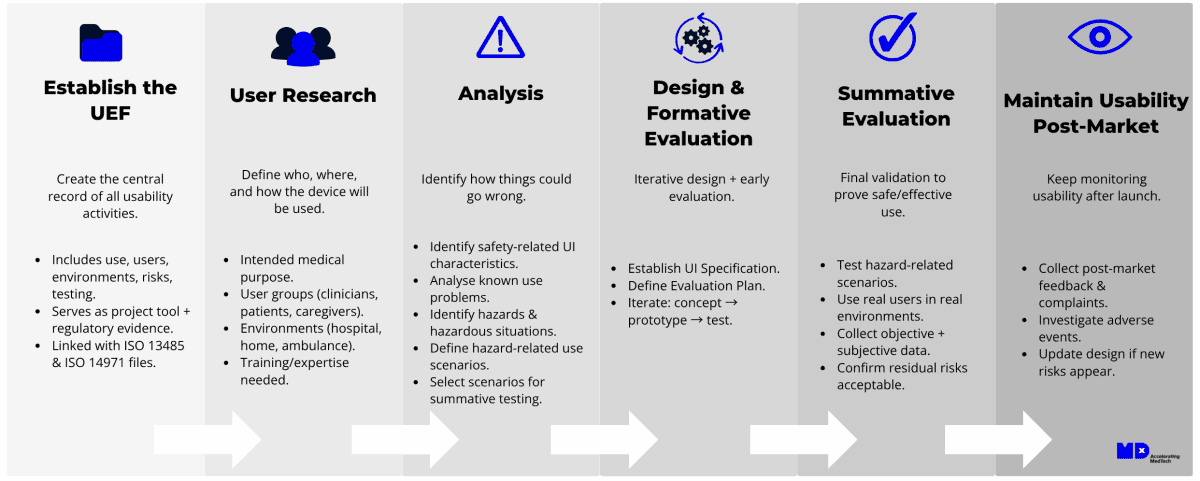
Step-by-step visual guide illustrating the IEC 62366 usability engineering process for medical devices, covering intended use definition, hazard identification, risk analysis, user interface requirements, formative evaluations, and summative usability validation, aligned with EU MDR and FDA human factors guidelines.

The UEF is the central documentation repository for all usability activities. It includes intended use, user profiles, use scenarios, hazard analysis, test results, and risk control measures. In practice, the records and other documents that form the UEF may also form part of the product design file (ISO 13485) or the risk management file (ISO 14971).

Think of the UEF as both a project management tool and evidence for regulators.

Prepare the Use Specification. This is where you define:

  • The intended medical purpose of the device
  • The user groups (e.g. clinicians, patients, laypersons, caregivers)
  • The use environments (hospitals, homes, ambulances, clinics)
  • Any training or expertise required

This forms the foundation of all subsequent usability activities.

Once you know who will use your device and where, the next step is to analyse how things could go wrong.

Activities include:

  • Identifying safety-related user interface characteristics (e.g. readability of displays, button layout, alarm visibility).
  • Reviewing post-production data and public databases for known usability issues with similar devices.
  • Identifying hazards and hazardous situations.
  • Identifying and describing hazard-related use scenarios, which describe exactly how use errors might occur and what consequences they could have.
  • Selecting hazard-related use scenarios for Summative Evaluation.

These scenarios are then prioritised to decide which will be evaluated in summative testing.

This is where design and usability testing happen in iterative cycles.

Key steps:

  1. Establish the User Interface Specification – the blueprint of all UI elements.
  2. Develop the User Interface Evaluation Plan – define how formative and summative testing will be performed.
  3. Iterative cycles of concept, prototype, and testing

The point of formative evaluation is to find usability issues early, before final validation, so changes are cheaper and less disruptive.

The final stage is a summative usability validation. This is a formal test that demonstrates to regulators that the device can be used safely and effectively by the intended users.

  • Test the hazard-related use scenarios identified earlier.
  • Use representative users in realistic environments.
  • Collect both objective performance data (task completion, error rates) and subjective feedback (ease of use, confidence).
  • Confirm that residual risks are acceptable in line with ISO 14971.

This stage provides the objective evidence regulators require to ensure compliance.

Usability engineering does not end at product launch. Post-market surveillance should collect feedback on usability issues, adverse events, and complaints. Updates or design changes may be required if new risks emerge.

Common Challenges in Applying IEC 62366

Many manufacturers encounter difficulties such as:

  • Underestimating resources needed for usability testing
  • Recruiting representative users for formative and validation studies
  • Defining realistic use scenarios that reflect actual clinical environments
  • Integrating usability with development timelines
  • Documenting evidence properly in the UEF

Failing to address these challenges can result in regulatory rejection, delays, or costly redesigns.

Best Practices for Success

  1. Start usability engineering early in the design process
  2. Involve multidisciplinary teams including engineers, clinicians, and usability experts
  3. Use a mix of qualitative and quantitative methods in evaluations
  4. Prioritise hazard-related use scenarios in validation testing
  5. Document everything thoroughly in the Usability Engineering File
  6. Where possible involve regulators early for alignment
  7. Leverage specialist expertise such as a Medical Device and IVD Consultancy with usability engineering experience
Does the FDA also recognise IEC 62366?

Yes. The latest versions of the IEC 62366 standards are recognised by the FDA as consensus standards. However, the FDA has also published specific human factors engineering guidances with minor differences to IEC 62366 so it is recommended that these are also considered for FDA submissions.

When should usability testing be performed?

Throughout development. Formative evaluations identify and correct issues early, while summative validation confirms safe and effective use before market approval.

Can simulated environments be accepted in usability validation?

Yes, provided they are representative of real-world conditions and cover all critical tasks and hazard-related use scenarios.

What is the difference between IEC 62366-1 and IEC 62366-2?

EC 62366-1 is the main normative standard that defines the usability engineering process manufacturers must follow. IEC 62366-2 is a companion informative document that provides guidance and rationale to help apply IEC 62366-1 in practice. For regulatory submissions, compliance with IEC 62366-1 is what notified bodies and regulators assess — IEC 62366-2 is a supporting resource, not a requirement.

What must be included in a Usability Engineering File?

The Usability Engineering File (UEF) is the core documentation output of the IEC 62366-1 process. It must document the intended use and user groups, use scenarios and user interface specification, formative evaluation records, summative evaluation plan and results, and risk-related findings and how they were addressed. It should be structured to allow a notified body or regulatory reviewer to trace the full usability engineering process from start to finish.

Does IEC 62366 apply to IVDs?

Yes. IEC 62366-1 applies to all medical devices, including in vitro diagnostic devices (IVDs). Under the EU IVDR and MDR, manufacturers are expected to demonstrate that human factors and usability have been considered as part of the design and development process. This is particularly relevant for IVDs used at the point of care or by lay users, where use errors can have direct patient safety implications.

How many participants are needed for a summative usability study?

There is no fixed number mandated by IEC 62366-1, but common practice — and FDA guidance — typically expects a minimum of 15 participants per user group for summative evaluations. The number should be justified based on the diversity of the user population, the complexity of the device, and the number of critical tasks being evaluated. For high-risk devices or large user populations, a larger sample may be required.

What is the difference between a formative and summative evaluation?

Formative evaluations are iterative assessments carried out during device development to identify and resolve usability problems early. They are exploratory in nature and do not need to meet a pre-defined pass/fail criterion. Summative evaluations, also called validation testing, are conducted on a near-final or final version of the device to confirm that users can operate it safely and effectively without being coached or corrected. Summative results are what get submitted to regulators.

How MDx CRO Can Help

Implementing IEC 62366 in-house can strain resources. At MDx CRO we can provide:

  • Protocol development and study design for usability testing
  • Recruitment of representative users across geographies
  • Moderation of formative and validation studies
  • Integration of usability engineering with regulatory strategy
  • Preparation of all usability documentation required for submissions including FDA submissions

As a trusted Medical Device and IVD consultancy, we support manufacturers in implementing IEC 62366, running usability studies, and preparing documentation that satisfies both EU and US regulators. Whether you are starting a new project or updating an existing device, our team helps you achieve compliance and deliver safer devices to market.

Need help with IEC 62366 compliance?

Talk to our usability engineering team.

Full Name
(Include device type, current challenge, or regulatory stage)
We respect your privacy. All information submitted will 
remain confidential.
Checkboxes
Written by:
Floella Otudeko

Floella Otudeko

Senior QARA Specialist

Senior QA/RA consultant with MDR, IVDR, Usability/Human Factors and MDSW expertise, supporting MedTech and IVD innovation globally.
Industry Insights & Regulatory Updates

MDR Compliance Checklist: What You Need Before Submitting

A Comprehensive Pre-Submission Readiness Guide

Navigating the European Union’s (EUs) Medical Device Regulation (Regulation [EU] 2017/745; MDR) demands meticulous preparation. Submitting incomplete technical documentation to a Notified Body (NB) for review triggers lengthy review cycles and costly delays. This guide serves as a final gap analysis to ensure a robust, coherent, and compliant submission, paving a smoother path to Conformité Européenne (CE) marking.

Your technical documentation is an output of your quality management system (QMS). The NB will review your technical file and your QMS, in accordance with the requirements of Annex IX of the MDR. Other conformity assessment routes, such as those outlined in Annex X (based on type-examination) or Annex XI (based on product conformity verification), may also be selected, although they are less commonly used.

The foundational systems and roles required of all manufacturers, regardless of device classification, are as follows:

  • MDR-compliant QMS: Per MDR Article 10(9), a QMS for developing, manufacturing, and post-market monitoring is mandatory. Although certification to ISO 13485:2016 is not mandatory, it is commonly used to demonstrate compliance and is considered the most effective way to fulfil the requirements of Article 10(9) of the MDR. For all devices, the QMS should incorporate MDR-specific processes such as post-market surveillance (PMS), vigilance, and unique device identification (UDI) management.

For Class IIa, IIb, and III devices, as well as certain Class I devices placed on the market in sterile condition, with a measuring function, or intended to be reused, the QMS is typically assessed by a Notified Body as part of the conformity assessment. For other Class I devices, while a QMS is still required under Article 10(9), it does not require Notified Body involvement.

  • Risk management system: Mandated by MDR Annex I, risk management per ISO 14971 must be a continuous process implemented throughout the entire product lifecycle, ensuring risks are controlled and an acceptable benefit-risk ratio.
  • Person Responsible for Regulatory Compliance (PRRC): MDR Article 15 obliges manufacturers to designate at least one qualified PRRC permanently and continuously at their disposal. This ensures technical documentation and declarations of conformity (DoC) are prepared and maintained in compliance with the Regulation.
  • Understanding stakeholder obligations: Ensure that your organisation understands, and has communicated, the necessary information to distributors and importers, who have specific obligations under MDR Articles 13 and 14 regarding verification, storage, and complaint handling.

Your technical documentation is the core evidence dossier for your device, structured in accordance with MDR Annexes II (Technical Documentation) and III (Technical Documentation on PMS).

Technical documentation (Annex II)

Must provide comprehensive evidence that all General Safety and Performance Requirements (GSPRs) from Annex I are met.

  • Device description & specifications: Detailed description of the device, including trade name, intended purpose, users, patient population, principles of operation, and key functional elements (components, materials, software). Identification via Basic UDI-DI (per MDR Article 27 and Annex VI, Part C) or other traceable identifiers. Justification of device qualification, risk class, and applied classification rules in accordance with MDR Annex VIII. Overview of previous and similar generations of the device
  • Labelling & Instructions for Use (IFU): All labelling must comply with MDR Annex I, Chapter III. Claims made in the IFU or labelling must be consistent with, and supported by, the clinical evaluation, GSPRs, and RMF. Labels and Instructions for Use (IFU) in all applicable EU languages
  • Design and Manufacturing Information: Description of design stages, manufacturing processes, validation data, and control of critical suppliers/subcontractors.
  • GSPR checklist: Links each applicable safety and performance requirement of the device to the source of objective evidence (ie, verification & validation [V&V] reports, test data, or procedures); GSPRs not considered applicable should be justified. Reference to applied harmonised standards, common specifications (CS), or equivalent solutions.
  • Risk management file (RMF): Must demonstrate a complete lifecycle approach to risk per ISO 14971, including analysis, evaluation, control, and a report concluding a favourable benefit-risk profile.
  • V&V reports: Data supporting device safety and performance, including
    • Biocompatibility (ISO 10993 series)
    • Electrical Safety & electromagnetic compatibility (IEC 60601 series)
    • Software V&V (IEC 62304 for lifecycle processes)
    • Stability and shelf-life testing
    • Sterilisation validation
    • Performance and safety testing relevant to intended use

Clinical Evaluation (Annex XIV)

Includes a clinical evaluation report (CER) based on a compliant clinical evaluation plan (CEP), providing sufficient clinical evidence to demonstrate device safety, performance, and a favourable benefit-risk ratio. It must also:

  • critically appraise data from manufacturer clinical investigations or an equivalent device (if claimed according to strict MDR criteria);
  • be updated continuously throughout the device’s lifecycle with post-market data.

PMS & vigilance (Annex III)

The Post-Market Surveillance (PMS) Documentation ensures continuous evaluation of device performance and compliance throughout its lifecycle, through the following documents.

  • A PMS plan: Proactively and systematically collects and analyses post-market data on device quality, performance, and safety.
  • A post-market clinical follow-up (PMCF) plan: Actively gathers clinical data post-market, required unless exclusion is justified.
  • Vigilance System: Robust procedures for reporting Serious Incidents and Field Safety Corrective Actions to competent authorities per MDR Article 87.
  • PMS reporting: Preparation of a Periodic Safety Update Report (PSUR) (Article 86) or Post-Market Surveillance Report (PMSR) (Article 85), depending on device class

Step 3: Pre-Submission – Administrative and Conformity Assessment Planning

Final checks before NB engagement.

  • Conformity assessment: Based on device classification, the correct conformity assessment procedure (detailed in MDR Annexes IX-XI) must be followed.
  • EU DoC (Annex IV): A draft DoC must be prepared, listing all applicable regulations and standards, signed after the NB grants CE certification.
  • Summary of Safety and Clinical Performance (SSCP): For implantable and Class III devices; must be written in clear, layperson language and must be consistent with the CER and IFU.
  • CRITICAL STEP – Internal Consistency Review: A cross-functional review to ensure the device name, intended purpose, indications, and key performance claims are consistent across documentation.
  • NB Engagement:
    • Designation Scope: Confirm your chosen NB is officially designated for your device type and classification.
    • HIGHLY RECOMMENDED – Pre-Submission Meeting: Discuss your strategy and the NB’s expectations through structured dialogues, de-risking the formal submission process.

Supporting Documents and Guidance

  • ISO 13485:2016 (QMS)
  • ISO 14971:2019 (Risk Management)
  • ISO 14155:2020 (Clinical Investigations)
  • MEDDEV 2.7/1 Rev. 4 (Clinical Evaluation: A Guide for Manufacturers and Notified Bodies)
  • MDCG 2020-6 (Clinical evidence needed for medical devices previously CE marked under Directives 93/42/EEC or 90/385/EEC: A guide for manufacturers and notified bodies)
  • MDCG 2020-7 (Post-market clinical follow-up [PMCF] Plan Template: A guide for manufacturers and notified bodies)
  • MDCG 2020-8 (Post-market clinical follow-up [PMCF] Evaluation Report Template: A guide for manufacturers and notified bodies)
  • MDCG 2019-9 (Summary of safety and clinical performance: A guide for manufacturers and notified bodies)

Key Takeaway

MDR compliance transcends document creation. It is about building a coherent, evidence-based narrative weaving together quality management, risk analysis, clinical data, and post-market vigilance into a single, compelling story of your device’s safety and performance. Using this comprehensive checklist to perform a final, critical gap analysis ensures your story is not only complete but also clear, consistent, and readily verifiable, paving a smoother path to successful CE marking under the MDR.

Request regulatory documentation services.

Contact us today for a consultation with our medical devices team.

Written by:
Grace Chia, PhD

Grace Chia, PhD

RA Specialist

Regulatory Affairs Specialist in MDR & IVDR with expertise in CERs, SVRs, literature review, and regulatory compliance.
Industry Insights & Regulatory Updates

Clinical Development for Medical Devices: From Strategy to Submission

Clinical development for medical devices is a complex and continuous process under Regulation (EU) 2017/745 (MDR), requiring robust clinical evidence to demonstrate safety and performance. Regardless of whether your product is a novel technology or an updated version of an existing device, regulators demand comprehensive evaluation across every phase. This guide walks you through the key steps, from early strategy to final submission, to help you achieve MDR compliance.

To begin with, this phase is critical for defining the scope, evidence routes, and overall resource allocation for your clinical efforts. A well-constructed strategy at this stage prevents costly errors and oversights, setting the trajectory for a successful submission. As a result, this phase produces the clinical evaluation plan (CEP), your core strategic document.

Key strategic actions:

Comprehensive gap analysis: Assess all existing data against the MDR requirements applicable to your device’s risk class and intended purpose. This includes preclinical data (biocompatibility, electrical safety, software validation, usability engineering) and potential sources of clinical data.

Defining the evidence route map: Decide if conformity with the general safety and performance requirements (GSPRs) set out in Annex I of the MDR can be demonstrated through existing data or if a new clinical investigation is required.

  • Waiver of clinical data: Under MDR Article 61(10), a justification for omitting clinical data may be possible if deemed “not appropriate.” This is reserved for low-risk devices where safety and performance can be demonstrated through comprehensive preclinical testing (e.g., bench testing, non-clinical performance evaluation). You must justify the waiver through risk management and support it with clear technical documentation.
  • Clinical investigation route: For novel devices or when equivalence cannot be sufficiently proven, a new clinical investigation is unavoidable, especially for Class IIb implantable and all Class III devices.
  • Equivalence route: Alternatively, if you rely on data from another device, you must provide rigorous proof of technical, biological, and clinical equivalence as per the MDR’s strict criteria. Notified Bodies (NBs) apply these requirements strictly, which makes this path to clinical evidence more difficult.

Developing the Clinical Development Plan (CDP): This overarching document integrates pre-market and post-market clinical activities, ensuring a seamless transition from pre-market approval to post-market surveillance.

Using the CEP as the roadmap:

The CEP must define the device and its intended purpose. It should also establish specific clinical safety and performance objectives that are aligned with the device’s intended clinical benefits and risk profile. It must outline clear clinical questions, list relevant data sources, and explain the literature search strategy. A well-crafted CEP is the strategic backbone of clinical development for medical devices, ensuring your evidence generation aligns with MDR expectations.

Need expert guidance navigating MDR clinical development? Partner with MDx CRO to streamline your clinical strategy, generate robust evidence, and ensure regulatory success. Contact us today.

While the clinical evaluation identifies evidence gaps, a clinical investigation may be required to generate the data needed to address them.

Clinical investigation set-up and conduct:

  • Investigation plan and protocol development: You must ensure the protocol is scientifically rigorous and ethically sound, in line with ISO 14155:2020. It should clearly define endpoints, sample size, and study methodology.
  • Navigating regulatory approvals: Secure necessary approvals from Competent Authorities and favourable opinions from Ethics Committees in each target member state.
  • Trial conduct, monitoring and oversight: Additionally, ensure all sites are adequately trained and monitored in study procedures. Use robust data systems to ensure data integrity and accuracy.
  • Vigilance and Safety Reporting: Establish clear processes for capturing, assessing, and reporting all adverse events and device deficiencies in accordance with regulatory timelines. You must ensure these processes comply with MDR requirements, particularly Articles 80–89 and Annex III Section 1.1(c). In addition, where applicable to clinical investigations, compliance with ISO 14155:2020 is also required.

At this stage, you must transform raw data into compelling evidence. The data must be critically appraised, synthesised, and contextualised within the current state of the art.

Understanding clinical data:

Per MDR Article 2(48), clinical data are information concerning safety or performance of a device that are generated from the use of a device, and are sourced from one or more of the following:

  • Clinical investigations of the device under evaluation (DuE).
  • Clinical investigation(s) or other studies reported in scientific literature, involving a device for which equivalence to the device in question can be demonstrated.
  • Peer-reviewed scientific literature reporting other clinical experience with the device in question or with a device for which equivalence can be demonstrated.
  • Clinically relevant information from post-market surveillance (PMS), particularly post-market clinical follow-up (PMCF).

Core components of data analysis and compiling the clinical evaluation report (CER):

  • Systematic literature review and data appraisal: Execute the literature search as defined in the CEP. The process must be fully transparent, systematic, and reproducible. Evaluate each data source critically for validity, quality, and relevance—whether from your study or existing literature. Standardised appraisal tools should be used to assess the risk of bias and the strength of the evidence.
  • Demonstrating conformity with GSPRs: You must clearly link your clinical evidence to the GSPRs in the CER. It should clearly state how the collected data verifies that each applicable clinical requirement is met.
  • State-of-the-art comparison: Compare your device’s performance, safety, and benefit-risk profile against the current standard of care and available alternatives. This contextualises your device’s value within the medical landscape.
  • Writing a comprehensive and well-structured CER: The final report should clearly justify the device’s clinical safety and performance. It must affirm that the overall benefit-risk conclusion is favourable for the intended target population and clinical setting. Your evaluator(s) must sign the CER to confirm responsibility, and all data, appraisals, and conclusions must be traceable.

Synthesising data into a Clinical Evaluation Report (CER) is a critical milestone in clinical development for medical devices, connecting raw data to a clear regulatory conclusion.

Under MDR, clinical evaluation is a continuous process. In fact, certification is not the finish line—it’s the midpoint of an ongoing cycle of evidence generation.

Ongoing post-market obligations:

  • PMS: Proactively collect and evaluate real-world data from various sources, including user feedback, complaint handling, literature screening, and registries. This system helps detect emerging risks or performance issues.
  • PMCF studies: Where required by the risk profile or as outlined in the CDP, conduct targeted PMCF studies to investigate the long-term performance and safety of the device, or to address any residual uncertainties from pre-market clinical evaluation.
  • CER updates: Treat the CER as a living document. Therefore, update it annually for Class III and implantable devices, or every 2–5 years for lower-risk classes. An immediate update is warranted upon the discovery of significant new information that could impact the benefit-risk assessment, such as newly available clinical data, emerging risks, or advancements in the state-of-the-art.

Navigating Challenges

  • Data quantity and quality: Data must be sufficient for statistical significance and come from reputable sources. Manufacturers must demonstrate a thorough search of relevant databases (e.g., PubMed, EMBASE) and a critical appraisal of the data’s scientific validity.
  • Justifying a waiver: However, waiving clinical data is risky. You must justify it scientifically and ethically, rooted in strong risk management
  • Proving equivalence: The bar for demonstrating technical, biological, and clinical equivalence is high. Because NBs assess equivalence strictly, a new clinical investigation is often the better option.

Supporting Documents and Guidance

Regulations

Harmonised Standards:

  • ISO 14155:2020 (Clinical investigation of medical devices for human subjects — Good clinical practice)

Guidance Documents:

  • MDCG 2020-13 (Clinical evaluation assessment report template)

Key Takeaway

Successful clinical development for MDR compliance is not a series of isolated tasks but an integrated, lifecycle-spanning process with clinical evaluation as its continuous core. To sum up, by planning strategically with a thorough gap analysis and a robust CEP, executing clinical investigations with rigor, synthesising data into compelling evidence in the CER, and embracing the ongoing cycle of PMS and CER updates, you demonstrate more than just compliance. You build and maintain a strong, evidence-based case for your device’s enduring value, safety, and performance in the marketplace.

Written by:
Grace Chia, PhD

Grace Chia, PhD

RA Specialist

Regulatory Affairs Specialist in MDR & IVDR with expertise in CERs, SVRs, literature review, and regulatory compliance.
Industry Insights & Regulatory Updates

Clinical Evaluation of Orphan Devices: Navigating MDCG 2024-10

The Medical Device Coordination Group (MDCG) recently released guidance MDCG 2024-10, focusing on the clinical evaluation of orphan medical devices. This comprehensive guidance aims to address the unique challenges and regulatory requirements for orphan devices under the Medical Device Regulation (MDR) 2017/745. Orphan medical devices are intended for rare diseases or conditions, affecting a small patient population. This article delves into the key aspects of the new guidance, emphasizing the clinical evaluation processes and the implications for manufacturers.

Introduction to Orphan Devices

Orphan medical devices play a crucial role in providing diagnostic or therapeutic solutions for rare diseases or conditions, which often lack adequate medical alternatives. The MDR has stringent requirements for clinical evidence, which pose significant challenges for orphan devices due to their limited patient population and the ethical concerns surrounding clinical investigations in vulnerable groups, such as children.

Defining Orphan Devices

Orphan devices (OD) are defined as medical devices or accessories intended for the treatment, diagnosis, or prevention of diseases or conditions that affect no more than 12,000 individuals annually in the European Union. To qualify as an orphan device, the device must meet one of the following criteria:

  • There is an insufficiency of available alternative options for the treatment, diagnosis, or prevention of the disease or condition.
  • The device provides an expected clinical benefit compared to available alternatives or the current state of the art, taking into account both device-specific and patient population-specific factors.

Scope of Applicability for MDCG 2024-10

The MDCG 2024-10 guidance does not apply to the following types of devices:

  • Custom-made devices: According to EU MDR Article 2(3).
  • In-house devices: According to EU IVDR Article 5(5).
  • Products without an intended medical purpose: According to EU MDR Annex XVI.
  • In vitro diagnostic medical devices: Devices covered under the In Vitro Diagnostic Medical Devices Regulation (IVDR) 2017/746.

Evaluating Clinical Data Limitations

For orphan devices, it is acknowledged that the scarcity of available patients and the nature of the conditions often limit the amount of comprehensive clinical data that can be gathered pre-market. Therefore, the MDCG allows for certain limitations in pre-market clinical data under specific conditions:

  • There must be enough existing non-clinical and clinical data to suggest that the device can perform its intended purpose with an acceptable level of safety.
  • Any limitations in the clinical data must be transparently communicated to healthcare professionals and users.
  • The manufacturer must implement an effective post-market surveillance (PMS) strategy and post-market clinical follow-up (PMCF) plan to gather further data and validate the clinical performance and safety of the device post-launch.

Importance of Non-clinical Data for OD

Non-clinical data play a pivotal role in supporting the safety and efficacy of orphan devices, especially when clinical data are limited. This data can include:

  • Laboratory and animal studies that provide preliminary safety and performance insights.
  • Engineering and bench tests that demonstrate the device’s mechanical and functional integrity.
  • Computational modeling that predicts device behavior in various scenarios.

Manufacturers are encouraged to utilize robust non-clinical data to justify the safe use of their devices, reducing the reliance on extensive pre-market clinical trials which may not be feasible for orphan devices.

Expert Panel Consultation: Enhancing the Orphan Device Certification Process

Section 11 of the MDCG 2024-10 guidance outlines the role of expert panels in the evaluation process of orphan medical devices. This section emphasizes the importance of obtaining external expert advice to ensure that orphan devices meet stringent safety and efficacy standards before they reach the market. The involvement of expert panels is particularly crucial given the unique challenges associated with the development and evaluation of devices intended for rare diseases.

Purpose of Expert Panel Consultation

The consultation with expert panels serves multiple purposes:

  • Verification of Orphan Device Status: Expert panels assist in verifying the orphan status of a device, ensuring that the manufacturer’s justification aligns with the regulatory definitions and requirements.
  • Assessment of Clinical Evidence: Panels review the sufficiency and appropriateness of both clinical and non-clinical data to support the intended use of the device. This is especially critical when traditional clinical trial routes are impractical due to the rarity of the condition the device is designed to treat.
  • Guidance on Regulatory Compliance: Expert panels provide guidance on whether the device meets the overall regulatory requirements, including safety and performance standards outlined in the MDR.

Process of Expert Panel Involvement

  1. Early Engagement: It is recommended that notified bodies engage with expert panels as early as possible, ideally during the pre-assessment phase of the device certification process. This early engagement allows for a structured dialogue between the manufacturer, the notified body, and the expert panel, facilitating a thorough and informed evaluation.
  2. Review of Manufacturer’s Submission: The expert panel reviews the documentation provided by the manufacturer, focusing on the justification for the orphan device classification and the adequacy of the clinical and non-clinical evidence.
  3. Issuance of Recommendations: Based on their review, the expert panel issues recommendations that can significantly impact the certification process. These recommendations might pertain to additional data requirements, modifications to the device or its intended use, or specific post-market surveillance strategies.
  4. Influence on Notified Body Decisions: The advice provided by the expert panel is taken into consideration by the notified body in their final decision-making process. While the notified body is not bound to follow the panel’s recommendations, any deviations must be well justified in the assessment report.

Benefits of Expert Panel Consultation

The involvement of expert panels in the certification process of orphan devices brings several benefits:

  • Enhanced Device Safety and Efficacy: Expert panels contribute to a higher level of scrutiny, potentially increasing the safety and efficacy of devices approved for rare conditions.
  • Reduced Risk of Post-Market Issues: By addressing potential issues during the pre-market phase, expert panels help reduce the risk of significant complications once the device is in clinical use.
  • Increased Confidence Among Stakeholders: The input from expert panels can increase confidence among healthcare providers, patients, and regulatory bodies regarding the reliability and effectiveness of orphan devices.

Notified Bodies

Notified bodies play an essential role in determining whether a device qualifies as an orphan device before its certification. This critical initial assessment should be conducted as early as possible to ensure compliance and readiness for market entry:

  • Verification of Orphan Device Status:

The orphan status of the device should be verified at the earliest opportunity, ideally during a structured dialogue before or during the initial conformity assessment activities. This verification involves a thorough assessment of the evidence provided by the manufacturer, which must justify the classification of the device as an orphan, as detailed in section 4.2 of the guidance.

  • Assessment of Clinical and Non-clinical Data:

Notified bodies are tasked with evaluating the sufficiency and quality of both clinical and non-clinical data submitted by the manufacturer. This evaluation is crucial to ensure that, despite the acknowledged limitations typically associated with clinical data for orphan devices, there is robust evidence to demonstrate that the device can perform safely and effectively.

  • Compliance with Regulatory Requirements:

The review process must confirm that the device complies with all relevant regulatory requirements, with a focus on safety and performance standards as specified in the Medical Device Regulation (MDR).

Additionally, if applicable, notified bodies may take into consideration advice provided by an expert panel. This advice can significantly influence the assessment, particularly regarding the device’s status as an orphan and the adequacy of the clinical evidence. This expert input ensures a comprehensive review process, aligning the device assessment with the highest standards of regulatory compliance and patient safety.

Conclusion for the Clinical Evaluation of Orphan Devices

The MDCG 2024-10 guidance provides a structured approach for the clinical evaluation of orphan medical devices, balancing the need for clinical evidence with the practical challenges of studying rare conditions. By allowing for limitations in pre-market clinical data and emphasizing robust non-clinical evidence and post-market follow-up, the guidance aims to facilitate the market access of orphan devices, ultimately improving patient care for rare diseases. Manufacturers must navigate these requirements carefully, leveraging robust non-clinical data and detailed documentation, to ensure that orphan devices meet regulatory standards while addressing the unique needs of patients with rare conditions.

Industry Insights & Regulatory Updates