

What separates a successful IVD clinical performance study from one that gets rejected by a Notified Body? With the IVDR now fully in force, MDCG 2025-5 reshaping how performance studies are planned, and the proposed IVDR targeted revision on the table, the rules have changed significantly since our original article. This 2026 update covers everything IVD manufacturers and sponsors need to know to design, conduct, and report performance studies that meet current regulatory expectations, and avoid the most common pitfalls we see in the field.
Why This Article Needed a 2026 Rewrite
When we first published this guide, the IVD landscape looked very different. Since then, several regulatory milestones have fundamentally changed how IVD clinical performance studies must be planned and executed:
- MDCG 2025-5 In June 2025, the Medical Device Coordination Group published 54 Q&A clarifying performance study requirements under IVDR Articles 57–77. This document addresses when studies require competent authority authorisation versus notification, how to handle companion diagnostics, and what constitutes a substantial modification. It has become the go-to reference for sponsors planning studies in the EU.
- ISO 20916:2024 with Annex ZA The revised standard now formally maps its clauses to IVDR requirements, creating a single harmonised pathway for clinical performance study conduct. While official recognition as an IVDR harmonised standard in the EU Official Journal is still pending, Notified Bodies are already referencing Annex ZA during reviews.
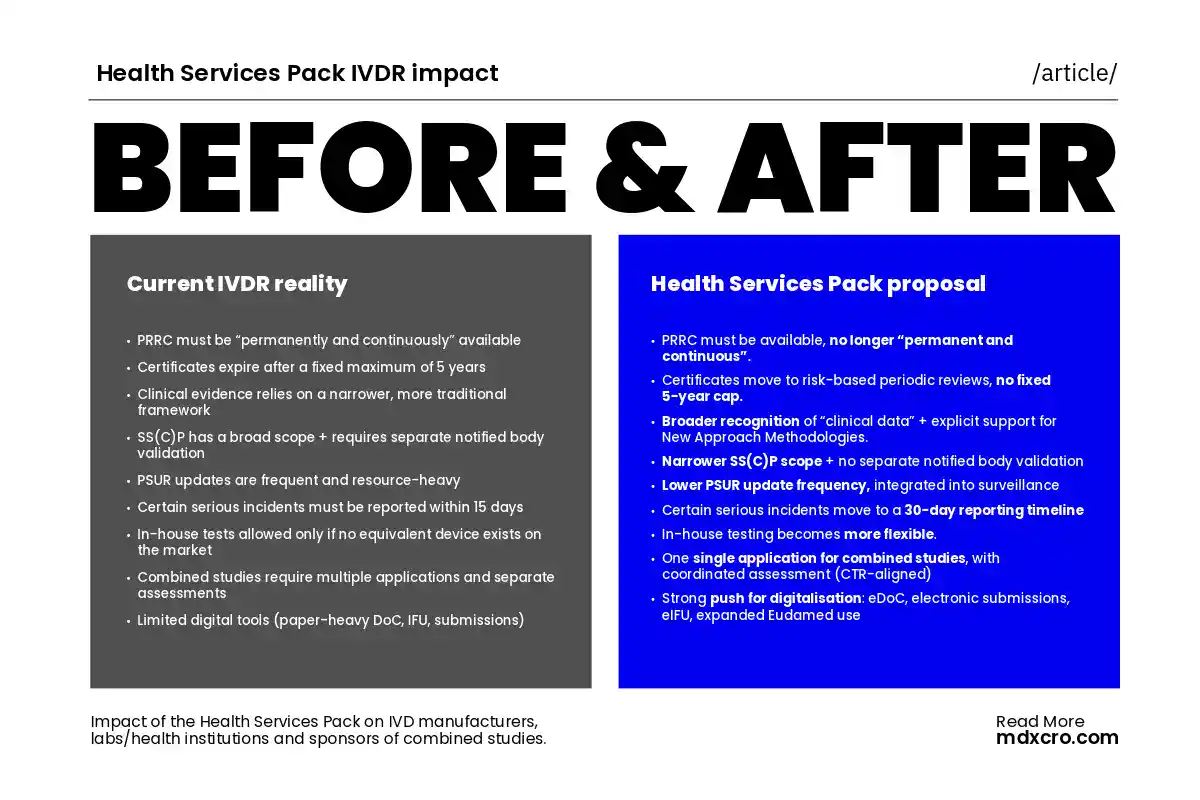
- The proposed IVDR targeted revision (COM(2025) 1023) Published in December 2025, this European Commission proposal includes direct changes to performance study requirements. Among them: performance studies involving only routine blood draws would no longer require prior authorisation, and the mandatory notification for CDx studies using exclusively leftover samples would be removed. This is still a legislative proposal, it must pass through Parliament and Council, but it signals the direction of travel.
- IVDR transition milestones for 2026 Under Regulation (EU) 2024/1860, Class C legacy devices must submit a formal IVDR certification application to a Notified Body by 26 May 2026. This means many manufacturers are running performance studies under significant time pressure right now.
These developments make the difference between planning a study that sails through regulatory review and one that stalls at the first checkpoint.
Read our in-depth IVDR clinical study guide to learn more.
A note on terminology: Under the EU IVDR 2017/746, what was traditionally called an “IVD clinical trial” is formally a clinical performance study. This article uses both terms, as many professionals still search for “IVD clinical trials,” but the regulatory-correct term is clinical performance study. Understanding this distinction matters, using incorrect terminology in submissions has been flagged as a cause of delays by competent authorities.
Understanding the IVDR Performance Study Framework
Before diving into the do’s and don’ts, it is essential to understand the regulatory architecture that governs these studies. Under the IVDR, the performance evaluation of an IVD device rests on three pillars:
- Scientific validity — The documented association between an analyte and a clinical condition or physiological state (IVDR Article 2(37)).
- Analytical performance — The ability of the device to correctly detect or measure a particular analyte. This is evaluated through bench studies covering parameters like sensitivity, specificity, accuracy, precision, and reproducibility (Annex I, Section 9.1).
- Clinical performance — The ability of the device to yield results that are correlated with a particular clinical condition or pathological process, as relevant for the target population and intended user (IVDR Article 2(40)).
Clinical performance studies address the third pillar. They are required by default under IVDR Article 56(4), unless the manufacturer can provide due justification for relying on other sources of clinical performance data such as published literature, routine diagnostic data, or results from previous studies.
MDCG 2025-5 clarifies an important nuance: it is not always required to perform both analytical and clinical performance studies. However, analytical performance must always be demonstrated through study data, while clinical performance may draw on a combination of study results, peer-reviewed literature, and data from routine diagnostics.
The results of all three pillars feed into the Performance Evaluation Report (PER), a mandatory component of IVDR technical documentation reviewed by Notified Bodies during the conformity assessment process.
IVD Clinical Performance Studies: The Do’s
1. Start with a Robust Clinical Performance Study Plan
The Clinical Performance Study Plan (CPSP) is the backbone of your study. Under IVDR Annex XIII, Section 2, and ISO 20916:2024, the plan must define:
- Study objectives and clearly formulated endpoints
- Target population and specimen types
- Inclusion and exclusion criteria
- Study design type (observational vs. interventional, this distinction has regulatory consequences for authorisation requirements)
- Statistical methodology, including sample size justification
- Comparator or reference method selection
- Data management procedures
- Ethical considerations and informed consent procedures
- Risk assessment for study participants
A common mistake is treating the CPSP as a formality. In practice, the CPSP is the first document a competent authority and ethics committee will scrutinise. A weak plan creates downstream problems that are expensive to fix once the study is underway.
2026 consideration: MDCG 2025-5 makes clear that the study design must be aligned with the device’s intended purpose as defined by the manufacturer. The intended purpose drives the scope of the required performance evidence, so any ambiguity in intended purpose will cascade into problems with the study plan, the submission, and ultimately the CE marking process.
2. Determine Your Regulatory Pathway Early
Not all performance studies follow the same regulatory route. Under the IVDR:
- Article 58(1) studies require application for authorisation to the competent authority. These include interventional clinical performance studies where the study procedure involves additional invasive specimen collection, or where the results are used to guide patient management.
- Article 58(2) studies specifically cover companion diagnostics, which always require authorisation when the CDx is investigational and specimens are prospectively collected.
- Article 70 studies involve post-market performance studies using CE-marked devices used within their intended purpose, these generally require notification rather than full authorisation.
- Other performance studies, such as those using exclusively leftover samples with no additional invasive procedures, may only need notification or, in some cases, fall outside the scope of Articles 58 and 70.
MDCG 2025-5 includes a decision flowchart (Appendix I) that helps sponsors determine which regulatory route applies to their specific study. Use it.
2026 consideration: The proposed IVDR revision (COM(2025) 1023) would simplify this landscape further, removing the authorisation requirement for studies involving only routine blood draws, and eliminating mandatory notification for CDx studies using exclusively leftover samples. However, these changes are not yet in force.
3. Account for National Variations Across EU Member States
The IVDR provides the regulatory framework, but ethics review requirements are set at the national level. MDCG 2025-5 explicitly reminds sponsors that it is necessary to check national requirements in each Member State where specimen collection occurs.
This means that a multi-country study can face different timelines, documentation requirements, and approval processes depending on the jurisdictions involved. Some Member States have well-established procedures for IVD performance study applications; others are still developing their processes under the IVDR.
Practical tips:
- The specimen collection site (not the analysis site) determines which Member State’s regulatory requirements apply (MDCG 2025-5, Q20).
- Plan for at least 38 days after notification before implementing any substantial modifications (this can be longer if expert consultation is triggered).
- Language requirements for patient-facing documents vary by country.
- Some Member States require parallel ethics committee and competent authority submissions; others accept sequential approaches.
4. Invest in Biostatistics from Day One
Biostatistics is not an afterthought, it is a design input. A qualified biostatistician should be involved from protocol development through final analysis. Key contributions include:
- Sample size calculation An undersized study produces inconclusive results; an oversized study wastes time and resources. Both are avoidable with proper statistical planning.
- Endpoint definition Clinical performance endpoints (sensitivity, specificity, predictive values, diagnostic accuracy) must be precisely defined and measurable.
- Bias control Randomisation, blinding, and confounding factor management must be built into the design, not retrofitted.
- Statistical analysis plan (SAP) This should be finalised before data collection begins. Post-hoc analysis adjustments are a red flag for Notified Bodies.
Under IVDR Annex XIII, Section 2.3.2, the competent authority may assess the statistical approach, study design, sample size, selected comparators, and choice of endpoints as part of the review process.
5. Use Validated Assays That Represent the Final Product
The IVDs used in clinical performance studies must accurately represent the final product as intended for commercial distribution. This means the device version used in the study should be equivalent, in terms of reagents, protocols, software, and hardware, to what will be placed on the market.
If the device undergoes changes between the study and CE marking, the manufacturer must justify that those changes do not invalidate the clinical performance data. Notified Bodies scrutinise this carefully.
IVDR Annex XIII also requires that analytical performance be established before or in parallel with the clinical performance study. There is no point in demonstrating that a device correlates with a clinical condition if the underlying analytical performance has not been characterised.
6. Follow Good Study Practice, Not GCP
This is a critical distinction that MDCG 2025-5 and industry experts have repeatedly emphasised. IVD performance studies are governed by Good Study Practice (GSP) as defined in ISO 20916, not Good Clinical Practice (GCP) as defined in ICH E6.
GCP was developed for pharmaceutical clinical trials and is referenced in ISO 14155 for medical device clinical investigations. While some principles overlap, the frameworks are different. Submitting a performance study designed under GCP rather than GSP can raise concerns during review and may even lead to rejection.
ISO 20916:2024, with its new Annex ZA, provides the direct link between GSP requirements and IVDR regulatory expectations. Sponsors should design their quality systems and study procedures around this standard.
7. Maintain Rigorous Data Management and Documentation
Data integrity is a central requirement under IVDR and ISO 20916. Your data management plan should cover:
- How data will be collected, entered, and verified
- Electronic data capture systems and their validation status
- Source data verification procedures
- Audit trail requirements
- GDPR compliance for personal and health data across all participating countries
- Data monitoring procedures and triggers for quality review
The Clinical Performance Study Report (CPSR) the final output of the study, feeds directly into the Performance Evaluation Report (PER). Any data integrity issues in the CPSR will compromise the entire PER and, by extension, the CE marking application.
8. Plan for Post-Market Performance Follow-Up from the Start
Under IVDR, clinical evidence is not a one-time exercise. The regulation requires a Post-Market Performance Follow-up (PMPF) plan that describes how the manufacturer will proactively collect and evaluate clinical performance data after the device is on the market.
For Class C and D devices, the PMPF Evaluation Report must be updated annually. Planning the PMPF in parallel with the pre-market study ensures continuity of evidence and avoids gaps that could jeopardise continued market access.
9. Incorporate User Feedback, Especially for Near-Patient and Self-Testing IVDs
Usability and user comprehension data are increasingly important, particularly for IVDs intended for lay users, point-of-care settings, or self-testing. Evidence of appropriate use, comprehension of instructions for use, and error rates should be captured during or alongside the clinical performance study.
This evidence supports compliance with the IVDR General Safety and Performance Requirements (GSPRs) and is expected in the technical documentation reviewed by the Notified Body. MDx’s usability engineering services can help integrate these requirements into your study design.
IVD Clinical Performance Studies: The Don’ts
1. Don’t Confuse Terminology or Regulatory Frameworks
As noted above, using GCP where GSP is required, or referring to your study as a “clinical trial” in regulatory submissions when the IVDR uses “clinical performance study,” can create unnecessary confusion and delays.
Similarly, do not conflate the FDA’s Investigational Device Exemption (IDE) framework with IVDR requirements. While both regulate clinical evidence generation for IVDs, the legal basis, study classifications, submission requirements, and oversight bodies are fundamentally different. An article on running clinical studies under IVDR versus the FDA pathway can help clarify these differences.
2. Don’t Neglect the Application or Notification Step
Depending on the study type (see Article 58(1), 58(2), or 70), your performance study may require formal authorisation from, or notification to, the competent authority in each Member State where specimens are collected. Failing to submit the correct application, or submitting under the wrong article, is a common cause of regulatory delays.
MDCG 2025-5 Appendix I provides a decision tree for determining your obligations. Use it systematically. When in doubt, apply for authorisation rather than merely notifying, it is easier to downgrade than to discover mid-study that you should have applied.
3. Don’t Underestimate Sample Size or Population Selection
A sample size that is too small produces inconclusive results. A sample size that is too large wastes time, budget, and participant goodwill. But more importantly, the study population must be representative of the device’s intended use population.
Under IVDR Annex XIII, the clinical performance study must include participants that reflect the diversity of the real-world target population, including age, gender, disease stage, and comorbidity profiles as relevant. A study conducted exclusively on one demographic may not satisfy Notified Body expectations for generalisability.
4. Don’t Treat Substantial Modifications Lightly
Once a study is authorised or notified, any significant change to the protocol, device, endpoints, or study design may constitute a substantial modification under IVDR Article 71.
MDCG 2025-5 Appendix II provides a non-exhaustive list of changes that may be considered substantial, including:
- Changes to the primary endpoint measurement method
- Modifications to the device under study (e.g., reagent formulation, software version)
- Changes to testing modalities or procedures
- Changes to the investigator or study sites
- Changes to the statistical analysis plan
Substantial modifications must be notified to the relevant competent authority, and sponsors must typically wait at least 38 days before implementation. Ignoring this requirement can invalidate study data.
5. Don’t Skip the Ethics Review
While the IVDR itself does not impose ethics committee review requirements (these are set nationally), MDCG 2025-5 explicitly reminds sponsors that national ethics requirements must be checked and followed. In most EU Member States, ethics committee approval is required for studies involving human participants, even when leftover samples are used.
Beyond regulatory compliance, ethical oversight protects participants, strengthens the credibility of the study data, and is expected by Notified Bodies reviewing the clinical evidence package.
6. Don’t Rush the Study to Meet Transition Deadlines
With 2026 IVDR transition milestones creating urgency, particularly the 26 May 2026 deadline for Class C Notified Body applications under Regulation (EU) 2024/1860, there is a temptation to cut corners on study design, shorten timelines, or accept suboptimal data quality.
This is counterproductive. A poorly designed or hastily executed study is more likely to result in Notified Body queries, additional evidence requests, or outright rejection, all of which cost more time than doing it right the first time.
7. Don’t Ignore Companion Diagnostic Complexity
Companion diagnostics (CDx) occupy a unique regulatory position. Under the IVDR, CDx performance studies are always subject to Article 58(2) when the CDx is investigational. The regulatory requirements, study design considerations, and evidence expectations are more demanding than for standard IVDs.
For CDx co-development programmes, where the diagnostic is developed in parallel with a therapeutic product, sponsors may also need to coordinate with the European Medicines Agency (EMA) through a pre-submission meeting to align timelines and evidence requirements.
MDCG 2025-5 addresses CDx-specific questions (Q28-Q29), including when a CDx study qualifies as interventional and how leftover samples are handled.
8. Don’t Overpromise the Device’s Performance
Title tags, promotional materials, and even study endpoints sometimes reflect aspirational rather than evidence-based performance claims. The IVDR requires that all performance claims be supported by the clinical evidence package. Overpromising leads to either failed endpoints, misleading data, or post-market compliance issues.
Be transparent about the device’s limitations. Define realistic performance targets based on the state of the art, and design the study to demonstrate what the device actually achieves.
Key Regulatory Updates That Affect Performance Studies in 2026
MDCG 2025-5: What Sponsors Must Know
Published in June 2025, this 54-question guidance document is now essential reading for anyone planning or conducting IVD performance studies. The most impactful clarifications include:
- Not all studies need both analytical and clinical components, but analytical performance must always be demonstrated via study data.
- Leftover samples can be used in many study types, but the regulatory obligations vary depending on whether the study is analytical or clinical, and whether the IVD is CE-marked.
- Specimen collection site determines jurisdiction, not the laboratory analysis site.
- “Research Use Only” (RUO) products used with a medical purpose in a performance study become IVDs under the IVDR and must meet all applicable requirements.
- Combined studies (medicinal product clinical trial + IVD performance study) are addressed, with specific guidance on sponsor responsibilities.
The Proposed IVDR Targeted Revision
The European Commission’s proposal (COM(2025) 1023), published in December 2025, includes changes that would directly impact performance studies if adopted:
- Routine blood draw studies would no longer require prior authorisation, a significant simplification for many analytical and clinical performance studies.
- CDx studies using exclusively leftover samples would no longer require mandatory notification.
- Combined studies would benefit from a streamlined single-application process aligned with the Clinical Trials Regulation (EU) No 536/2014.
This proposal is still in the legislative process. The European Commission opened a feedback period until March 2026, and final adoption is not expected before late 2026 or 2027. Manufacturers should plan under current rules but stay informed of developments.
IVDR Transition Deadlines
For manufacturers relying on transitional provisions:
- Class C devices: Notified Body application due by 26 May 2026.
- Written agreement with Notified Body: Required by 26 September 2026 for Class C.
- Legacy devices: Must continue to meet post-market surveillance and vigilance obligations under the IVDR, regardless of transitional status.
These deadlines are not flexible. Missing a milestone can mean loss of legal market access.
Summary: Performance Study Checklist for 2026
Before launching your IVD clinical performance study, confirm that you have addressed:
Planning phase:
- Intended purpose clearly defined (manufacturer’s responsibility)
- Regulatory pathway determined (Article 58(1), 58(2), 70, or other)
- MDCG 2025-5 flowchart consulted
- Clinical Performance Study Plan aligned with IVDR Annex XIII and ISO 20916:2024
- Biostatistician engaged for sample size, endpoints, and SAP
- National requirements checked for each Member State involved
- Ethics committee submissions prepared
Execution phase:
- Device version matches intended commercial product
- Analytical performance established before or in parallel with clinical performance study
- Data management plan in place with GDPR compliance
- Good Study Practice (GSP) followed, not GCP
- Substantial modification procedures defined
- Safety reporting aligned with IVDR Article 76 and MDCG 2024-4
Reporting phase:
- Clinical Performance Study Report (CPSR) prepared
- Results integrated into Performance Evaluation Report (PER)
- Post-Market Performance Follow-up (PMPF) plan developed
- Documentation ready for Notified Body review
Frequently Asked Questions about IVD Clinical Trials
IVDR (In Vitro Diagnostic Regulation) is the EU regulatory framework that mandates clinical performance studies for IVDs. It requires documented evidence of analytical and clinical performance before market approval.
Do establish clear study protocols aligned with IVDR guidelines, conduct ethical reviews early, use appropriate reference comparators, implement ISO 20916 standards, and document all decisions with traceability.
Don’t skip ethics submissions, don’t underestimate sample size calculations, don’t use outdated reference materials, don’t ignore ISO 20916 requirements, and don’t delay documentation—regulators expect complete records.
ISO 20916 is the standard for clinical performance studies of in vitro devices. While referenced in IVDR, implementation depends on device class and intended use, but compliance significantly strengthens regulatory submissions.
Timeline varies by device complexity, study design, and patient availability—typically 6-18 months. Proper planning, early regulatory consultation, and avoiding common mistakes can accelerate approval timelines.
How MDx Can Help
Planning and executing an IVD clinical performance study under the current IVDR framework requires regulatory expertise, operational capability, and deep understanding of the evolving guidance landscape.
As a dedicated MedTech and IVD Contract Research Organisation (CRO), MDx supports manufacturers across the full study lifecycle, from protocol design and competent authority submissions to study conduct, monitoring, and reporting. Our team has hands-on experience with CDx companion diagnostics, NGS panels, and IVDs across Class B, C, and D classifications.
Whether you are launching your first IVDR performance study or managing a portfolio of legacy devices under transition pressure, we provide the expertise to navigate the process efficiently and avoid costly delays.
Explore our IVD clinical performance study services
Contact us to discuss your study

Planning your first IVD study?
Related Resources
- Running Clinical Studies Under IVDR: What You Need to Know
- ISO 20916:2024 and IVDR Harmonisation for IVD Studies
- IVDR Annex XIV Performance Studies for Companion Diagnostics
- Clinical Performance Study for IVDR Compliance
- MDR and IVDR Targeted Revision 2026
- MDCG 2025-5 Full Document (European Commission)
This article was last updated in March 2026. The regulatory landscape for IVD clinical performance studies continues to evolve. For the latest information on IVDR requirements and how they affect your product, contact us.