

A clinical performance study can have a sound protocol, an appropriate statistical design and a well-characterised assay, yet still produce weak evidence if the sites cannot execute the study under controlled conditions.
For IVD studies, site feasibility extends considerably further than investigator experience and access to patients. The site also becomes part of the specimen pathway. Collection, processing, storage, transport and testing conditions can affect the material on which the device’s clinical performance is ultimately assessed.
This makes site selection an important component of study quality.
Under the EU IVDR, the Clinical Performance Study Plan (CPSP) must identify the investigation sites and investigators, describe the specimens under investigation, define the study population and document monitoring and data-management arrangements. For studies subject to the additional requirements of Annex XIV, the application must also include evidence that the investigator and investigational site are capable of conducting the study according to the performance study plan.
Sponsors therefore need to establish site suitability before activation, while there is still time to modify the study footprint, workflows or specimen strategy.
For broader guidance on study planning, see our guide to developing an IVD clinical performance study under IVDR. This article focuses specifically on what should be evaluated when selecting and qualifying the sites that will execute it.
Why site selection matters differently in IVD performance studies
Traditional clinical-site feasibility tends to concentrate heavily on investigator qualifications, access to the relevant population, competing studies and recruitment potential.
All of these remain important in an IVD clinical performance study. They do not, however, provide a complete picture of site suitability.
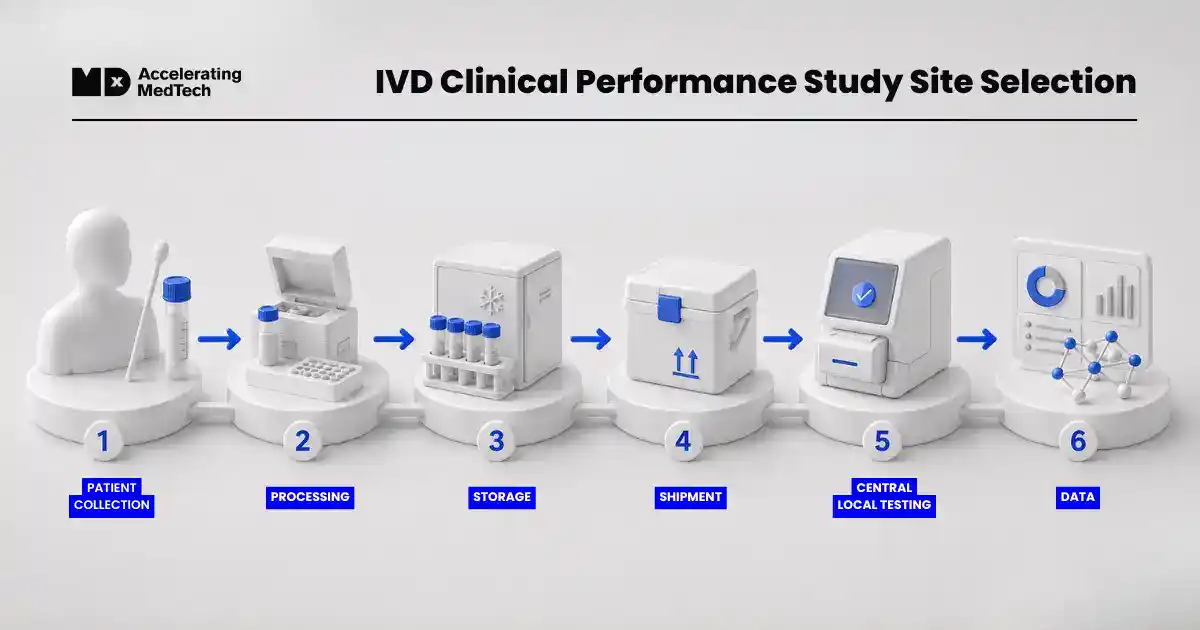
The study may depend on biological specimens passing through several stages before an IVD result is generated:
- collection;
- identification;
- temporary storage;
- processing;
- centrifugation or other preparation;
- aliquoting;
- freezing;
- retrieval;
- transport;
- receipt;
- and testing.
Each stage introduces variables that may affect specimen integrity or study data.
This becomes particularly important in multicentre studies. Two hospitals may recruit apparently comparable patients but handle their specimens differently. Differences in collection tubes, processing times, temperature exposure, freeze-thaw cycles or local laboratory practices can introduce variability that has little to do with the performance of the device itself.
“In multi-center IVD studies, the biggest operational risk is often pre-analytical variability rather than the assay itself. Different sites may collect, process, store and ship specimens differently, and relatively small deviations in collection tubes, processing windows, temperature, freeze-thaw cycles or sample quality can undermine an otherwise strong study.”
Carlos Galamba | Head of IVD and CEO at MDx CRO
Site selection should therefore establish whether each candidate centre can reproduce the specimen and study workflow required by the protocol, rather than assuming that an experienced clinical research site will automatically be suitable for an IVD study.
Start with specimen requirements, not the site CV
An efficient feasibility process begins with the evidence the study needs to generate.
Before approaching candidate sites, the sponsor and CRO should have sufficient clarity around:
| Study requirement | Questions to resolve before site selection |
|---|---|
| Specimen type | What matrix is required? Whole blood, plasma, serum, tissue, swab, urine or another specimen? |
| Target population | Which disease state, phenotype, genotype or clinical characteristics must be represented? |
| Clinical status | How will the subject’s true clinical status or comparator result be established? |
| Specimen numbers | How many evaluable positive and negative specimens are required? |
| Prevalence | Is the target condition sufficiently prevalent at the candidate site? |
| Collection | Does collection have to occur prospectively or can existing specimens be used? |
| Processing | What time, temperature, centrifugation, aliquoting or preparation requirements apply? |
| Storage | What short-term and long-term storage conditions are permitted? |
| Testing | Will testing take place locally, centrally or using a hybrid model? |
| Transport | Will specimens need domestic or international shipment? |
| Rejection criteria | Which specimens become non-evaluable because of quality or protocol deviations? |
Only after these conditions are defined can a feasibility questionnaire meaningfully establish whether a particular centre is appropriate.
This prevents a common problem: selecting a site because of its reputation or patient volume and discovering later that its routine clinical pathway does not produce specimens in the condition required by the study.
Evaluate the complete pre-analytical workflow
Pre-analytical feasibility should be assessed as a workflow rather than a laboratory capability checklist.
Consider a study requiring plasma to be separated within a defined period after blood collection. The hospital may have the correct centrifuge and freezer, but this does not establish feasibility.
The relevant questions include whether samples can reliably reach the laboratory within the required window, whether processing is available outside normal working hours, who records collection and processing times, what happens during weekends, how temperature excursions are documented and whether the required storage capacity is available throughout the expected recruitment period.
The assessment should follow the specimen from the participant to the point at which it is tested or transferred to a central laboratory.
Depending on the study, qualification may need to cover:
- specimen collection devices and tubes;
- collection technique;
- maximum collection-to-processing intervals;
- centrifugation or preparation requirements;
- aliquoting procedures;
- temporary storage conditions;
- freezer or refrigerator temperature monitoring;
- permissible freeze-thaw cycles;
- equipment maintenance and calibration;
- sample identification;
- handling of haemolysed, insufficient or otherwise compromised specimens;
- availability of trained staff;
- contingency procedures for equipment or courier failure.
The purpose is not to force every site to operate identically where this is unnecessary. The purpose is to control the variables capable of affecting the validity of the clinical performance assessment.
This is particularly important where the eventual intended use depends on specific specimen conditions. The IVDR itself requires consideration of specimen stability, transport conditions, storage and, where relevant, the interval between specimen collection and analysis as part of device performance documentation.
Can the site recruit the right population and specimens?
A large patient population does not necessarily translate into usable study specimens.
Feasibility should estimate how many evaluable subjects or specimens the site can contribute after applying the protocol requirements.
That distinction matters when eligibility depends on characteristics such as disease stage, treatment status, biomarker expression, genotype, previous diagnostic testing, specimen availability or a particular clinical pathway.
Historical recruitment figures can help, but they should be interrogated carefully. Sponsors should understand:
- how the site generated its estimate;
- whether the data come from actual records or investigator recollection;
- whether the proposed population matches the device’s intended-use population;
- how many potential participants are likely to meet all inclusion and exclusion criteria;
- whether competing studies are drawing from the same population;
- whether adequate positive and negative specimens will be available;
- whether prevalence assumptions reflect the site’s real case mix;
- and what proportion of collected specimens is expected to remain evaluable after quality criteria are applied.
An apparently high-recruiting site can become a weak contributor if most potential participants are ineligible or specimen rejection is frequent.
For uncommon biomarkers and rare conditions, this assessment may also determine whether a multicentre or multinational strategy is necessary.
Assess specimen representativeness, not only specimen availability
Availability and representativeness are separate questions.
A site may have access to hundreds of archived specimens, but those specimens may not adequately represent the population for which the IVD is intended.
For example, a biobank could contain disproportionately advanced-stage disease, specimens collected under historical protocols, material from a narrow demographic group or samples generated using collection systems that differ from current clinical practice.
The EU IVDR specifically requires the CPSP to address the representativeness of the study population. Where left-over specimen banks, genetic or tissue banks, patient registries or similar sources are used, their reliability and representativeness also need to be described.
Site and specimen-source feasibility should therefore examine whether the available material supports the clinical question, not simply whether sufficient numbers can be obtained.
Shipping, storage and sample traceability
Once specimens leave the point of collection, logistics become part of study execution.
For multicentre studies using central testing, candidate sites should be assessed against the actual shipping model planned for the study.
Questions include:
- Can the required packaging be prepared correctly?
- Is the selected courier operational from that location?
- Are weekend or public-holiday shipments feasible?
- Can dry ice or other temperature-controlled materials be sourced reliably?
- Are export or import requirements relevant?
- How will temperature excursions be detected and assessed?
- Is there sufficient freezer capacity while specimens await shipment?
- How will the site reconcile shipped, received, rejected and missing specimens?
Where shipment conditions influence specimen stability, they should be validated or otherwise supported appropriately before routine study shipments begin.
Traceability should also allow the study team to reconstruct the history of a specimen without compromising subject confidentiality.
That normally means linking the relevant study identifiers with collection, processing, storage, shipment, receipt, testing and final disposition records.
Our experts recommend establishing these controls before the first specimen enters the study:
“I mitigate that through highly prescriptive specimen-management procedures, site-specific workflow qualification, validated shipping routes, central tracking, clear sample-rejection criteria and training before the first patient or specimen is enrolled.”
Carlos Galamba | CEO MDx CRO
Ethics, consent and cross-border specimen requirements
Regulatory feasibility can eliminate an otherwise attractive site.
Under the IVDR, performance studies are subject to scientific and ethical review, while additional regulatory requirements apply to certain interventional studies, studies involving surgically invasive sample-taking solely for the study, and studies involving additional invasive procedures or risks.
The precise pathway also depends on study design and national requirements.
During site selection, sponsors should therefore determine how each proposed centre affects:
- ethics committee submissions;
- competent authority requirements where applicable;
- prospective versus retrospective specimen collection;
- use of left-over specimens;
- informed consent;
- genomic or genetic testing;
- secondary use of specimens;
- data protection;
- pseudonymisation;
- transfer of health or genomic data;
- export of human biological material;
- and cross-border specimen shipments.
These issues should be mapped early when planning multinational IVDR clinical performance studies.
A site with excellent recruitment potential may add disproportionate complexity if specimens cannot legally or operationally be transferred to the planned testing laboratory, or if consent obtained under the site’s existing biobank arrangements does not support the intended analysis.
For Annex XIV studies, regulatory and ethics strategy should therefore be considered alongside operational site feasibility rather than after the sites have already been selected. Our IVDR Annex XIV performance study guide covers the authorisation pathway in greater detail.
Qualifying the site before the first patient or specimen
Feasibility determines whether a site appears capable of performing the study, and qualification should establish that it is actually ready to do so. Activation criteria, on the other hand, should be defined prospectively and applied consistently across sites.
Depending on the study, these may include confirmation that:
- the investigator and study team meet qualification requirements;
- required ethics and regulatory approvals are in place;
- contracts and data-processing arrangements have been completed;
- the site has sufficient staff and laboratory capacity;
- required equipment is available, maintained and appropriately controlled;
- the specimen workflow has been reviewed or qualified;
- required training has been completed and documented;
- collection, processing and shipping materials are available;
- study devices and reagents are available and controlled;
- temperature monitoring is operational;
- eCRF and other study systems are accessible;
- laboratory reference ranges or comparator procedures are documented where relevant;
- specimen rejection procedures are understood;
- and escalation routes for deviations, device deficiencies and safety events are established.
For complex studies, a dry run can be valuable.
Following a mock specimen through collection, processing, labelling, storage, shipment documentation and data entry can expose practical gaps that remain invisible during document review.
A missing timestamp field, inadequate freezer space or courier collection that occurs before the laboratory finishes processing samples can become obvious immediately.
Resolving those issues before activation is considerably easier than investigating affected specimens after recruitment has started.
What should monitoring focus on once the study starts?
Site qualification does not guarantee continued compliance.
Monitoring should concentrate on the processes most capable of affecting participant protection and the reliability of the clinical performance evidence.
Article 68 of the IVDR requires sponsors to ensure adequate monitoring of performance studies, with its extent and nature determined according to the characteristics of the study.
For IVD studies, monitoring priorities can therefore differ from those of a conventional therapeutic trial.
Carlos Galamba recommends directing monitoring towards the variables that can materially influence performance:
“Monitoring should then focus disproportionately on the variables that can actually affect performance: eligibility, specimen provenance, protocol deviations, device and reagent versions, testing workflow, result transcription and missing or invalid results. Risk-based central monitoring is particularly powerful when combined with targeted onsite verification.”
Carlos Galamba | CEO MDx CRO
Central monitoring can reveal patterns that are difficult to identify through individual site visits.
For example:
- one site’s specimen-rejection rate is materially higher than the others;
- processing times are gradually increasing;
- one centre has an unusual proportion of invalid results;
- a particular freezer records repeated excursions;
- enrolment characteristics differ significantly from the expected population;
- or protocol deviations cluster around one stage of specimen processing.
These signals can then trigger targeted investigation, retraining or onsite verification.
Monitoring strategy should therefore be connected directly to the risks identified during site qualification.
Warning signs that a site may be unsuitable for an IVD study
Certain feasibility findings deserve particular attention before activation.
| Warning sign | Why it matters |
|---|---|
| Recruitment estimates cannot be supported by site data | Planned enrolment may be unrealistic. |
| Routine specimen handling conflicts with the protocol | Repeated deviations may occur once recruitment begins. |
| Critical processing depends on one individual | Absence or staff turnover can stop enrolment. |
| No reliable weekend or out-of-hours workflow exists | Time-sensitive specimens may become unusable. |
| Temperature-controlled storage is insufficient or poorly documented | Specimen integrity may become difficult to demonstrate. |
| The site cannot reconstruct specimen chain of custody | Traceability and data reliability are compromised. |
| High expected specimen-rejection rates | Nominal recruitment may not translate into evaluable data. |
| Shipping feasibility has not been tested | Samples may accumulate onsite or arrive outside stability limits. |
| The proposed population differs from the intended-use population | Data may not adequately support the intended clinical claim. |
| Ethics, consent or specimen-use permissions are unclear | Site activation or later use of collected material may be delayed. |
| Extensive protocol exceptions are requested before activation | The site’s routine workflow may be fundamentally incompatible with the study. |
| The site is already competing for the same patients or specimens | Recruitment projections may be overstated. |
One red flag does not automatically disqualify a centre. It should, however, trigger a documented assessment of whether the risk can be controlled without weakening the study.
IVD clinical performance study site selection checklist
Before approving a site for activation, sponsors and CROs should be able to answer the following questions.
Population and recruitment
- Does the site genuinely have access to the intended-use population?
- Are prevalence and recruitment estimates supported by credible site data?
- Can the site provide the required balance of positive, negative or subgroup specimens?
- Have competing studies been considered?
- Is the expected number of evaluable specimens realistic after exclusions and rejections?
Specimen workflow
- Can the required specimen type be collected consistently?
- Can processing occur within protocol-defined windows?
- Are required equipment and trained personnel available?
- Are collection, processing, aliquoting and storage procedures compatible with the study?
- Are sample rejection criteria operationally understood?
- Can deviations be detected and documented promptly?
Storage and logistics
- Are appropriate storage conditions available throughout the study?
- Is temperature monitoring adequate?
- Is the shipping route operational and suitable for the specimen?
- Have weekend, holiday and contingency arrangements been considered?
- Can the complete specimen journey be traced?
Regulatory and ethical feasibility
- Is the applicable ethics pathway understood?
- Have local competent authority requirements been assessed where relevant?
- Does the consent strategy support the intended specimen use and testing?
- Are genetic or genomic analyses adequately addressed where applicable?
- Are privacy and data-transfer arrangements workable?
- Can specimens legally and operationally cross borders where required?
Study operations
- Is the investigator appropriately qualified?
- Does the team have enough capacity to execute the protocol?
- Have study-specific workflows been reviewed or qualified?
- Is training complete?
- Are systems, documentation and study supplies ready?
- Are communication and escalation responsibilities clear?
Monitoring readiness
- Are critical processes and data identified?
- Can the necessary source information be verified?
- Can specimen-processing metrics be monitored centrally?
- Are device and reagent versions traceable?
- Are invalid results, missing specimens and deviations captured consistently?
A site should be activated when the study team has evidence that these conditions are adequately controlled, rather than simply because regulatory approvals have been received.
Site selection is part of evidence generation
Clinical performance evidence is generated through a system comprising the device, subjects or specimens, study procedures, laboratories, investigators, logistics and data processes.
Weakness in any of those components can affect the reliability of the final dataset.
This is why effective site selection begins with the intended population and specimen requirements, examines the entire pre-analytical pathway, and defines clear qualification criteria before activation.
For multicentre studies in particular, harmonising critical workflows early can prevent site-specific practices from becoming unexplained variability in the final analysis.
As Carlos Galamba explains:
“The solution is early country and site feasibility, a master submission package with controlled local adaptations, and a regulatory matrix covering every approval, contract, consent and data-transfer dependency before study activation.”
Carlos Galamba | CEO MDx CRO
For sponsors preparing an IVD programme in Europe or internationally, MDx CRO provides IVD clinical performance study services covering protocol development, site feasibility and qualification, regulatory and ethics submissions, specimen logistics, monitoring, data management and study reporting.
Planning an IVD clinical performance study? Talk to our IVD clinical team.
Frequently Asked Questions About Clinical Performance Study Site Selection
Site selection should assess more than investigator experience and recruitment potential. Sponsors should evaluate access to the intended-use population, availability of the required specimens, pre-analytical workflows, processing and storage capacity, shipping arrangements, traceability, regulatory and ethics requirements, staffing, equipment and the site’s ability to comply consistently with the study protocol.
The relevant question is whether the site can generate evaluable specimens and reliable clinical performance data under the conditions defined by the study.
Site feasibility determines whether a candidate site appears capable of conducting the proposed study. It typically considers patient or specimen access, recruitment potential, facilities, staffing, laboratory capabilities, logistics and regulatory constraints.
Site qualification goes further. Before activation, the sponsor should confirm that the site has the required personnel, equipment, approvals, training, procedures and operational controls to execute the protocol as planned. A site can therefore appear feasible during early assessment but still fail qualification if critical operational requirements cannot be controlled.
Specimen handling can be a decisive selection criterion because pre-analytical variables may directly affect the reliability of clinical performance data. Collection tubes, processing intervals, temperature, centrifugation, storage conditions, freeze-thaw cycles and transport can all influence specimen quality.
For this reason, sponsors should assess the complete specimen pathway at each candidate site rather than assuming that standard hospital or laboratory procedures are compatible with the study protocol.
A site should not be activated until critical risks that could affect participant protection, specimen integrity or data reliability have been adequately controlled. Examples include unsupported recruitment projections, inability to meet processing windows, inadequate specimen traceability, insufficient storage capacity, unresolved consent or ethics requirements, unreliable shipping arrangements or routine workflows that remain incompatible with the protocol after training and mitigation.
The decision should be based on whether the remaining risks can realistically be controlled throughout the study, rather than on the reputation or recruitment potential of the site alone.
Some operational differences between sites may be acceptable, but critical variables capable of affecting specimen integrity or device performance need to remain controlled.
The sponsor should identify which elements of collection, processing, storage, transport and testing require standardisation and which can vary without affecting the study objectives. Where local workflows differ, their compatibility with the protocol should be assessed during qualification and appropriate training, documentation and monitoring controls established before enrolment begins.
The most common reason is a mismatch between the study’s critical specimen requirements and the site’s actual routine workflow. A site may have an experienced investigator and excellent recruitment potential, but if it cannot consistently collect, process, store or ship specimens within the conditions required by the protocol, this can directly affect specimen quality and ultimately the reliability of the performance data.
The key question is therefore not simply whether the site has the right equipment or experience, but whether it can execute the complete specimen pathway consistently throughout the study. If doing so would require repeated protocol exceptions or depend on processes the site cannot reliably control, I would normally reconsider activation.
“I look at whether the differences affect variables that could materially influence specimen integrity or device performance, and whether those differences can realistically be controlled.
If the gap can be addressed through clear study-specific procedures, training, appropriate equipment or materials, defined responsibilities and monitoring, then the site can usually be made suitable. A dry run of the specimen workflow before activation is often very useful in confirming this.
I would be more cautious where the mismatch is structural, for example, the site cannot meet a critical processing window, lacks reliable out-of-hours processing, does not have adequate storage capacity, cannot support the required shipping conditions, or would need to make repeated exceptions to its normal clinical pathway. In those circumstances, adding more training does not necessarily remove the underlying risk, and selecting another site may be the better option.” Carlos Galamba | CEO MDx CRO