TGA guidance (Oct 2025): IVD Companion Diagnostics (CDx) Requirements in Australia

What’s new

TGA IVD companion diagnostics requirements are now clearly explained in the Therapeutic Goods Administration’s guidance on IVD companion diagnostics (CDx) in Australia (updated 16 October 2025). Their revised companion diagnostics framework, adds process diagrams, a companion testing plan concept for medicine/biological sponsors, clearer clinical performance expectations, and case studies showing how the pathway works in practice.

This blog post summarises the definition of a CDx, Class 3 IVD classification, ARTG inclusion, companion testing plans, and the TGA CDx List.

What is a CDx under Australian law?

A companion diagnostic is an IVD (commercial or in‑house) that provides information essential for the safe and effective use of a corresponding medicine or biological—for patient selection, risk of serious adverse reactions, or treatment monitoring. To qualify, the test must be referenced in the Product Information (PI) for the medicine or in the Instructions for Use (IFU) of the biological. Tests used only for cell/tissue compatibility are excluded from the CDx definition.

This definition underpins the TGA IVD companion diagnostics requirements for medicines and biologicals that rely on patient selection testing.

Note: The term “a particular medicine or biological” can also cover a class of products with a similar mechanism of action, not only a single named product.

When does an indication require CDx testing?

An indication requires CDx testing when both:

  1. the medicine’s PI (or biological IFU) states that CDx testing is essential, and
  2. the CDx claims it is intended for that testing to enable use of the medicine/biological.
    This may apply to some (not all) indications of a medicine.

To aid transparency, the TGA recommends a PI “flag phrase” indicating that testing is essential and that clinical practice testing should be adequately comparable to the pivotal trial testing; the TGA also publishes a CDx List of approved tests.

How the TGA applies CDx requirements: Class 3 IVDs and ARTG inclusion

  • Classification: Under TGA IVD companion diagnostics requirements, all CDx—commercial and in-house—are Class 3 IVDs (including in‑house CDx).
  • Separate ARTG entries: Each CDx requires its own ARTG inclusion with a Unique Product Identifier (UPI) defined by the manufacturer.
  • Application audit: CDx applications are subject to a mandatory application audit unless supported by specified comparable overseas regulator documentation (e.g., EU IVDR, FDA PMA, PMDA, HSA, Health Canada).
  • Concurrent submissions: While encouraged, concurrent medicine/CDx submissions are not mandatory; however, a CDx application should only be submitted if the corresponding indication is approved or under concurrent review.

From companion testing plans to ARTG submissions, MDx CRO streamlines the end-to-end CDx pathway in Australia, aligning clinical, regulatory, and quality workstreams to the TGA’s expectations.

The companion testing plan (for medicine/biological sponsors)

Every new indication that requires CDx testing must include a companion testing plan (dated and version‑controlled) describing how Australian patients will access at least one adequate test. This is central to meeting TGA IVD companion diagnostics requirements. Four options are available:

  1. Option 1: A commercial CDx ARTG application is planned/underway (provide device submission details and sponsor contact).
  2. Option 2: An in‑house IVD CDx will be accredited under the National Pathology Accreditation Scheme (provide lab details, accreditation timeline, and quality/access reassurances).
  3. Option 3: Standard Australian testing is expected to deliver comparable clinical outcomes to the pivotal trials (provide detailed justification).
  4. Option 4: None of the above—TGA reviews full device data within the medicine dossier (appropriate when no onshore testing is expected).

If Option 4 is used, TGA may add a condition of registration requiring the sponsor to maintain and update the plan (e.g., in case of supply interruption, regulatory action, or material changes to test methodology). Approval of an indication can proceed even when no ARTG‑listed or accredited CDx is available, provided an adequate plan exists; however, a commercial CDx must be in the ARTG (or an in‑house CDx accredited) before supply in Australia.

Clinical trial assay evaluation & comparability

When an indication requires CDx testing, TGA evaluates the clinical trial assay used in the pivotal studies—reviewing scientific validity, analytical performance, clinical performance, and clinical utility. Subsequent CDx must show clinical comparability to the trial assay, typically via concordance and/or bridging studies (or other appropriate evidence) aligned to the trial assay’s core characteristics.

Responsibilities at a glance

Medicine/Biological sponsors must:

  • Use the TGA CDx identification guide to determine if CDx testing is essential.
  • Consider consequences of false positives/negatives, test failures or no result.
  • Include: (a) evidence to support evaluation of the clinical trial assay, and (b) a companion testing plan nominating at least one adequate test.
  • Note: The framework does not require a one‑to‑one link between an indication and a single proprietary CDx; it focuses on the core characteristics of testing.

Device sponsors must:

  • Submit an IVD medical device application for ARTG inclusion of the CDx (indicating the application is for a CDx and providing the UPI).
  • Demonstrate comparability to pivotal trial testing and meet Essential Principles; applications may undergo audit as above.
  • Ensure the corresponding indication is approved or under concurrent review.

In-house IVD CDx, NATA accreditation and NPAAC obligations

Pathology laboratories may develop/modify in‑house tests for use as CDx. Class 1–3 in‑house IVDs are not included in the ARTG, but require NATA accreditation, identification of CDx in the TGA notification test list, and compliance with the NPAAC standard. Under a NATA–TGA MoU, NATA can request TGA technical assistance during evaluation of in‑house CDx performance; TGA is not otherwise involved in the accreditation decision.

TGA CDx List

The TGA publishes a CDx List showing approved commercial CDx linked to corresponding indications (with in‑house CDx to be added). The list is informational (not a regulatory instrument) and may lag recent approvals by up to one month.

Transitional arrangements and change control

  • Transition: CDx previously included in the ARTG as Class 2 or 3 before 1 Feb 2020 (and certain in‑house IVDs) may continue supply until 31 Dec 2028; a new compliant application is required to continue supply thereafter.
  • Changes: Sponsors manage post‑market device changes via the TGA Device Change Request process.

Key takeaways (quick reference)

  • All CDx are Class 3 IVDs and require separate ARTG inclusion (commercial) or NATA accreditation (in‑house).
  • Every relevant medicine/biological indication must include a companion testing plan (Options 1–4).
  • TGA assesses the clinical trial assay and expects comparability evidence for subsequent CDx.
  • Approval can proceed without on‑shore CDx if a robust plan exists, but supply requires ARTG inclusion or in‑house accreditation.

FAQs

Are all CDx Class 3 IVDs in Australia?

Yes. The regulations specify all CDx (commercial and in‑house) are Class 3 IVDs.

Can an indication be approved if no Australian CDx is available yet?

Yes—if a suitable companion testing plan is in place; however, a commercial CDx must be in the ARTG (or an in‑house CDx accredited) before legal supply.

What goes into a companion testing plan?

Identify at least one adequate test and choose Option 1–4 with supporting details (e.g., ARTG application in progress, in‑house accreditation, justification that standard testing is adequate, or full device data reviewed within the medicine dossier).

Will the PI show that CDx testing is essential?

The TGA recommends a PI “flag phrase” indicating testing is essential and should be comparable to trial testing; approved tests appear on the TGA CDx List.

Written by:
Carlos Galamba

Carlos Galamba

CEO

Senior regulatory leader and advisor to top 10 global precision medicine companies with deep experience in high-risk IVDs including companion diagnostics.
Industry Insights & Regulatory Updates

IVDR CE marking NGS: MDx Case Study with Fulgent

IVDR CE marking NGS at a glance

  • Outcome: CE mark granted by TÜV SÜD for an end-to-end Class C germline NGS solution (wet lab + bioinformatics).
  • Scope: Furthermore, panel covering 4,600+ clinically relevant genes with a validated PLM (Pipeline Manager) software component; later expanded to >7,000 genes using a new probe set.
  • What we did: Specifically, we built an ISO 13485 QMS from the ground up, prepared full Annex II + III technical documentation, validated bioinformatics under IEC 62304/82304, split documentation into two Basic UDI-DIs (wet lab vs. software), and guided Stage I/II audits.
  • Why it matters: Ultimately, this demonstrates a repeatable pathway to IVDR certification for large NGS services and software, something that hadno clear precedent.

Read the announcements: For details, read the Fulgent press release and Citeline case study.

0+

Genes Certified

Class C

IVDR Classification

0 mo

To CE Mark

0+

Post-Cert Scale

The challenge: certifying a service-based, large-scale NGS system under IVDR

To begin with, FulgentExome is a service-based NGS solution that integrates wet-lab workflows with the Fulgent PLM bioinformatics pipeline. As a result, pursuing IVDR certification meant converting a mature CLIA/CAP testing service into a CE-marked IVD system with robust evidence across scientific validity, analytical performance, and clinical performance, for thousands of genes. In particular, key hurdles included: defining intended use at scale; validating third-party components; proving scientific validity across 4,600+ genes; above all fully validating the bioinformatics pipeline under medical device software standards.

MDx approach: a playbook for complex NGS + software

1) Build the right QMS, fast

First, we performed an IVDR GAP assessment. Next, we designed and implemented an ISO 13485-compliant QMS with risk management, supplier control, document control, internal audits, and management review—migrating from a CLIA/CAP model to IVDR-ready operations.

2) Engineer a defensible intended use

Meanwhile, the intended-use statement evolved iteratively, from an initial ~300-gene scope to whole-exome, finally landing on 4,600+ genes aligned to available clinical and analytical evidence. In the end, the final language was future-proofed to support rapid updates as evidence expands.

3) Split wet lab and software into two regulated products

Afterward, following round 1 review feedback, we separated the documentation into two Basic UDI-DIs, FulgentExome (wet lab) and Fulgent PLM (software) to align with IVDR expectations for traceability and lifecycle control. Consequently, this restructuring sharpened conformity assessment and accelerated subsequent approvals.

4) Validate the informatics stack like a medical device

In parallel, we validated PLM under IEC 62304/82304, including architecture, version control, cybersecurity, verification/validation, and integration with external databases. Therefore, the result was a fully evidence-backed bioinformatics pipeline capable of reproducible, high-confidence variant calling and reporting.

5) Make “evidence at scale” practical

  • First, Scientific validity: Three-tier strategy combining validation of exome sequencing as an approach, reliance on curated public databases, and deep exemplars for a large subset of genes.
  • Second, Clinical performance: Leveraged routine testing experience (thousands of positives) to focus clinical evidence on high-prevalence genes, and instituted a robust PMPF strategy to continuously strengthen low-prevalence areas.

6) Orchestrate TÜV SÜD audits to success

  • Initially, Stage I confirmed documentation readiness, scope, Basic UDI-DIs and integration of IVDR processes into daily practice.
  • Subsequently, Stage II verified on-the-floor implementation of SOPs, training, competence, CAPA and change control—closing findings on short cycles to hit NB timelines.

Results that move the market

  • CE mark granted for FulgentExome & Fulgent PLM, among the first end-to-end Class C germline NGS solutions under IVDR.
  • Certified scope covers 4,600+ genes, positioning Fulgent as a reference lab for comprehensive hereditary disease testing serving European patients.
  • Post-certification, the platform scaled to >7,000 genes using a new probe set, demonstrating the inherent scalability built into the certified system (process, documentation, and change control).
  • Strengthened competitive standing in the EU diagnostics market; public communications highlight the magnitude of this achievement for large NGS panels.

Read more in the Fulgent press release and Citeline’s in-depth article.

What this means for labs and IVD developers planning large NGS submissions

If you operate an LDT today: you’ll need to translate CLIA/15189 practices into an ISO 13485 framework, document design controls, and produce a full PER (PEP/PER), APR, SVR, PMS/PMPF, SSP, and labeling/IFU aligned to GSPR. Expect to validate any bioinformatics pipeline as SaMD with IEC 62304/82304 and cybersecurity controls.

If your panel is “large”: you likely won’t have uniform clinical data across every gene. A structured tiered evidence model + PMPF can satisfy Notified Bodies while keeping your roadmap scalable.

If you combine wet lab + software: plan for separate Basic UDI-DIs and documentation sets. Treat the pipeline as a product with its own requirements, verification, and risk controls.

Why MDx

  • End-to-end IVDR expertise: From regulatory strategy & classification to Annex II/III technical files, PER/SVR/APR, training, and mock NB reviews. Read more about our NGS regulatory services.
  • Clinical performance studies: We design, run, and report ISO 20916 studies (protocols, eTMF, monitoring, biostats, PER alignment), and we can act as delegated sponsor for multi-country submissions—100% submission success rate to date.
  • Operational scale: ISO 9001 clinical QMS, EU/US partner network, multilingual CRAs, and a repeatable process honed on 60+ performance study submissions for top IVD and pharma clients.

Project timeline

Our joint project with Fulgent spanned July 2023–July 2025, with overlapping tracks for QMS creation, technical documentation, NB review, and Stage I/II audits, a coordinated plan that allowed rapid closure of findings and post-certification scaling.

Client perspective

The program demanded evening/weekend execution across regulatory, documentation, and project management to meet Notified Body timelines, effort that, in the client’s words, made all the difference in achieving what initially “seemed almost impossible.

Planning IVDR for your NGS panel? Here’s a quick readiness checklist

  • Intended use aligned to evidence (and future updates)
  • ISO 13485 QMS with software lifecycle integration
  • PER (PEP/PER), SVR, APR mapped to gene-level strategy
  • PLM/DR pipeline validated per IEC 62304/82304 (+cybersecurity)
  • Separate documentation/UDI for wet lab vs. software (if applicable)
  • PMS/PMPF plan to mature low-prevalence evidence post-market
  • Mock NB review + Stage I/II audit readiness

(Our team can lead or co-author each artifact above.)

Talk to us

Whether you’re certifying a focused oncology panel or pushing the limits with exome-scale content, MDx brings the cross-functional regulatory, clinical, quality, and software depth to make it possible—on a timeline that keeps your business competitive.

How long does IVDR CE marking take for an NGS panel?

For a large, complex NGS panel (thousands of genes, wet lab + bioinformatics software), expect 18 to 24 months from project kickoff to CE mark, assuming you need to build a QMS from scratch. If you already have an ISO 13485-certified QMS and partial technical documentation, the timeline can shorten to 12 to 16 months. The main variables are: the scope of the panel (more genes = more validation work), whether the bioinformatics pipeline needs IEC 62304 validation from zero, Notified Body capacity and review cycles, and the maturity of your clinical evidence. In the Fulgent case, the full project spanned 24 months (July 2023 to July 2025), including QMS creation, full Annex II/III technical documentation, and TÜV SÜD Stage I and Stage II audits.

What IVDR class are NGS diagnostic panels?

Most NGS-based IVDs classify as IVDR Class C under Annex VIII classification rules, because they typically provide information used to determine patient predisposition or individual risk for serious conditions (e.g., hereditary cancer panels, germline disease testing). NGS panels intended for infectious disease detection with high public health risk (e.g., HIV, hepatitis) may classify as Class D. Companion diagnostic NGS panels co-developed with a therapeutic product also typically fall under Class C. Classification depends on the specific intended use and clinical claims, not the technology itself. All Class C and D IVDs require Notified Body conformity assessment.

Do you need separate UDI identifiers for NGS software under IVDR?

Yes, when the bioinformatics pipeline qualifies as standalone software (SaMD) or is a distinct regulated component, IVDR requires a separate Basic UDI-DI. In the Fulgent case, MDx split the documentation into two Basic UDI-DIs: one for FulgentExome (the wet-lab component) and one for Fulgent PLM (the bioinformatics pipeline). This separation aligns with IVDR expectations for traceability, lifecycle control, and independent conformity assessment. Each Basic UDI-DI has its own technical documentation, risk management file, and performance evaluation. This approach also makes post-market updates easier, a software update does not trigger re-review of the entire wet-lab documentation.

Can a CLIA/CAP-accredited laboratory use its existing QMS for IVDR CE marking?

No, CLIA/CAP accreditation and ISO 15189 certification are not equivalent to ISO 13485, which is the QMS standard required for IVDR CE marking. While CLIA/CAP provides a strong operational foundation (proficiency testing, personnel qualifications, quality control), it does not cover medical device design controls, supplier management, CAPA, post-market surveillance, or the device lifecycle documentation that IVDR demands. Laboratories transitioning from CLIA/CAP to IVDR must implement an ISO 13485-compliant QMS and document design inputs, outputs, verification, validation, and change control for each IVD product.

What is the tiered evidence strategy for scientific validity of large NGS panels?

For panels targeting thousands of genes, it is typically not feasible to generate individual clinical evidence for every gene-disease association. A tiered approach addresses this: Tier 1 validates the underlying sequencing technology (e.g., exome sequencing as a methodology) with evidence from published literature and peer-reviewed validation studies. Tier 2 relies on curated public databases such as ClinVar, OMIM, and HGMD to establish gene-disease associations at scale. Tier 3 provides deep exemplar evidence (including analytical and clinical performance data) for a representative subset of high-prevalence genes. Genes with limited data are supported through a Post-Market Performance Follow-up (PMPF) plan that progressively strengthens evidence after CE marking. This strategy was accepted by TÜV SÜD in the Fulgent certification.

Written by:
Carlos Galamba

Carlos Galamba

CEO

Senior regulatory leader and former BSI IVDR reviewer with deep experience in CE marking high-risk IVDs, companion diagnostics, and IVDR implementation.
Industry Insights & Regulatory Updates

The future of in vitro diagnostics

The future of in vitro diagnostics is being written at the intersection of tighter regulation, workforce pressure, and data‑driven innovation. Under the EU In Vitro Diagnostic Regulation (IVDR), evidence expectations and lifecycle obligations have risen sharply, changing how products are designed, validated, and maintained in the market. For manufacturers, success now depends on pairing scientific advances with stronger clinical evidence strategies, interoperable data flows, and operational resilience across supply, quality, and post‑market systems.

Demand is rising while systems are stretched

Backlogs from the pandemic have converged with long‑standing workforce shortages, particularly in diagnostic specialties, delaying access and lengthening diagnostic pathways. The OECD’s Health at a Glance: Europe 2024 highlights these shortages as a structural risk to access, quality, and system resilience—evidence that the pressure to do more with fewer people is not easing soon. For diagnostics leaders, that reality elevates the value case for automation, near‑patient testing, and real‑world evidence that proves earlier, faster decisions.

Market momentum is real—if evidence and access align

IVDs remain a cornerstone of Europe’s medtech economy and the largest segment globally by sector share, signaling robust demand for better, earlier diagnostics. But translating that momentum into market access requires credible performance evaluation, clear intended‑purpose claims, and a plan for post‑market performance follow‑up that stands up to Notified Body scrutiny. (MedTech Europe DataHub – Market). 

IVDR is raising the bar—and capacity is still normalizing

IVDR’s higher evidence threshold is now a constant, but Notified Body (NB) capacity and throughput continue to shape time‑to‑market. The European Commission’s latest Notified Bodies Survey shows progress on designations and certifications under MDR/IVDR while acknowledging persistent bottlenecks—practical context for planning dossier quality, NB engagement, and transition timelines. Manufacturers that front‑load clinical evidence planning and close gaps against GSPR, PER, and PMPF requirements are better positioned to move through review without costly rework. 

What the next decade looks like for IVD innovators

Expect faster iteration cycles powered by cloud connectivity and AI‑assisted analytics, paired with stronger governance of data provenance, cybersecurity, and change control. Procurement and HTA bodies will demand interoperable outputs that feed clinical systems and population analytics. In practice, this means designing for the 4P future—predictive, preventive, personalized, and participatory—while proving clinical performance and patient‑management claims under IVDR. Aligning technical files, labeling, and performance evaluation with clinical utility (not just analytical superiority) will increasingly differentiate winners.

What leaders should do now

Treat clinical evidence as a product pillar from day one—map intended purpose, target population, and clinical benefit to a coherent performance evaluation plan that integrates literature, device‑generated data, and targeted clinical performance studies. Build for integration and reuse of data across care settings to ease adoption and payer evaluation. Engage NBs early with complete, audit‑ready files. And make post‑market performance follow‑up a source of competitive insight, not a compliance afterthought.

How MDx CRO accelerates IVD market readiness

MDx CRO helps IVD manufacturers compress time‑to‑evidence and navigate IVDR with confidence—from regulatory strategy and technical documentation to clinical performance studies and post‑market performance follow‑up. We translate regulatory expectations into practical study designs and submission‑ready deliverables, then stay with you through NB interactions and lifecycle monitoring. Explore our IVD regulatory services and clinical research support, or contact us to scope a market‑access plan tailored to your portfolio.

Written by:
Carlos Galamba

Carlos Galamba

CEO

Senior regulatory leader and former BSI IVDR reviewer with deep experience in CE marking high-risk IVDs, companion diagnostics, and IVDR implementation.
Industry Insights & Regulatory Updates

MedTech Companies in Europe: Hubs, Opportunities, and What You Need to Know

Europe is one of the world’s most significant medical technology markets, and one of its most complex. With more than 38,000 MedTech companies operating across the continent, a rigorous regulatory framework under EU MDR and IVDR, and a network of world-class research and manufacturing clusters, it represents both a major opportunity and a substantial challenge for manufacturers, diagnostics companies, and pharma organisations looking to operate here.

This guide covers what the European MedTech landscape actually looks like: where the key hubs are, what kinds of companies operate here, and what any organisation, whether entering the EU market for the first time or scaling an existing presence, needs to understand about the environment they’re entering.

The Scale of Europe’s MedTech Industry

According to MedTech Europe, the sector directly employs over 930,000 people across the continent and generates annual revenues estimated at roughly €170 billion (2024). It is one of the largest life sciences industries in the world, second only to the United States in terms of market size.

A few figures that put the landscape in context:

  • 38,000+ companies: operating in medical devices, IVDs, and digital health
  • Over 90% are SMEs: the sector is dominated by small and mid-sized innovators, not large multinationals
  • Europe accounts for roughly 27% of global MedTech revenue
  • The EU is the world’s second-largest medical device market after the US
  • More than 2,000,000 medical technology products and services currently available in the European market

For US manufacturers, Asian diagnostics companies, and global pharma organisations, Europe is not a single market — it is a collection of national healthcare systems, procurement processes, and regulatory pathways that sit under a shared EU framework. Understanding where the industry is concentrated, and how it operates, is the starting point for any effective market strategy.

Europe’s Major MedTech Hubs

Germany: The Largest Market in Europe

Germany is the single largest MedTech market in Europe, accounting for roughly €40 billion in annual revenue and home to major global players including Siemens Healthineers, B. Braun, Dräger, and Karl Storz, alongside thousands of specialist mid-sized manufacturers (the Mittelstand).

Key clusters include:

  • Tuttlingen (Baden-Württemberg): The surgical instruments capital of the world. Over 400 MedTech companies operate within a 20km radius, manufacturing more than half of the world’s surgical instruments.
  • Munich: A hub for medical imaging, digital health, and life sciences, anchored by Siemens Healthineers and a growing startup ecosystem.
  • Hamburg and the Rhine-Ruhr region: Strong in diagnostics, laboratory technology, and healthcare IT.

Germany also hosts two of Europe’s most important MedTech trade events: MEDICA in Düsseldorf (the world’s largest medical trade fair) and COMPAMED, its companion event for medical technology suppliers.

For IVD and diagnostics companies, Germany is particularly significant, it is one of the largest markets for in vitro diagnostics globally and home to companies such as Roche Diagnostics and Qiagen.

The Netherlands: Diagnostics and Digital Health Innovation

The Netherlands punches well above its weight in MedTech. Philips Healthcare is headquartered in Amsterdam and Eindhoven, and the country has developed a strong ecosystem around medical imaging, point-of-care diagnostics, and health technology.

The Brainport Eindhoven region is one of Europe’s most productive technology clusters, with Philips and ASML as anchors and a dense network of high-tech suppliers and spin-offs. Dutch MedTech companies benefit from strong R&D infrastructure, close ties between university medical centres and industry, and an internationally oriented business environment.

The Netherlands is also a significant European gateway market, its logistics infrastructure (Rotterdam port, Schiphol Airport) and the presence of major European headquarters make it a preferred entry point for non-EU manufacturers registering their first EU presence.

France: A Major Market with Growing Innovation

France is the third-largest MedTech market in Europe, with a sizeable domestic industry and a healthcare system that is one of the continent’s largest public purchasers of medical technology.

Key companies include Stryker’s European operations, Guerbet, Servier Medical, and a growing cluster of digital health and AI-powered diagnostics startups concentrated around Paris, Lyon, and Grenoble. Lyon in particular has emerged as a strong hub for minimally invasive surgery and interventional cardiology, building on the presence of bioMérieux (a global diagnostics leader headquartered nearby in Marcy-l’Étoile).

France’s national innovation agency Bpifrance and the health innovation programmes under France 2030 have significantly increased investment in digital health and MedTech startups, making it an increasingly dynamic market for early-stage companies and international partners alike.

Spain: A Fast-Growing Hub with Iberian Reach

Spain is one of Europe’s most dynamic and fast-growing MedTech markets, with a strong concentration of companies in Barcelona, Madrid, and the Basque Country. The Spanish sector has historically been strong in orthopaedics, dental technology, and hospital equipment, but it is increasingly significant in IVDs, molecular diagnostics, and digital health.

Barcelona is home to a thriving life sciences ecosystem anchored by the Barcelona Health Hub, the proximity of world-class research institutions (IRB, CRG, ISGlobal), and a growing cluster of diagnostics and genomics companies. Madrid is the commercial and regulatory centre, with strong connectivity to Latin American markets — a route often used by global manufacturers to establish a dual EU/LATAM presence.

For companies targeting the Spanish and Portuguese-speaking world, Spain also serves as a strategic gateway to Latin America, with regulatory knowledge and commercial networks that extend to Brazil, Mexico, Colombia, and beyond.

A landmark development for the Spanish regulatory environment is Royal Decree 192/2023, which introduced specific requirements for clinical investigations with medical devices and IVDs in Spain, bringing national legislation into closer alignment with EU MDR and IVDR.

United Kingdom: Post-Brexit Reconfiguration

The UK remains one of Europe’s most important MedTech markets, even outside the EU. With a market value exceeding £10 billion, the UK is home to major global players (Smith+Nephew, Oxford Instruments, Consort Medical), a world-leading academic research base, and a concentration of MedTech companies around London, Cambridge, Oxford, and the M4 corridor.

The critical development for any manufacturer is the post-Brexit regulatory divergence. The UKCA mark (UK Conformity Assessed) is now required for devices placed on the Great Britain market, separate from the EU CE mark. While the UK has extended the period during which CE-marked devices can be sold in Great Britain, the timelines for full UKCA compliance are firm and require planning.

The MHRA (Medicines and Healthcare products Regulatory Agency) has been active in shaping post-Brexit regulatory guidance, and the UK has also signalled ambitions to develop faster, innovation-friendly pathways — including the ILAP (Innovative Licensing and Access Pathway) for combination products.

For manufacturers already CE-marked, the UK requires a separate regulatory strategy. For those entering from outside Europe, the question of CE + UKCA sequencing is an important early strategic decision.

Switzerland: Precision and High-Value Manufacturing

Switzerland is not an EU member but operates under a mutual recognition agreement for medical devices and is deeply integrated into the European MedTech ecosystem. It is home to some of the world’s most significant MedTech and diagnostics companies: Roche (Basel), Novartis (Basel), Straumann (dental), Ypsomed (drug delivery), and a dense cluster of precision manufacturing suppliers in the watch-making tradition that has transferred into surgical robotics, implants, and microfluidics.

Switzerland’s combination of engineering excellence, multilingual workforce, and proximity to major EU markets makes it a significant hub for high-value device development and manufacturing, and a frequent base for global companies establishing their European regulatory presence.

The Regulatory Landscape: What It Means in Practice

Understanding the MedTech industry in Europe is inseparable from understanding its regulatory framework. The introduction of EU MDR (2017/745) and EU IVDR (2017/746) represents the most significant overhaul of European medical device regulation in 25 years, and it has reshaped how companies of all sizes operate.

For manufacturers entering the EU market for the first time, the key requirements include:

  • CE marking through a conformity assessment route appropriate to the device’s risk classification
  • Technical documentation demonstrating safety and performance, including clinical evidence
  • Quality Management System (QMS) certified to ISO 13485
  • EUDAMED registration, the EU’s centralised database for devices, manufacturers, and clinical investigations, which becomes mandatory from May 2026
  • Notified Body involvement for Class IIa, IIb, III (MD) and Class B, C, D (IVD) devices
  • EU Authorised Representative (EU AR) for manufacturers based outside the EU

For IVD and diagnostics companies specifically, IVDR introduced a significant reclassification of products — the vast majority of IVDs that were previously self-certified under the old IVDD now require Notified Body review under IVDR, including companion diagnostics, oncology markers, and infectious disease assays. The transition timelines vary by device class and certification status.

For pharma companies developing companion diagnostics, the EU framework requires co-development alignment between the drug and its accompanying IVD, with specific submission pathways for Class D companion diagnostics (EMA consultation required).

Opportunities in the European MedTech Market

Despite, and in some ways because of, its regulatory complexity, Europe offers compelling opportunities for manufacturers and diagnostics companies with the right preparation.

Market access across 27 EU member states through a single CE mark remains one of the most powerful aspects of the European regulatory system. A device approved in Germany can be sold in France, Spain, Italy, Poland, and beyond without separate national approvals in most cases.

The SME ecosystem creates partnership opportunities. With over 90% of European MedTech companies being SMEs, there is a substantial market for contract research, regulatory outsourcing, clinical study support, and quality management services — particularly as regulatory demands increase under MDR and IVDR.

Growing demand in IVDs and molecular diagnostics is accelerating across Europe, driven by population ageing, oncology precision medicine, and the lessons of COVID-19 for diagnostic infrastructure. Countries including Spain, Portugal, Germany, and the Netherlands are investing significantly in laboratory infrastructure and point-of-care testing capacity.

The Spanish and Portuguese-speaking corridor (Spain, Portugal, and by extension Latin America) represents a particularly underexploited route for companies seeking both EU certification and access to a combined market of over 600 million people. Regulatory expertise that spans the EU and LATAM is rare and commercially valuable.

What Companies Operating in Europe Need to Get Right

Three things consistently determine whether a MedTech company navigates the European environment successfully:

1. Regulatory strategy from day one. The classification of a device under MDR or IVDR determines the entire development and approval pathway. Getting this wrong early, misclassifying a device, choosing the wrong conformity assessment route, or underestimating the clinical evidence requirements, creates delays that are expensive and difficult to recover from.

2. Clinical evidence that meets the standard. Both MDR and IVDR have raised the bar for clinical evidence significantly. For medical devices, clinical evaluation is an ongoing process, not a one-time submission. For IVDs, performance evaluation under ISO 20916 must be designed to satisfy both EU and, where applicable, FDA requirements.

3. A Notified Body relationship that works. With only a limited number of IVDR-designated Notified Bodies currently active, access to conformity assessment is a genuine constraint. Early engagement, well-prepared technical documentation, and experience managing the review process are not optional, they are the difference between a smooth approval and a two-year delay.

About MDx CRO

MDx CRO is a full-service MedTech CRO specialising in clinical research, regulatory affairs, and technical documentation for medical devices and IVDs. With offices in Barcelona, Madrid, Lisbon, and London, and a team operating across Europe, MDx supports manufacturers, diagnostics companies, and pharma organisations at every stage, from early regulatory strategy to Notified Body submission and post-market compliance.

Explore our services or get in touch to discuss your European regulatory and clinical strategy.

We partner with both large diagnostic leaders and agile SMEs to deliver compliant, high-quality, and market-ready solutions.

A Pan-European Presence

With offices in Barcelona, Madrid, Lisbon, and London, and a network of CRAs and regulatory experts across Europe, MDx provides localized insight with global reach—helping MedTech companies meet requirements faster and smarter.

The European MedTech sector is growing—but so are its regulatory challenges. Whether you’re launching a new diagnostic product or preparing for a Notified Body audit, MDx CRO is here to support your success every step of the way.

Let’s talk about your next clinical or regulatory challenge.

Further Reading

Industry Insights & Regulatory Updates

How many new medical devices are developed per year?

In the fast-moving world of MedTech, innovators often ask: how many new medical devices are developed per year? There isn’t a single global number, but we can triangulate it using patent trends, regulatory authorizations, and industry signals grounded in current, authoritative data.

Innovation Signals: Patent Filings

Patent activity is a reliable early indicator of device development. According to the European Patent Office (EPO), medical technology led all fields in 2020 with 14,295 applications, a 2.6% increase over 2019—a reminder of the sector’s deep innovation pipeline.

More recently, medical technology remains a leading technical field. The EPO Patent Index 2024 confirms medical technology as one of the most active categories for invention. Industry analysis also highlights ~15,700 MedTech applications in 2024 across Europe’s patent system, reflecting sustained growth (MedTech Europe DataHub).

From Idea to Market: Regulatory Authorizations

Patents show invention; regulatory authorizations show how many devices actually reach patients. In the U.S., the FDA’s Center for Devices and Radiological Health (CDRH) publishes device approvals under rigorous pathways such as PMA (FDA 2023 Device Approvals).

2023 was a record year for novel authorizations, with the FDA approving 124 new devices, excluding emergency use authorizations. (MedTech Dive | Fierce Biotech). The FDA’s official CDRH Annual Report 2024 (PDF) confirms that momentum continued, with 120 novel devices authorized in 2024, keeping approvals among the highest ever recorded.

These authorizations form the conservative baseline of what counts as truly new medical devices entering the market.

Estimating “New Device Development”

Taken together, patents and regulatory approvals show the spectrum of innovation. Patent filings in the tens of thousands capture early-stage ideas and prototypes, while hundreds of annual regulatory authorizations reflect devices that complete the journey to patient use.

Depending on definition—prototype, clinical trial initiation, clearance, or market launch—the best evidence-based answer is that hundreds of new medical devices are developed per year, supported by a much larger innovation pipeline still in progress.

Why These Numbers Matter

This activity carries important implications. Competition in MedTech is intense, with medical technology consistently leading global patent activity. Yet translation remains the bottleneck: many promising inventions never reach the market due to regulatory and clinical hurdles.

For innovators, success depends not just on invention but on execution. That means robust design, evidence-driven clinical research, proactive regulatory strategy, and strong post-market surveillance. At MDx CRO, we guide teams through this entire journey—helping promising concepts become compliant, market-ready devices.

Conclusion

So, how many new medical devices are developed per year? The most defensible conclusion is that hundreds of novel devices achieve authorization annually, supported by tens of thousands of upstream inventions captured in patent data.

The MedTech field remains one of the most dynamic and competitive arenas in global innovation. For developers, the opportunity has never been greater—but so too have the challenges. To succeed, innovators must match great ideas with great execution.

If you are developing a new device and want to navigate this journey with confidence, contact MDx CRO today.

Industry Insights & Regulatory Updates

IVDR for NGS Assays: 7 Key Compliance Challenges (and How to Solve Them)

TL;DR | What You Need to Know

NGS-based IVDs face unique IVDR compliance challenges, from validating bioinformatics pipelines under IEC 62304 to demonstrating scientific validity across thousands of genes. Most NGS assays classify as IVDR Class C or D, requiring Notified Body review, comprehensive performance evaluation, and lifecycle documentation. This article covers the 7 critical challenges and practical solutions, informed by MDx’s experience CE-marking one of the world’s first 4,600+ gene panels under IVDR.

Next-Generation Sequencing (NGS) has revolutionized molecular diagnostics by enabling simultaneous analysis of hundreds or thousands of genes across diverse clinical applications. These include germline testing for hereditary disorders, somatic mutation profiling in oncology, infectious disease characterization, and transcriptomic gene expression analysis.

A particularly impactful advancement is liquid-biopsy NGS, which allows non-invasive detection of tumor-derived nucleic acids, such as circulating tumor DNA (ctDNA) or RNA, from blood or other bodily fluids. This method now supports cancer screening, minimal residual disease monitoring, and therapy stratification.

NGS also powers Comprehensive Genomic Profiling (CGP). These assays assess a wide spectrum of biomarkers, single nucleotide variants (SNVs), insertions and deletions (indels), copy number alterations (CNAs), copy number losses (CNLs), gene fusions, and splicing events, across large panels in a single run. Many workflows also integrate microsatellite instability (MSI) and tumor mutational burden (TMB).

Assays can range from targeted panels to whole exome sequencing (WES) or whole genome sequencing (WGS). Each format carries unique validation needs and bioinformatics requirements. The mix of technologies, analytes, sample types (e.g., blood, plasma, FFPE, cfDNA, RNA), and clinical contexts increases regulatory complexity.

Under the EU In Vitro Diagnostic Regulation (IVDR; EU 2017/746), you must define each intended use clearly and support it with comprehensive evidence of scientific validity, analytical performance, and clinical performance. That requirement calls for a holistic, coordinated validation and documentation strategy.

For CE-marking manufacturers and clinical laboratories operating under Article 5(5), IVDR demands structured validation, clear documentation, and lifecycle management. For NGS-based assays, compliance becomes even more demanding due to scientific, technical, and operational intricacies.

Key Challenges in IVDR Compliance for NGS

1) Complex Gene Panels & Variant Diversity

NGS panels often include multiple genes and variant types, each with distinct performance characteristics. You must demonstrate analytical performance—sensitivity, specificity, LoD, and robustness—per variant class. This tailoring increases the scale and complexity of testing.

2) Defining a Clear Intended Use

A precise, testable intended purpose statement anchors the program. Define analytes, clinical context, sample types, output format, and role in patient care. Any ambiguity risks misclassification or validation gaps.

3) Scientific Validity Across Many Analytes and Conditions

Establishing scientific validity grows challenging when one test targets dozens or hundreds of genes. Under IVDR, link each analyte to a clinically relevant condition. That linkage often requires extensive literature review, database referencing, and written justification for inclusion.

4) Clinical Performance Evidence

With broad genomic scope, comprehensive clinical studies may be infeasible. A pragmatic approach combines routine diagnostic data, published literature, and a clear link to Post-Market Performance Follow-up (PMPF) plans to support claims over time.

5) Complex Bioinformatics Pipelines

Bioinformatics sits at the core of NGS diagnostics. Validate every step—from base calling to variant annotation. Implement version control, clear revalidation triggers, and change management to maintain consistent performance after software updates.

6) Use of Third-Party Reagents and Instruments

NGS workflows often incorporate off-the-shelf reagents and platforms not originally CE-marked as part of the IVD system. Document compatibility, performance, and traceability of third-party components to meet IVDR expectations.

7) Labelling Without a Physical Device

Many NGS assays function as software-driven services or LDTs without a packaged device. You still must meet Annex I labelling and Instructions for Use (IFU) requirements—even without physical labels or packaging.

How MDx CRO Supports Your IVDR Journey

MDx CRO brings specialized expertise to guide NGS programs through IVDR across the full lifecycle:

  • Gap Assessments: Identify regulatory shortfalls and prioritize remediation.
  • Performance Evaluation Plan (PEP): Craft PEPs that balance analytical rigor with operational feasibility.
  • Analytical Study Oversight: Design statistically robust studies tailored to complex panels.
  • Bioinformatics Validation: Map and validate each software component under IEC 62304 and ISO 13485.
  • QMS Integration: Build audit-ready documentation, risk management, and traceability.
  • PMS & PMPF Strategies: Establish real-world evidence systems that sustain compliance and support clinical claims.

Frequently Asked Questions

What IVDR class are NGS-based diagnostic tests?

Most NGS-based diagnostic tests fall into IVDR Class C because they typically provide high-risk individual patient information (e.g., germline disease or somatic mutation profiling). NGS assays used for infectious disease with high public health risk may classify as Class D. Classification depends on the specific intended use, clinical claims, and risk profile of each test.

How do you validate an NGS bioinformatics pipeline for IVDR compliance?

Under IVDR, bioinformatics pipelines must be validated as medical device software following IEC 62304 and IEC 82304-1. This includes documenting the software architecture, implementing version control and change management, verifying variant calling accuracy at each step (base calling, alignment, variant annotation), and establishing revalidation triggers for software updates. Risk management per ISO 14971 must also be integrated into the software lifecycle.

How do you demonstrate scientific validity for a large NGS gene panel under IVDR?

For large panels covering hundreds or thousands of genes, a tiered evidence strategy is recommended. This combines validation of exome sequencing as a methodology, reliance on curated public databases (e.g., ClinVar, OMIM) for gene-disease associations, and deep exemplar evidence for high-prevalence genes. Low-prevalence genes are supported through a structured Post-Market Performance Follow-up (PMPF) plan that matures evidence over time.

Do clinical laboratories running NGS LDTs need to comply with IVDR?

Yes. Under IVDR Article 5(5), EU health institutions manufacturing and using in-house IVDs (including NGS-based laboratory-developed tests) must meet six specific conditions: justification that no equivalent CE-marked device meets patient needs, ISO 15189-compliant QMS, alignment with IVDR General Safety and Performance Requirements, documentation of design and manufacture, and publication of a public declaration. Laboratories that cannot meet these conditions must pursue CE marking.

What are the biggest challenges in achieving IVDR compliance for NGS assays?

The seven key challenges are: (1) demonstrating analytical performance across complex gene panels and diverse variant types, (2) defining a precise intended use statement, (3) establishing scientific validity across many analytes, (4) generating clinical performance evidence at scale, (5) validating bioinformatics pipelines as medical device software, (6) documenting third-party reagents and instruments not originally CE-marked, and (7) meeting IVDR labelling requirements for software-based or service-based assays without a physical device.”

Conclusion

Achieving IVDR compliance for NGS assays poses a multi-dimensional challenge that blends regulatory discipline with scientific depth. From defining intended use to managing software changes and clinical claims, every step benefits from clarity, structure, and foresight.

MDx CRO partners with diagnostics developers and clinical laboratories to turn regulatory complexity into actionable validation strategies, accelerating time to market while protecting long-term compliance and patient safety.

Related Reading

Written by:
Marketa Svobodova, PhD

Marketa Svobodova, PhD

Regulatory Director, Precision Medicine

Expert in Precision Medicine, NGS & CDx, combining technical and regulatory expertise to guide IVDs through CE certification.
Industry Insights & Regulatory Updates

ISO 13485 Implementation Guide: How to Stand Up a World-Class QMS (and Win Faster Market Access)

For MedTech and diagnostics companies, ISO 13485:2016 is the operating system for quality. It’s the globally recognized standard that regulators and notified bodies expect you to use to design, manufacture, and maintain safe, effective devices across the full lifecycle. Implement it well and you accelerate technical documentation, reduce rework, and shorten time-to-market. Implement it poorly and every audit, change, and submission becomes harder than it should be.

There’s an additional strategic reason to act now: the U.S. FDA’s Quality Management System Regulation (QMSR) formally converges 21 CFR 820 with ISO 13485:2016. The QMSR’s effective date is February 2, 2026, with a two-year transition from the legacy QS Reg—so a robust ISO 13485 QMS positions you for both EU and U.S. expectations. (QMSR overview PDF).

What ISO 13485 actually requires (and how to build it right)

At its core, ISO 13485 demands a documented, controlled set of interrelated processes that meet regulatory requirements for medical devices—from design and production to post-market activities. Success is not about templates; it’s about process architecture, risk-based decision-making, and evidence you can defend. (ISO 13485 handbook preview).

1) Map your process architecture

Start with a top-level map that shows how design & development, purchasing/supplier control, production & service provision, software validation (for QMS and process software), vigilance, and post-market processes interact. Keep ownership clear; keep inputs/outputs traceable.

2) Make risk management the backbone

ISO 13485 expects risk-based controls throughout realization and post-market feedback. Operationalize ISO 14971:2019 (and ISO/TR 24971 guidance) so hazards, risk controls, and residual risk tie directly into design inputs, verification/validation, and change control.

3) Design controls that satisfy NB and FDA reviewers

Build a single D&D framework that covers planning, inputs/outputs, reviews, verification, validation (including clinical/performance where applicable), transfer, and DHF/Design History File traceability. Link your design plans to intended purpose/indications so your technical documentation aligns with MDR/IVDR and (when applicable) FDA submissions.

4) Supplier & software rigor

Qualify and monitor critical suppliers with risk-based controls; embed incoming inspection and performance metrics. Validate QMS/production software proportional to risk and document configuration management so you can pass objective evidence reviews.

5) Document control that scales

Use a lean document hierarchy (policy → process → work instruction → form) and number it so auditors can navigate quickly. Automate change control and training effectiveness checks; link each controlled record to the process requirement it satisfies.

6) Post-market surveillance that drives improvement

Your PMS loop should systematically capture complaints, feedback, vigilance, field actions, and real-world performance. Close the loop with CAPA and management review using trend analysis and risk re-evaluation.

7) Internal audits and management review that add value

Audit for process performance (not just procedural conformance). Track effectiveness KPIs and feed them into management review alongside regulatory metrics (e.g., NB queries, submission outcomes, vigilance timelines).

EU alignment matters: harmonized EN ISO 13485 and MDR/IVDR

In Europe, EN ISO 13485:2016 (including A11:2021 and AC:2018) is recognized as a harmonized standard supporting MDR/IVDR requirements—useful for presumption of conformity where applicable. Aligning your QMS to the harmonized edition reduces friction in notified body assessments and surveillance.

Implementation roadmap (what works in the real world)

  • Phase 1 — Gap Assessment & Plan: Benchmark current practices against ISO 13485 clauses, ISO 14971 integration points, and your market strategy (EU MDR/IVDR, FDA QMSR). Produce a prioritized remediation plan with owners and dates.
  • Phase 2 — Process Build & Evidence: Draft/revise procedures; pilot them with one product line to generate real records (design plan, risk files, supplier files, software validation, training, internal audit).
  • Phase 3 — System Activation: Roll out across programs; execute internal audit cycle and management review with measurable outcomes.
  • Phase 4 — NB/FDA Readiness: Run a mock audit; fix systemic findings; align technical documentation index to QMS records; confirm personnel qualification and training effectiveness.

Avoid the top 5 pitfalls we see

  • Building dozens of procedures without a process map (auditors get lost; so do teams).
  • Treating risk management as a document, not a process that drives design and post-market decisions.
  • Weak supplier controls for critical components and software.
  • Software validation that stops at IQ/OQ and misses real-world configurations.
  • “One-and-done” internal audits that don’t test effectiveness or feed CAPA.

How MDx CRO makes ISO 13485 implementation faster (and audit-proof)

MDx CRO designs right-sized 13485 systems for MedTech and diagnostics teams—from first-time implementations to remediation before NB or FDA inspections. We build the process architecture, author and train on lean SOPs, integrate ISO 14971 risk into day-to-day decision-making, and generate submission-ready evidence. Then we run mock audits that mirror NB/FDA styles so you walk into the real thing prepared.

Explore Regulatory & Quality Services and Clinical & Post-Market Support, or contact MDx CRO to scope your ISO 13485 program.

Industry Insights & Regulatory Updates

A Step-by-Step Guide to IEC 62366 and Usability Engineering

The usability of medical devices is not just a matter of convenience. It is a matter of safety, effectiveness, and regulatory compliance. Poor design that confuses or frustrates users can lead to use errors, adverse events, and even patient harm. To address this, the international standard IEC 62366-1:2015/Amd 1:2020 establishes a structured framework for usability engineering in medical device development.

For medical device manufacturers, understanding and applying IEC 62366 is essential. Compliance demonstrates that usability risks have been identified, reduced, and documented, which is essential for all medical devices including IVDs and Software as a Medical Device (SaMD).

What Is IEC 62366?

IEC 62366 is the internationally recognised standard that defines how to integrate usability into the design and development process.

It has two main parts:

  • IEC 62366-1:2015/Amd 1:2020 Medical devices – Application of usability engineering to medical devices: The core standard describing the usability engineering process.
  • IEC/TR 62366-2:2016 Medical devices – Guidance on the application of usability engineering to medical devices: A technical report providing guidance and examples to support implementation.

The goal is to ensure that usability engineering is applied consistently so that devices can be used safely and effectively by intended users, in intended use environments, while ensuring that use errors that could lead to harm are identified, reduced, and controlled through structured usability activities.

Why Usability Engineering Matters

Use-related errors are a leading cause of device-related adverse events. By embedding usability engineering into product development, manufacturers can:

  • Reduce use errors that could lead to harm
  • Improve patient safety and treatment outcomes
  • Satisfy regulatory requirements from the MDR, IVDR, and FDA
  • Increase user acceptance and market success
  • Lower long-term costs by avoiding redesigns or recalls

In short, usability is both a compliance requirement and a competitive advantage.

Step-by-Step Guide to Applying IEC 62366

The usability engineering process defined in IEC 62366 is systematic and iterative. It integrates into the overall product development lifecycle and risk management process in line with ISO 14971. Below is a step-by-step breakdown.

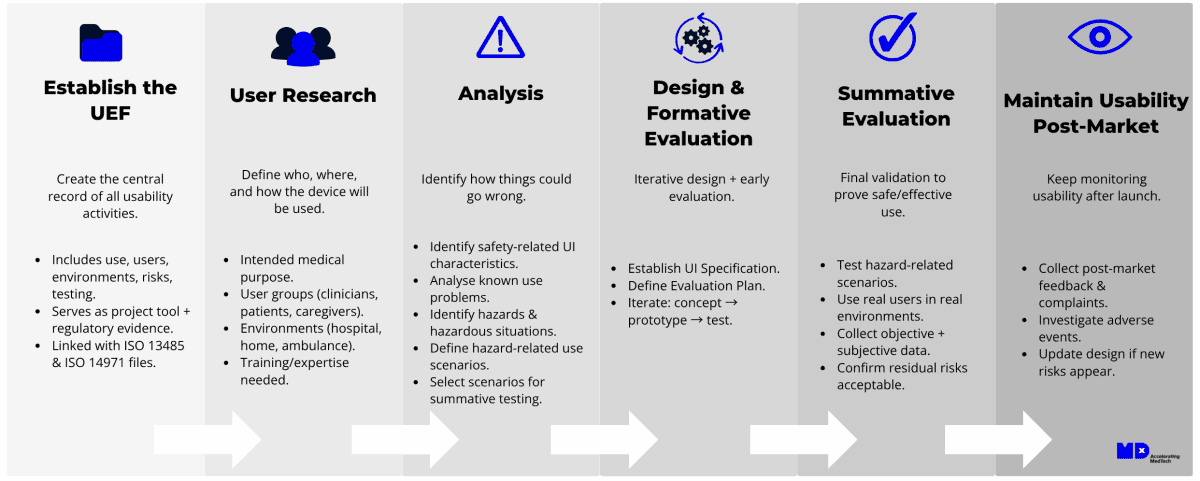
Step-by-step visual guide illustrating the IEC 62366 usability engineering process for medical devices, covering intended use definition, hazard identification, risk analysis, user interface requirements, formative evaluations, and summative usability validation, aligned with EU MDR and FDA human factors guidelines.

The UEF is the central documentation repository for all usability activities. It includes intended use, user profiles, use scenarios, hazard analysis, test results, and risk control measures. In practice, the records and other documents that form the UEF may also form part of the product design file (ISO 13485) or the risk management file (ISO 14971).

Think of the UEF as both a project management tool and evidence for regulators.

Prepare the Use Specification. This is where you define:

  • The intended medical purpose of the device
  • The user groups (e.g. clinicians, patients, laypersons, caregivers)
  • The use environments (hospitals, homes, ambulances, clinics)
  • Any training or expertise required

This forms the foundation of all subsequent usability activities.

Once you know who will use your device and where, the next step is to analyse how things could go wrong.

Activities include:

  • Identifying safety-related user interface characteristics (e.g. readability of displays, button layout, alarm visibility).
  • Reviewing post-production data and public databases for known usability issues with similar devices.
  • Identifying hazards and hazardous situations.
  • Identifying and describing hazard-related use scenarios, which describe exactly how use errors might occur and what consequences they could have.
  • Selecting hazard-related use scenarios for Summative Evaluation.

These scenarios are then prioritised to decide which will be evaluated in summative testing.

This is where design and usability testing happen in iterative cycles.

Key steps:

  1. Establish the User Interface Specification – the blueprint of all UI elements.
  2. Develop the User Interface Evaluation Plan – define how formative and summative testing will be performed.
  3. Iterative cycles of concept, prototype, and testing

The point of formative evaluation is to find usability issues early, before final validation, so changes are cheaper and less disruptive.

The final stage is a summative usability validation. This is a formal test that demonstrates to regulators that the device can be used safely and effectively by the intended users.

  • Test the hazard-related use scenarios identified earlier.
  • Use representative users in realistic environments.
  • Collect both objective performance data (task completion, error rates) and subjective feedback (ease of use, confidence).
  • Confirm that residual risks are acceptable in line with ISO 14971.

This stage provides the objective evidence regulators require to ensure compliance.

Usability engineering does not end at product launch. Post-market surveillance should collect feedback on usability issues, adverse events, and complaints. Updates or design changes may be required if new risks emerge.

Common Challenges in Applying IEC 62366

Many manufacturers encounter difficulties such as:

  • Underestimating resources needed for usability testing
  • Recruiting representative users for formative and validation studies
  • Defining realistic use scenarios that reflect actual clinical environments
  • Integrating usability with development timelines
  • Documenting evidence properly in the UEF

Failing to address these challenges can result in regulatory rejection, delays, or costly redesigns.

Best Practices for Success

  1. Start usability engineering early in the design process
  2. Involve multidisciplinary teams including engineers, clinicians, and usability experts
  3. Use a mix of qualitative and quantitative methods in evaluations
  4. Prioritise hazard-related use scenarios in validation testing
  5. Document everything thoroughly in the Usability Engineering File
  6. Where possible involve regulators early for alignment
  7. Leverage specialist expertise such as a Medical Device and IVD Consultancy with usability engineering experience
Does the FDA also recognise IEC 62366?

Yes. The latest versions of the IEC 62366 standards are recognised by the FDA as consensus standards. However, the FDA has also published specific human factors engineering guidances with minor differences to IEC 62366 so it is recommended that these are also considered for FDA submissions.

When should usability testing be performed?

Throughout development. Formative evaluations identify and correct issues early, while summative validation confirms safe and effective use before market approval.

Can simulated environments be accepted in usability validation?

Yes, provided they are representative of real-world conditions and cover all critical tasks and hazard-related use scenarios.

What is the difference between IEC 62366-1 and IEC 62366-2?

EC 62366-1 is the main normative standard that defines the usability engineering process manufacturers must follow. IEC 62366-2 is a companion informative document that provides guidance and rationale to help apply IEC 62366-1 in practice. For regulatory submissions, compliance with IEC 62366-1 is what notified bodies and regulators assess — IEC 62366-2 is a supporting resource, not a requirement.

What must be included in a Usability Engineering File?

The Usability Engineering File (UEF) is the core documentation output of the IEC 62366-1 process. It must document the intended use and user groups, use scenarios and user interface specification, formative evaluation records, summative evaluation plan and results, and risk-related findings and how they were addressed. It should be structured to allow a notified body or regulatory reviewer to trace the full usability engineering process from start to finish.

Does IEC 62366 apply to IVDs?

Yes. IEC 62366-1 applies to all medical devices, including in vitro diagnostic devices (IVDs). Under the EU IVDR and MDR, manufacturers are expected to demonstrate that human factors and usability have been considered as part of the design and development process. This is particularly relevant for IVDs used at the point of care or by lay users, where use errors can have direct patient safety implications.

How many participants are needed for a summative usability study?

There is no fixed number mandated by IEC 62366-1, but common practice — and FDA guidance — typically expects a minimum of 15 participants per user group for summative evaluations. The number should be justified based on the diversity of the user population, the complexity of the device, and the number of critical tasks being evaluated. For high-risk devices or large user populations, a larger sample may be required.

What is the difference between a formative and summative evaluation?

Formative evaluations are iterative assessments carried out during device development to identify and resolve usability problems early. They are exploratory in nature and do not need to meet a pre-defined pass/fail criterion. Summative evaluations, also called validation testing, are conducted on a near-final or final version of the device to confirm that users can operate it safely and effectively without being coached or corrected. Summative results are what get submitted to regulators.

How MDx CRO Can Help

Implementing IEC 62366 in-house can strain resources. At MDx CRO we can provide:

  • Protocol development and study design for usability testing
  • Recruitment of representative users across geographies
  • Moderation of formative and validation studies
  • Integration of usability engineering with regulatory strategy
  • Preparation of all usability documentation required for submissions including FDA submissions

As a trusted Medical Device and IVD consultancy, we support manufacturers in implementing IEC 62366, running usability studies, and preparing documentation that satisfies both EU and US regulators. Whether you are starting a new project or updating an existing device, our team helps you achieve compliance and deliver safer devices to market.

Need help with IEC 62366 compliance?

Talk to our usability engineering team.

Full Name
(Include device type, current challenge, or regulatory stage)
We respect your privacy. All information submitted will 
remain confidential.
Checkboxes
Written by:
Floella Otudeko

Floella Otudeko

Senior QARA Specialist

Senior QA/RA consultant with MDR, IVDR, Usability/Human Factors and MDSW expertise, supporting MedTech and IVD innovation globally.
Industry Insights & Regulatory Updates

MDR Compliance Checklist: What You Need Before Submitting

A Comprehensive Pre-Submission Readiness Guide

Navigating the European Union’s (EUs) Medical Device Regulation (Regulation [EU] 2017/745; MDR) demands meticulous preparation. Submitting incomplete technical documentation to a Notified Body (NB) for review triggers lengthy review cycles and costly delays. This guide serves as a final gap analysis to ensure a robust, coherent, and compliant submission, paving a smoother path to Conformité Européenne (CE) marking.

Your technical documentation is an output of your quality management system (QMS). The NB will review your technical file and your QMS, in accordance with the requirements of Annex IX of the MDR. Other conformity assessment routes, such as those outlined in Annex X (based on type-examination) or Annex XI (based on product conformity verification), may also be selected, although they are less commonly used.

The foundational systems and roles required of all manufacturers, regardless of device classification, are as follows:

  • MDR-compliant QMS: Per MDR Article 10(9), a QMS for developing, manufacturing, and post-market monitoring is mandatory. Although certification to ISO 13485:2016 is not mandatory, it is commonly used to demonstrate compliance and is considered the most effective way to fulfil the requirements of Article 10(9) of the MDR. For all devices, the QMS should incorporate MDR-specific processes such as post-market surveillance (PMS), vigilance, and unique device identification (UDI) management.

For Class IIa, IIb, and III devices, as well as certain Class I devices placed on the market in sterile condition, with a measuring function, or intended to be reused, the QMS is typically assessed by a Notified Body as part of the conformity assessment. For other Class I devices, while a QMS is still required under Article 10(9), it does not require Notified Body involvement.

  • Risk management system: Mandated by MDR Annex I, risk management per ISO 14971 must be a continuous process implemented throughout the entire product lifecycle, ensuring risks are controlled and an acceptable benefit-risk ratio.
  • Person Responsible for Regulatory Compliance (PRRC): MDR Article 15 obliges manufacturers to designate at least one qualified PRRC permanently and continuously at their disposal. This ensures technical documentation and declarations of conformity (DoC) are prepared and maintained in compliance with the Regulation.
  • Understanding stakeholder obligations: Ensure that your organisation understands, and has communicated, the necessary information to distributors and importers, who have specific obligations under MDR Articles 13 and 14 regarding verification, storage, and complaint handling.

Your technical documentation is the core evidence dossier for your device, structured in accordance with MDR Annexes II (Technical Documentation) and III (Technical Documentation on PMS).

Technical documentation (Annex II)

Must provide comprehensive evidence that all General Safety and Performance Requirements (GSPRs) from Annex I are met.

  • Device description & specifications: Detailed description of the device, including trade name, intended purpose, users, patient population, principles of operation, and key functional elements (components, materials, software). Identification via Basic UDI-DI (per MDR Article 27 and Annex VI, Part C) or other traceable identifiers. Justification of device qualification, risk class, and applied classification rules in accordance with MDR Annex VIII. Overview of previous and similar generations of the device
  • Labelling & Instructions for Use (IFU): All labelling must comply with MDR Annex I, Chapter III. Claims made in the IFU or labelling must be consistent with, and supported by, the clinical evaluation, GSPRs, and RMF. Labels and Instructions for Use (IFU) in all applicable EU languages
  • Design and Manufacturing Information: Description of design stages, manufacturing processes, validation data, and control of critical suppliers/subcontractors.
  • GSPR checklist: Links each applicable safety and performance requirement of the device to the source of objective evidence (ie, verification & validation [V&V] reports, test data, or procedures); GSPRs not considered applicable should be justified. Reference to applied harmonised standards, common specifications (CS), or equivalent solutions.
  • Risk management file (RMF): Must demonstrate a complete lifecycle approach to risk per ISO 14971, including analysis, evaluation, control, and a report concluding a favourable benefit-risk profile.
  • V&V reports: Data supporting device safety and performance, including
    • Biocompatibility (ISO 10993 series)
    • Electrical Safety & electromagnetic compatibility (IEC 60601 series)
    • Software V&V (IEC 62304 for lifecycle processes)
    • Stability and shelf-life testing
    • Sterilisation validation
    • Performance and safety testing relevant to intended use

Clinical Evaluation (Annex XIV)

Includes a clinical evaluation report (CER) based on a compliant clinical evaluation plan (CEP), providing sufficient clinical evidence to demonstrate device safety, performance, and a favourable benefit-risk ratio. It must also:

  • critically appraise data from manufacturer clinical investigations or an equivalent device (if claimed according to strict MDR criteria);
  • be updated continuously throughout the device’s lifecycle with post-market data.

PMS & vigilance (Annex III)

The Post-Market Surveillance (PMS) Documentation ensures continuous evaluation of device performance and compliance throughout its lifecycle, through the following documents.

  • A PMS plan: Proactively and systematically collects and analyses post-market data on device quality, performance, and safety.
  • A post-market clinical follow-up (PMCF) plan: Actively gathers clinical data post-market, required unless exclusion is justified.
  • Vigilance System: Robust procedures for reporting Serious Incidents and Field Safety Corrective Actions to competent authorities per MDR Article 87.
  • PMS reporting: Preparation of a Periodic Safety Update Report (PSUR) (Article 86) or Post-Market Surveillance Report (PMSR) (Article 85), depending on device class

Step 3: Pre-Submission – Administrative and Conformity Assessment Planning

Final checks before NB engagement.

  • Conformity assessment: Based on device classification, the correct conformity assessment procedure (detailed in MDR Annexes IX-XI) must be followed.
  • EU DoC (Annex IV): A draft DoC must be prepared, listing all applicable regulations and standards, signed after the NB grants CE certification.
  • Summary of Safety and Clinical Performance (SSCP): For implantable and Class III devices; must be written in clear, layperson language and must be consistent with the CER and IFU.
  • CRITICAL STEP – Internal Consistency Review: A cross-functional review to ensure the device name, intended purpose, indications, and key performance claims are consistent across documentation.
  • NB Engagement:
    • Designation Scope: Confirm your chosen NB is officially designated for your device type and classification.
    • HIGHLY RECOMMENDED – Pre-Submission Meeting: Discuss your strategy and the NB’s expectations through structured dialogues, de-risking the formal submission process.

Supporting Documents and Guidance

  • ISO 13485:2016 (QMS)
  • ISO 14971:2019 (Risk Management)
  • ISO 14155:2020 (Clinical Investigations)
  • MEDDEV 2.7/1 Rev. 4 (Clinical Evaluation: A Guide for Manufacturers and Notified Bodies)
  • MDCG 2020-6 (Clinical evidence needed for medical devices previously CE marked under Directives 93/42/EEC or 90/385/EEC: A guide for manufacturers and notified bodies)
  • MDCG 2020-7 (Post-market clinical follow-up [PMCF] Plan Template: A guide for manufacturers and notified bodies)
  • MDCG 2020-8 (Post-market clinical follow-up [PMCF] Evaluation Report Template: A guide for manufacturers and notified bodies)
  • MDCG 2019-9 (Summary of safety and clinical performance: A guide for manufacturers and notified bodies)

Key Takeaway

MDR compliance transcends document creation. It is about building a coherent, evidence-based narrative weaving together quality management, risk analysis, clinical data, and post-market vigilance into a single, compelling story of your device’s safety and performance. Using this comprehensive checklist to perform a final, critical gap analysis ensures your story is not only complete but also clear, consistent, and readily verifiable, paving a smoother path to successful CE marking under the MDR.

Request regulatory documentation services.

Contact us today for a consultation with our medical devices team.

Written by:
Grace Chia, PhD

Grace Chia, PhD

RA Specialist

Regulatory Affairs Specialist in MDR & IVDR with expertise in CERs, SVRs, literature review, and regulatory compliance.
Industry Insights & Regulatory Updates